Tomioka Silk Mill Coloring Pages
 ~

About Tomioka Silk Mill
A Factory for Making Raw Silk
Tomioka Silk Mill is an old factory in Tomioka City, Gunma Prefecture.
It was a factory that took thin threads called raw silk from silkworm cocoons.
Raw silk is the thread used to make silk cloth.
At the start of the Meiji period, Japan wanted to sell a lot of raw silk to other countries to make the nation rich.
The government built Tomioka Silk Mill as a model factory for everyone else to follow.
Started in 1872
Tomioka Silk Mill started running in 1872.
A French man named Brunat guided the building of the factory.
They brought in French machines, and young women from all over Japan gathered to learn how to make thread.
The people who learned here went back to their hometowns and spread those skills all across the country.
A Warehouse of Brick and Wood
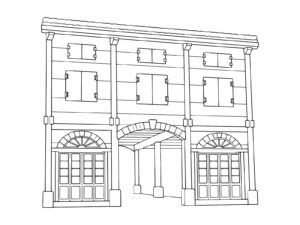
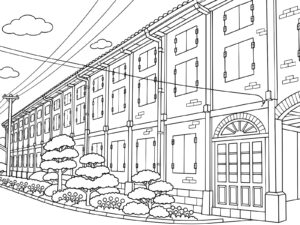
The 1st and 2nd coloring pages show a building called the East Cocoon Warehouse.
It is a warehouse for drying and storing cocoons.
It is a big 2-story building that is about 104 meters long!
It was built in a style called timber-framed brick construction, where they made frames with wooden posts and beams, and filled the spaces with stacked bricks.
The arch entrance in the middle of the 1st picture is still used today by visitors walking through!
A Room Lined with Thread-Making Machines
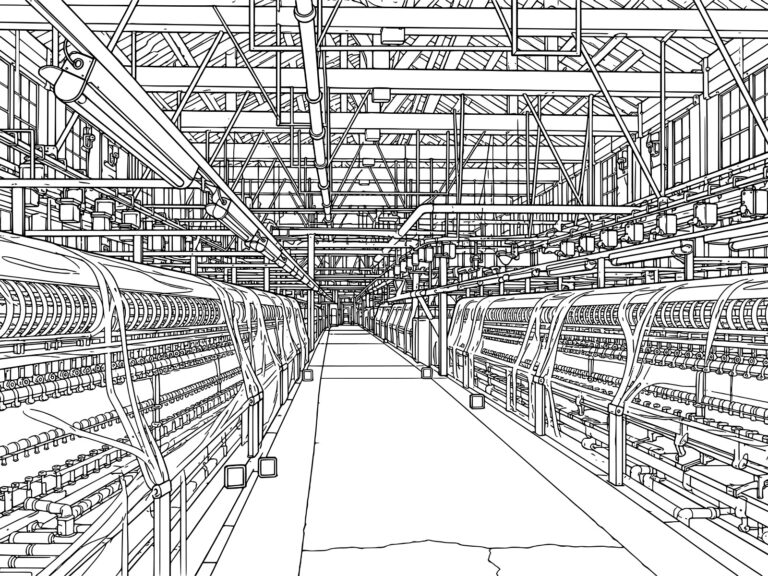
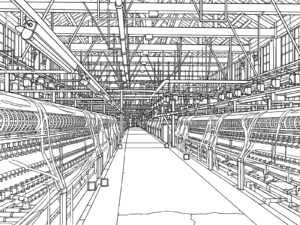
The 3rd picture shows the inside of the Silk Reeling Plant, the building where they pulled thread from cocoons.
You can see long rows of machines lined up all the way to the back!
The ceiling was built to be wide and bright with very few posts.
In 2014, it was chosen as a World Heritage Site as part of the "Tomioka Silk Mill and Related Sites," and buildings like the East Cocoon Warehouse and Silk Reeling Plant became National Treasures.
Many Buildings on Big Grounds
On the grounds of Tomioka Silk Mill, besides the East Cocoon Warehouse, you can still see the matching West Cocoon Warehouse, the Silk Reeling Plant, and the Brunat House where Brunat's family lived.
The buildings stand in a U-shape around a central plaza.
Today, you can visit the site, and sometimes you can even watch real demonstrations of thread making.
It is very rare in the world to find a place where an entire factory from the Meiji period remains so well preserved!
How to Color Tomioka Silk Mill
The bricks are reddish-brown and orange
The bricks of the Tomioka Silk Mill are reddish-brown.
If you color them lightly with orange first and then layer reddish-brown on top, you get a nice warm brick color.
If you leave the line spaces between the bricks a little bit white, they will look just like real bricks!
The wooden pillars are whitish gray
The wooden pillars and beams around the brick walls are whitish gray and light bluish-gray.
The difference between the reddish-brown bricks and the whitish wood makes a cool pattern on this building.
Try coloring the window shutters in the same whitish gray, too.
If you color the roof tiles dark gray, it will make the whole building look neat and sharp!
The silk-reeling mill is white and silver
For the ceiling frame in the 3rd picture, leave a lot of white and add light gray in the shadowy parts.
For the clear covers on the machines, use light blue and light gray. Leave white spots where the shine is to make them look shiny and smooth!
If you color the walkway on the floor light brown or gray, you can easily see the path going straight back.
Line it up with the Gunkanjima (Hashima) coloring page and trace the history of Japanese industry!
The pine tree and flower bed in front
The round pine tree in front of the 2nd picture will look nice and round if you color it dark green and add a little yellow-green near the top.
If you color the flowers in the flower bed red and pink, they will match the reddish-brown bricks nicely.
Color the path on the left with light gray.
Fun Facts About Tomioka Silk Mill
"1872" On the Entrance Arch
On the top stone of the East Cocoon Warehouse arch, the words "Meiji 5 (1872)" are carved.
This shows the year the building was built.
When you go visit, try looking up at the top of the arch!
Bricks Made by Japanese Tile Makers
Back then, bricks were still very rare in Japan.
So, roof tile makers in a nearby town baked the bricks instead.
It is said that plaster was used in clever ways to hold the bricks together instead of cement.
It Kept Running for 115 Years!
Tomioka Silk Mill started as a government factory and later became a private factory.
And it kept running for 115 years until it stopped making silk thread in 1987.
Even after the factory closed, people took great care of the buildings, so you can still see how it looked in the Meiji period today!
One Long Thread from a Silkworm Cocoon
A silkworm cocoon is made of one thin thread wound round and round.
They boil the cocoons in hot water, find the ends of the threads, and twist threads from several cocoons together to make one strand of raw silk.
The thread you can get from just one cocoon is super long!
Share These Tomioka Silk Mill Coloring Pages


More Landmarks of Japan Coloring Pages
-
Entrance of the East Cocoon Warehouse
-
East Cocoon Warehouse
-
-
Inside the silk reeling factory
-
-