Bird's-eye speedwell Coloring Pages
 ~
~ 
About Bird's-eye speedwell
Flowers that turn the schoolyard blue in early spring
Around February when it is still cold, tiny blue flowers start blooming here and there close to the ground in schoolyard corners and along school roads. This is Bird's-eye speedwell.
It is one of the very first flowers to let you know that "Spring is here!" From March to April, so many of them bloom that the ground turns completely blue.
It stays short, and its stems grow sideways like they are crawling on the ground, with only the tips poking straight up.
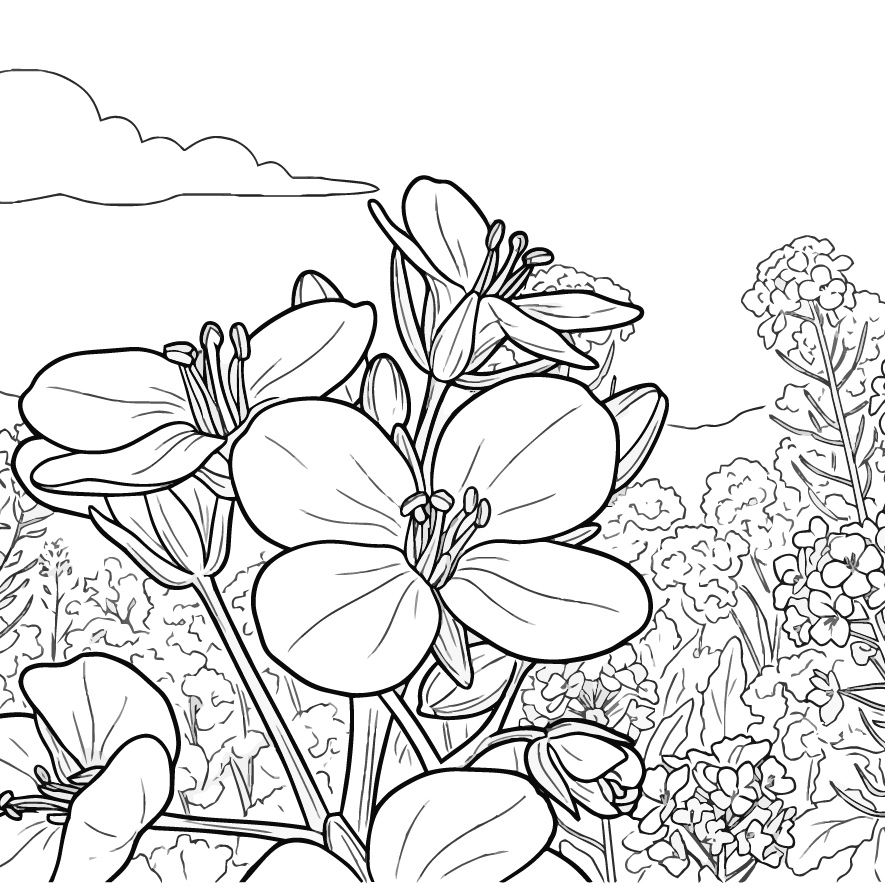
Bird's-eye speedwell has 4 petals. But 1 petal is smaller!
Take a close look at the flower. It has four petals, right? But if you look closely, can you see that only one is smaller? The top one and the left and right ones are big, and only the bottom one is a bit smaller.
The flower is about one centimeter wide. It is small, but this "one out of four is smaller" shape is a big clue to spot the Bird's-eye speedwell.
From the middle of the flower, two stamens and one pistil stick out, three in total. They are drawn in the coloring page too, so try counting them!
Dark lines on the blue petals
Another thing to look for is the stripes on the petals. Dark blue lines run outward from the center like a starburst.
People think these stripes are like little signposts that tell bugs, "The nectar is right here!" Isn't it amazing how such a small flower comes up with clever tricks to invite bugs over?
The center is clear white, and the lines all gather toward it. It is a really pretty pattern.
They open in the morning and fall off by evening
Surprisingly, the flower of the Bird's-eye speedwell linked to withering and dropping off in just one day. A flower like this is called a one-day flower.
Also, it opens only while the sun is shining. On cloudy days or in the evening, it closes its flower.
So if you want to look at it, around noon on a sunny day is the best time. The next day, a different flower is blooming, so you can't see "the same flower as yesterday." The ground looks completely blue because new flowers keep blooming every single day.
The name comes from the shape of its fruit
Bird's-eye speedwell has a bit of an unusual name. It actually got its name from the shape of its fruit.
Long ago, there was a plant in Japan called Inunofuguri. It got that name because the shape of its fruit looked like two little bumps near a dog's bottom.
Then, this plant came over from another country later on. It looked like Inunofuguri, but it was even bigger! That is why people started calling it Bird's-eye speedwell.
The funny thing is that the fruit of Bird's-eye speedwell is shaped like a heart, so it does not look much like it at all. It just borrowed its name from another plant!
A beautiful nickname: "Star's Eyes"
Because of its name, many people think, "I want to give it a cuter name!" So, another name given to it was Star's Eye.
Tiny blue eyes looking up at the sky all over the ground—it really looks that way, doesn't it?
Bird's-eye speedwell came from Europe and Western Asia. People first found it in Japan around the start of the Meiji period. After it was found in Tokyo in 1887, it spread all across Japan in no time! We have only known Bird's-eye speedwell for about 150 years.
How to Color Bird's-eye speedwell
Color the petals without hiding the lines
The best part of this coloring page is the lines spreading out on the petals. Keeping these lines clear is the most important step!
To do this, color between the lines one by one using light blue. If you rub hard with dark blue, all the lines will disappear.
Once you get used to it, make the color a little darker near the lines. That will make it look 3D, just like a real flower!
Keep the middle white
The center of the flower is pure white. If you leave it white without coloring it, it will pop against the blue petals!
Try leaving the 2 stamens and 1 pistil sticking out white too, or color them light yellow. They are tiny parts, but leaving them light brings your picture to life!
Don't use just one shade of blue
The blue of the Bird's-eye speedwell is a bright, clear color called cobalt blue.
If you use the same blue everywhere, it will look flat. Make the outside of the petals dark blue, and make it lighter as you get closer to the center to look just like a real one! It is also fun to use three colors: light blue, blue, and blue-purple.
Keep the rounded, jagged edges of the leaves
The leaves are almost round, and they have round, jagged edges. These soft edges are special to this plant!
Color carefully along the shape of the edges. The leaf color is bright yellow-green. It looks super pretty next to the blue flower!
Once you finish coloring, go look for them at noon on a sunny day
When you finish your coloring page, take it outside! But make sure to go around noon on a sunny day.
This flower only opens while the sun is shining. That means it is hard to find on cloudy days or in the evening.
When you find one, crouch down and try counting the lines on the petals. You will see that it has the exact same pattern as your drawing!
Fun Facts About Bird's-eye speedwell
Its name came from another plant
The "fukuguri" part of the Japanese name for Bird's-eye speedwell means the two bumps near a dog's bottom. It is a bit embarrassing to say, isn't it?
But actually, this name did not come from the shape of this plant's fruit. Long ago in Japan, there was a plant called Inunofukuguri, and its fruit looked like that shape. When Bird's-eye speedwell arrived later, it looked like that plant but was much bigger, so people added "Oo" (meaning big) to its name.
The fruit of Bird's-eye speedwell is actually heart-shaped, so it does not really look like that at all. It is a slightly pitiful plant that just got given someone else's name.
The original plant is rare now
The original Inunofukuguri that gave its name is a plant that has been in Japan for a long time. It blooms with even smaller, light blue flowers.
However, you can hardly find it anymore. People think this is because it lost its home and Bird's-eye speedwell took over its space after arriving. Now, people worry that it might disappear completely.
Behind the bright blue flowers spreading all over your schoolyard, the original plant is slowly disappearing. Thinking about that makes you feel a little sad, doesn't it?
The nickname "Star Eyes"
Because its name is a bit pitiful, people gave this flower a lovely nickname: Star Eyes.
All over the ground, it looks like tiny blue eyes are looking up at the sky. That is how the name was born. It also has other pretty names, like "Lapis Lazuli Grass".
The reason one plant has so many nicknames might be that so many people felt sorry for its real name.
It came to Japan only about 150 years ago
You can see it everywhere today, but it actually came to Japan only about 150 years ago.
It traveled from Europe and Western Asia, and was first found in Tokyo in 1887. From there, it spread across all of Japan in no time.
To your great-great-grandparents, it might have still been a very rare plant.
Share These Bird's-eye speedwell Coloring Pages



-
Persian speedwell
-
Persian speedwell spreading on the ground

-