Katakana "Gyu" Coloring Pages


About Katakana "Gyu"
The "Gyu" in "Gyu"
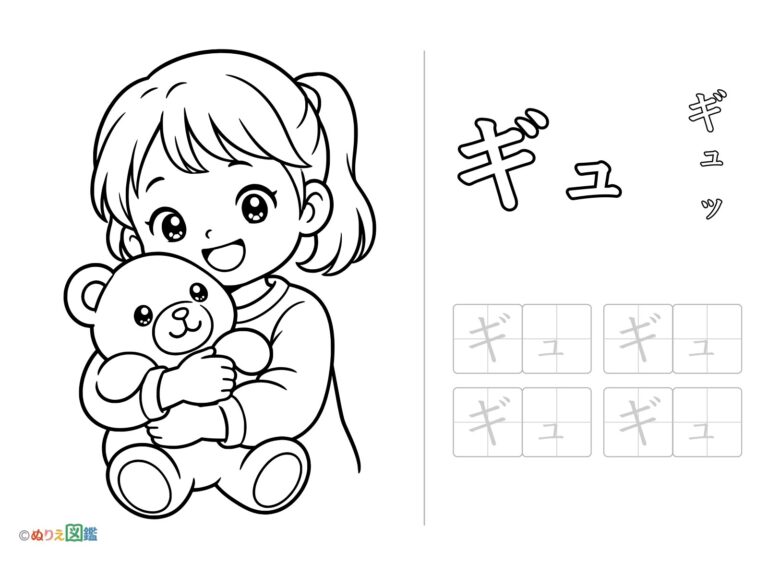
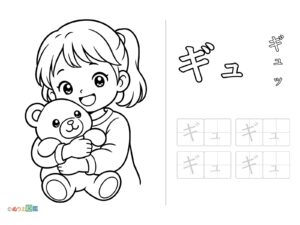
This coloring page is for practicing the Katakana "Gyu".
The word is "Gyu". It is a word that shows how you hug or squeeze something tightly.
On the left, there is a drawing of a child hugging a teddy bear tightly with both arms.
They look so happy hugging their favorite teddy bear!
One sound made with 2 characters
Katakana "Gyu" uses two letters, "Gi" and a small "yu," to make one sound.
Letters like this that use a small "ya," "yu," or "yo" to make one sound are called youon.
When you say it out loud, do not split "Gi" and "yu." Try to say them together in one go! The small "tsu" at the end is a sign to catch your breath and stop the sound quickly.
How the Katakana "Gyu" character came to be
Katakana characters were made long ago by taking one small part of a Kanji or making its shape simpler.
"Gi" is the letter "Ki" with two little dots added. These dots are also called dakuten.
The original "Ki" came from a small part of the Kanji "幾".
The little "yu" is just a smaller version of "Yu". "Yu" was made from a small part of the Kanji "由".
While Hiragana was made by smoothing out whole Kanji, Katakana was made from just pieces of Kanji, so it has lots of straight lines!
How to write Katakana "Gyu"
Katakana "Gyu" has 5 strokes in total. You take the 3 strokes of "Ki" and add 2 little dots.
"Ki" is made of 2 horizontal lines and 1 vertical line going through them.
If you make the bottom horizontal line a little longer than the top one, it will look really nice.
For the dots, write 2 short dots side by side at the top right at the end.
The small "ュ" has 2 strokes. With the 1st stroke, write a line that goes across and bends down. With the 2nd stroke, write the bottom line a little longer.
Write small letters about one-quarter the size of a box. Place it in the bottom left of the box when writing across, and in the top right of the box when writing down.
If you write "ュ" too big, it will be read as two sounds like "Gyu", so be careful!
Words with Katakana "Gyu"
Katakana is often used for words from other countries, and also to write words that show sounds or how things look.
When you stretch "Gyu" into Gyū, it feels like an even longer and stronger hug.
Other words from outside Japan with "Gyu" inside them include regurā for regular players in sports, and figyua sukēto for figure skating on ice.
In Hiragana, "Gyu" shows up in words with cows, like gyūnyū for milk and gyūdon for beef bowls.
It is fun to say Katakana "Gyu" while making a big hug with your body!
How to Color Katakana "Gyu"
Color the Big Katakana "Gyu" with Your Favorite Color
Try coloring the big Katakana "Gyu" with the outline in the top right using any color you like.
To show a warm feeling, it is also a great idea to use gentle colors like pink or orange.
To make it look nice and neat, slowly color along the outside first so you do not go over the lines, and then fill in the inside.
The Teddy Bear is Soft and Brown
If you color the teddy bear with light brown or ocher, it will look just like a soft, fluffy stuffed animal.
If you use cream color or light pink for the inside of the ears and around the mouth, it will look even cuter.
You can also draw a ribbon on its neck and color it with your favorite color.
Color the Child's Clothes with Your Favorite Color
If you use colors like blue, yellow, or green for the child's clothes—colors different from the bear's brown—the stuffed animal will stand out clearly.
If you add a little bit of light pink to the cheeks, it will make a happy, smiling face.
Trace carefully, one pair at a time
In the boxes at the bottom right, there are four pairs of light gray Katakana "Gyu", with two letters in each pair.
Try tracing over the light letters slowly with a dark colored pencil or a soft pencil.
If you use the vertical and horizontal center lines inside the boxes as a guide, you can easily see the difference in size between the big letter and the small letter.
It is easy to learn if you say the stroke order out loud while you write.
When you finish one pair, give yourself a big hug, just like hugging a teddy bear!
Fun Facts About Katakana "Gyu"
Secrets of the Teddy Bear's Name
Stuffed bears are also called teddy bears.
This name comes from "Teddy," the nickname of U.S. President Theodore Roosevelt.
They say the president became famous for a story about a bear, and people started calling stuffed bears "Teddy's bear."
Words for Sounds and Feelings
Words that show how things look or feel, like "gyu," are called mimetic words.
Words that copy sounds or voices, like "bow-wow," are called onomatopoeia.
Japanese has so many of these words, and they make stories come alive!
Dots Change the Power
Try saying "Kyu" and Katakana "Gyu" to compare them.
"Kyu" has no dots, so it feels small and cute.
Katakana "Gyu" has dots, so it feels strong and firm.
Just two little dots can totally change how a word feels!
Let's Write in Romaji
When you write Katakana "Gyu" in Romaji, it becomes gyu.
For sounds with small "ya," "yu," or "yo," you put in a y when writing Romaji.
You will learn Romaji in Japanese class around 3rd grade.
It is also written on station names and road signs, so try reading it when you find it!
Share These Katakana "Gyu" Coloring Pages


-
Tracing the "ギュ" (Gyut)
-