Gray Wolf (Continental Gray Wolf) Coloring Pages
 ~

About Gray Wolf (Continental Gray Wolf)
The Biggest Animal in the Dog Family: Gray Wolf (Continental Gray Wolf)
The Gray Wolf (Continental Gray Wolf) is the biggest animal in the dog family.
Most of the wolves you see in zoos are this kind: Gray Wolf (Continental Gray Wolf).
They live in many places like forests, grasslands, and snowy mountains in North America, Europe, and Asia.
Their bodies are about 1 to 1.6 meters long. With their long legs, they can walk long distances over snow and through forests.
Their fur comes in many colors, like gray, brown, black, and white, depending on where they live.
Living Together in a Family Pack
A Gray Wolf (Continental Gray Wolf) lives in a group called a "pack."
A pack is usually a family made of a mom, a dad, and their pups.
When they hunt big animals like deer, everyone in the pack works together to chase them down.
When pups are born, all the adult wolves in the pack bring them food and help raise them.
3 Coloring Pages
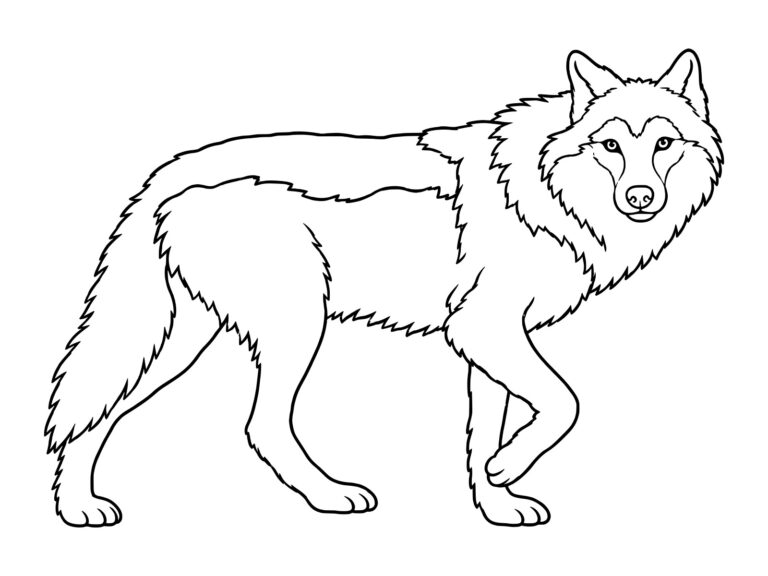
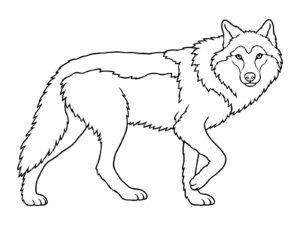
The 1st coloring page shows a walking Gray Wolf (Continental Gray Wolf), made from a real photo.
Check out its fluffy tail and the long fur around its neck!
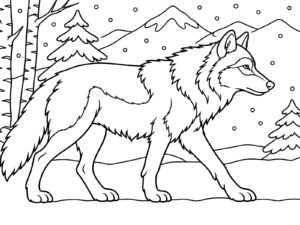
The 2nd coloring page is a Gray Wolf (Continental Gray Wolf) walking through a snowy forest.
Behind it, you can see birch trees, fir trees, and snowy mountains.
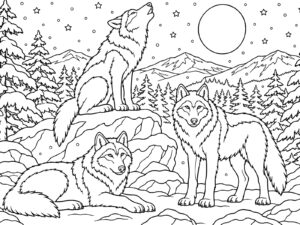
The 3rd coloring page shows a Gray Wolf (Continental Gray Wolf) howling on a rock on a full-moon night, along with its friends.
Try to find all 3 wolves!
Secrets of the Gray Wolf (Continental Gray Wolf)'s Body
A Gray Wolf (Continental Gray Wolf) has long legs and walks on its toes. This keeps it from getting tired, so it can walk dozens of kilometers in a single day!
In winter, its fur grows into a double layer. The soft fur inside keeps its body warm.
Its ears stand straight up, so it never misses small sounds far away.
Its nose is super strong, too. It can smell prey that is far away!
It can even tell its friends how it feels by changing the shape or direction of its tail.
At the zoo, you might see wolves in a pack leaning on each other or sniffing one another.
When you watch a Gray Wolf (Continental Gray Wolf) at the zoo, take a close look to see who is doing what in the pack.
If you get to hear them howl, you are super lucky!
How to Color Gray Wolf (Continental Gray Wolf)
Layer Colors for the Gray Fur
First, color the whole body of the Gray Wolf (Continental Gray Wolf) with light gray.
After that, layer dark gray or brown on its back and the tip of its tail.
If you leave its belly, the inside of its legs, and around its mouth whitish, it will look like a real Gray Wolf (Continental Gray Wolf)!
If you draw short lines along the flow of the fur, it will look nice and fluffy.
Color its eyes yellow or gold to give it a sharp look.
Snowy Forest and Night Sky
For the snow on the 2nd sheet, leave it white and add light sky blue only to the shadowed parts.
Keep the birch trees white, and color the pattern parts black or dark gray.
For the night sky on the 3rd sheet, color it dark blue or navy blue, and leave the full moon and stars white or yellow.
If you make the snow hit by the moonlight a slightly lighter blue, it will create a night mood.
Try coloring the Red Fox coloring page, another member of the dog family, together with this one!
Try Changing the Fur Colors of the 3 Animals
Each Gray Wolf (Continental Gray Wolf) has a different fur color.
For the 3 animals on the 3rd sheet, try coloring them with slightly different colors, like gray, brownish-gray, and whitish-gray.
That will make it easy to tell them apart.
If you color the howling Gray Wolf (Continental Gray Wolf) on the rock with the darkest color, the main star will stand out.
When you finish coloring, step back a little bit and look at the overall balance.
If you shade softly around the full moon with light yellow, the moon will look like it is shining!
Fun Facts About Gray Wolf (Continental Gray Wolf)
Howling Is a Signal to Friends
A wolf's howl can reach very far away.
It is thought that they use it to call friends who are far away, or to tell other packs, "This is our territory!"
When one wolf starts to howl, friends around it sometimes howl together too.
Wolves That Lived in Japan
Long ago in Japan, wolves called the Japanese Wolf and the Hokkaido Wolf lived here.
However, during the Meiji period, both of them vanished and became extinct.
The Japanese Wolf is sometimes worshipped at shrines as a messenger of the mountain gods.
The Ancestors of Dogs
It is thought that pet dogs in our homes came to be when wolves from long ago started living with humans.
A dog's great sense of smell comes from its wolf ancestors.
Wolves and dogs look a little different in their faces and bodies, but they are very close relatives.
Share These Gray Wolf (Continental Gray Wolf) Coloring Pages


More Other Mammals Coloring Pages

-
Walking wolf
-
A wolf walking in a snowy forest
-
-
A pack of wolves howling at the full moon
-
-