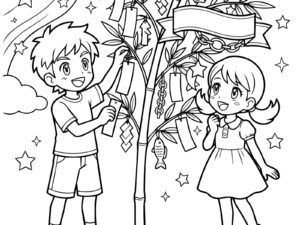
Tanabata (Star Festival) Coloring Pages
 ~
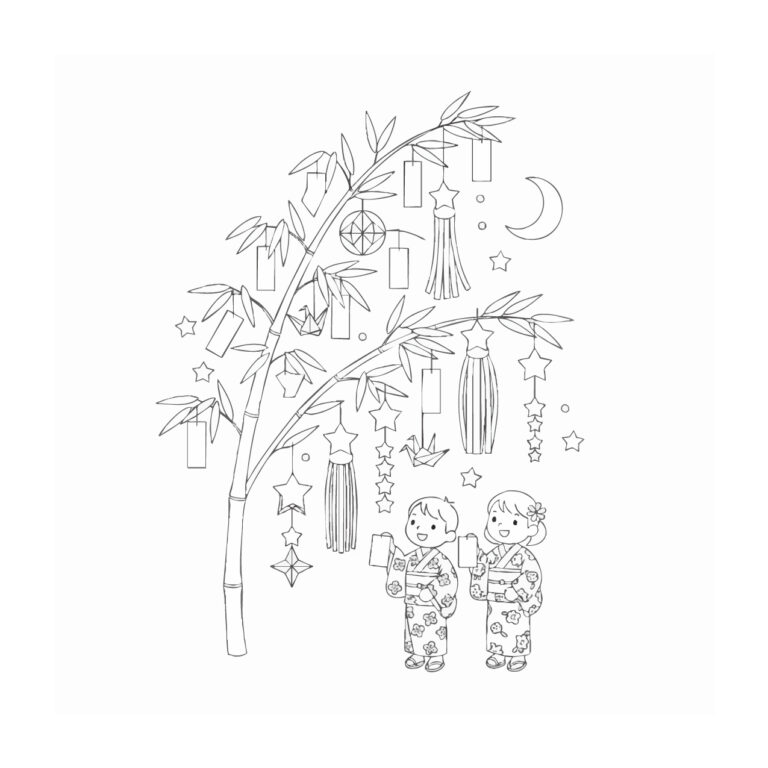

About Tanabata (Star Festival)
The star festival where Orihime and Hikoboshi meet
Tanabata (Star Festival) isJuly 7thOn the night of Tanabata (Star Festival),Orihime (the Weaver Princess)andHikoboshitwo stars calledMilky WaycrossTo meet only once a yearThis is a beautiful Japanese festival based on a legend.
The story of Orihime and Hikoboshi
- Orihime: She lived on the banks of the Milky Way,WeavingGood atThe daughter of the Sky KingIt's
- Hikoboshi: Living across the river from each other,Taking care of cowsdoA hard-working young manIt is.
- Meeting and Saying Goodbye: The two fell in love as soon as they metThey fell in love and got marrieddid, butThey were such great friends,Both of them stopped doing their workI put it away.
- God's Anger: You saw thatThe King of the Heavens(Orihime's father) got angry, andput them far apart on the east and west sides of the Milky WayIt got put away.
- Reunion: But for the sad pair, a promise was made: "You may meet only once a year, on the night of July 7th."
- Tears of Rain: IfIt rains on the day of Tanabata (Star Festival), the Milky Way would overflow and the two couldn't meet,Tears of sadnessIt is said that
What kind of personality and symbol is Tanabata (Star Festival)?
Tanabata (Star Festival) isWishAndGetting better at studying and sewing, andRomance of the night sky...symbolizes it!
- Wishes:Bamboo leavesinFive-color Tanabata (Star Festival) paper stripshang, andWishWriting on is the main event of Tanabata (Star Festival), right? May this wishGod of the Heavensreaches,May your wish come trueThey pray like that!
- Five-color paper strips: Used for wish stripsBlue, Red, Yellow, White, Black (Purple)ofFive colorsmeans "caring," "politeness," "honesty," "justice," and "wisdom" respectivelyand the likeYour special wishes **are tucked inside!
- Improving your skills: Orihime isSewing, Hikoboshi isFarmingBecause they were seen as the gods ofImprovement in sewing and calligraphyIt is also an event where you make a wish.
The Meaning of Tanabata (Star Festival) Decorations
Each decoration you hang on the bamboo leaf has its ownLucky wishesis packed into it.
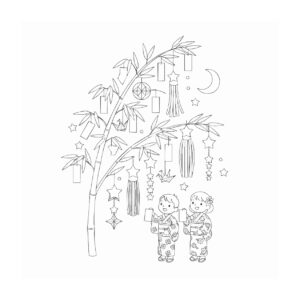
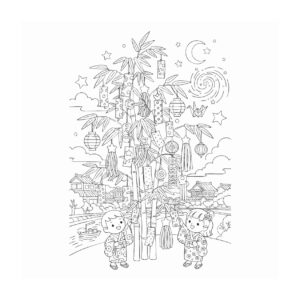
- Paper strip: For learning and wishesLevel upWish for.
- Fukinagashi streamers:Orihime's weaving threadand it showsImprovement in sewing SkillsI wish for
How to Color Tanabata (Star Festival)
How to choose colors: Let's use deep colors for the summer night sky and bright colors to make your wishes come true!
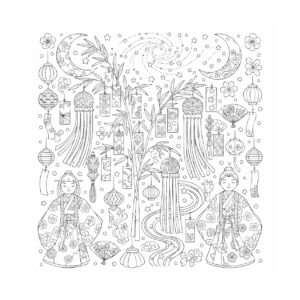
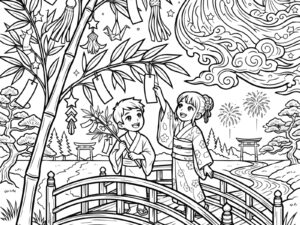
For your Tanabata (Star Festival) coloring page, let's use lots of blue, purple, gold, and bright five colors to show the deep colors of the summer night sky and the gorgeous decorations.
- Basic colors: Pick dark blue and purple (night sky), gold and silver (stars), green (bamboo), and the five colors (wish paper strips and streamers) as your main colors.
Colors for each part:
- Night sky: Use dark indigo or deep purple for the sky to create a night feeling. It will make the stars and decorations stand out!
- Milky Way: If you color the lines of the Milky Way with white, silver, or light blue, it will look sparkly and bright.
- Wish paper strips and decorations: For the five-colored wish paper strips, use blue, red, yellow, white, and purple (or black). Color them in a random order to make them look gorgeous!
- Bamboo leaves: If you color them freshly with dark green or blue-green, the decorations will look great on them.
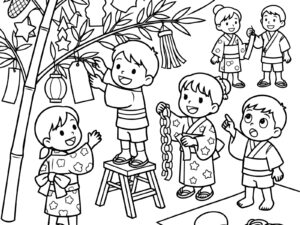
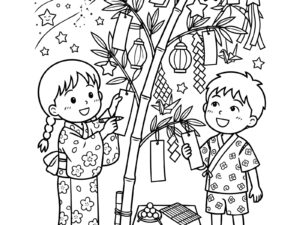
- Yukata on the characters: The children's yukata (summer kimonos) are inspired by Orihime and Hikoboshi. They will look super cute if you color them in bright summer festival colors!
How to color with 3D effects: Use light and shadows for a magical feel!
Let's show the magical feeling of a summer night and make the wish paper strips and decorations look 3D. Places with shadows:
- Add shadows to places where the light does not hit, like the back of the bamboo leaves, the bottom of the lanterns, and the folds of the kimonos. Use a darker color than your main color to give the night a deep feel.
Places where light hits:
- For the stars, moon, and lanterns, color the around them with bright yellow or white. This shows how they are shining in the night sky!
Let's create cool textures!
Colored pencils: For the bamboo leaves, layer thin lines to color them sharply. This shows how they sway in the wind. For the paper of the lanterns, color with light colors to make it look like light is shining through!
Hints for enjoying your coloring page!
- Make a wish!
- Try writing your own wish with a pencil in the blank space on the wish paper strip before you color it!
- Draw the Milky Way!
- Use a white or yellow pen or colored pencil around the Milky Way to**
Fun Facts About Tanabata (Star Festival)
Orihime and Hikoboshi are real stars in the night sky!
Orihime and Hikoboshi are actually real stars shining in the night sky! Orihime is the star Vega in the constellation Lyra. Hikoboshi is the star Altair in Aquila. These two bright stars, plus Deneb in Cygnus, are called the "Summer Triangle." On the night of July 7th, they sparkle bright across the Milky Way. They are true stars of the night sky!
The secret meaning of the 5 colors on paper strips
Paper strips for your wishes come in 5 colors: blue (or green), red, yellow, white, and black (or purple). This comes from a very old idea from China. Each color has a special wish and meaning. They mean things like "be good to your family" or "try your best at school."
If it rains, magpies will come to help!
People say that if it rains on July 7th, the Milky Way floods. Then the two stars cannot meet. But when that happens, a flock of birds called magpies flies in! They spread their wings over the river to make a helpful bridge. Thanks to the kind birds, the two can meet even on rainy days!
Why do we hang decorations on bamboo leaves?
Bamboo stays green even in cold winter. It grows straight up toward the sky! Because of this, people long ago believed gods lived in bamboo. When the wind rustles the leaves, people say it is sending your wishes to the gods!
Share These Tanabata (Star Festival) Coloring Pages



-
Tanabata (Star Festival)
-
Tanabata 2
-
-
Star Festival 3
-
Tanabata 4
-
-
Tanabata 5
-
Tanabata 6
-
-
Tanabata 7
-