Hammerhead shark Coloring Pages
 ~

About Hammerhead shark
A shark with a hammer-like head, the Hammerhead shark
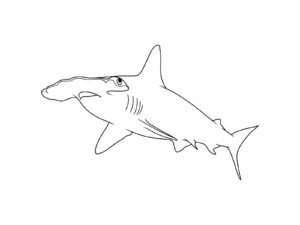
The Hammerhead shark is a very uniquely shaped shark with a head that sticks way out to the sides. When you look at it from above, it looks just like the letter T! In English, it is called a "Hammerhead shark," which means a shark with a hammer head. The one drawn in this coloring page is the Scalloped Hammerhead shark, a kind often seen in the seas around Japan.
Its Japanese name comes from a temple tool
The Japanese name "Shumokuzame" comes from a wooden mallet tool called a shumoku. People use it to strike bells at temples and shrines. A shumoku is a T-shaped wooden hammer. Long ago, people looked at this shark's head and said, "Wow, it looks just like a shumoku!" so they gave it that name. You are looking at the very same shape in this picture that people saw hundreds of years ago!
Its eyes and nose are at the very edges of its head
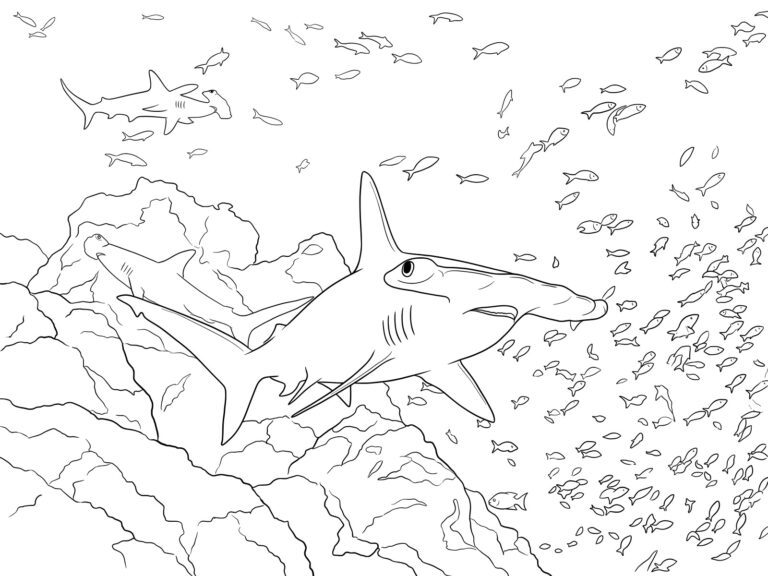
Look closely at the picture. The eyes are at the very tips of its wide head, one on each side. They are not in the middle of its face! Its nostrils are the same, way out on both ends of its head.
Why are they in a place like that? It is because the right eye and left eye, and the right nostril and left nostril, are very far apart. When they are far apart, the shark can figure out exactly which direction a smell or sight came from. Its wide head also works like a rudder to help it steer when it swims!
It can even find stingrays hiding in the sand
On the flat head of the Hammerhead shark, there are tons of sensors called Ampullae of Lorenzini. They can feel super weak electricity. All living things give off a tiny bit of electricity. So, the Hammerhead shark swims while swinging its head like a metal detector on the ocean floor. It can even find stingrays hiding under the sand!
Usually, it eats fish, crabs, shrimp, and squid.
A rare shark that swims in schools of hundreds
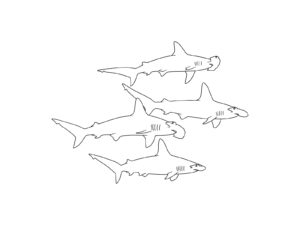
Many sharks swim alone, but the Hammerhead shark is different. Sometimes, they gather in huge schools of hundreds of sharks and swim together! The second coloring page shows what one of these big schools looks like.
Surprisingly, we still do not fully know why they gather in schools! Researchers all over the world are still studying it today.
A shark you can meet in the seas of Japan
The Hammerhead shark loves warm seas. In Japan, divers sometimes run into big schools around Yonaguni Island in Okinawa and Mikomoto Island in Izu. At Yonaguni Island, lots of them gather from winter to spring, so divers come from all over the world just to see them! When it grows up, it can reach about 4 meters long. That is more than twice as tall as you! It is a grand and impressive big shark.
How to Color Hammerhead shark
Color the back and belly in two clear parts
The Hammerhead shark has a body that is greyish on its back and white on its belly. So, if you switch colors around the middle of its body, it will look super real!
We recommend coloring the back with grey or a blue-grey color, and leaving the belly white. Leaving parts uncolored is a great way to color, too! If you rub and blend the edge, it will look even more natural.
Leave the 5 gill lines open
You can see 5 short lines side by side on its body, right? These are gill slits. They are very important places that help the shark take in oxygen from the water.
If you color the spaces between these 5 lines completely black, they will just look like stripes. Keep the spaces between the lines the same color as the body, and leave just the lines as they are. That way, everyone can tell right away that they are gills!
Color the T-shaped head a little darker
The main feature of this picture is definitely the T-shaped head. If you color this part just a little bit darker than the body, the shape of the head will stand out clearly.
The eyes are on both ends of the head. Instead of coloring them completely black, draw circles while leaving the space around them white to give it a lively face!
Try changing the color for each fish in the school
The second picture shows a school of sharks. It looks pretty if you color all 4 sharks the same, but changing the colors a little bit for each one makes it look super lively! If you color the shark in front darker and the ones in the back lighter, it will look like they are far away.
In the Hard coloring page, try leaving the rocks white
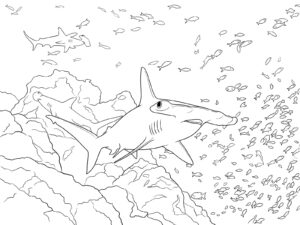
The 3rd picture shows lots of rocks and schools of small fish. It takes time to color everything, but if you boldly leave the rocks white, the Hammerhead shark and the small fish will really pop out!
For the small fish, if you use about 3 colors in turn, the school will look shiny and bright without having to color every single fish separately!
Fun Facts About Hammerhead shark
There are 5 gill slits. Some sharks even have 7!
The Hammerhead shark has 5 gill slits on the side of its body. Actually, most sharks alive today have 5! So, counting and drawing 5 lines carefully is the key to making it look like a real shark.
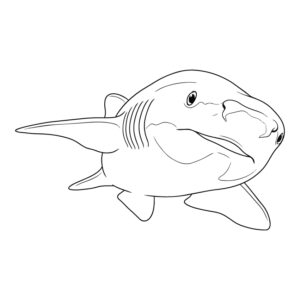
However, there are rare sharks in the world that have 7 gill slits. The "broadnose sevengill shark" in Nurie Zukan is one of them! There are only 2 kinds of sharks in the whole world that have 7 gills.
There are almost no known cases of them attacking people
Because they are big and look sharp, people often think they are scary sharks. But in reality, there are almost no clear reports of a Hammerhead shark attacking a person. Even if divers swim right up near a school of them, they usually just swim away softly.
Actually, people are worried they might go extinct
Even though they swim in such big groups, the scalloped Hammerhead shark has become very low in numbers today. On the IUCN Red List, it is placed in the most worrying group, "Critically Endangered."
Sharks take many years to grow up into adults, and they do not have many babies at one time. So once their numbers drop, it is hard for them to go back to how they were. As you color your coloring page, it would be wonderful if you could hope that sharks with this shape never vanish from the sea.
Why they make groups is still a secret
Seeing hundreds of them swimming in the exact same direction together is one of the most amazing sights in the ocean! But we still do not know why they gather in groups. Some people think they use magnetism at the bottom of the sea as a guide, but no one knows the real answer yet.
Share These Hammerhead shark Coloring Pages


More Sharks Coloring Pages
-
Hammerhead shark
-
School of hammerhead sharks
-
-
Powerful Hammerhead Shark
-