Natto Coloring Pages
 ~
~ 
About Natto
A Sticky Food Made from Soybeans
Natto is a Japanese food made from soybeans.
Boiled or steamed soybeans become soft. Then, tiny living things called Natto bacteria are added. They sit in a warm room overnight, and Natto is made!
During this time, the Natto bacteria eat and grow, making the soybeans ferment. Natto belongs to the fermented food family, just like miso, soy sauce, and yogurt.
Lined Up at the Store in White Packs
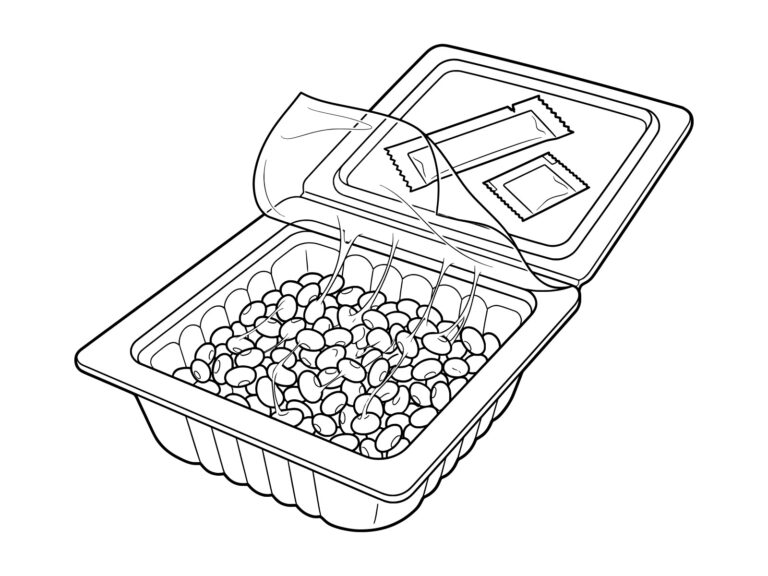
The Natto you see at the supermarket usually comes in square white packs.
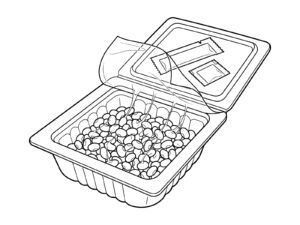
When you open the lid, you will see a thin plastic film. On top of the lid, there are small packets of sauce and mustard.
One pack has just enough for one person to eat. You often see them sold in sets of three or four.
The More You Stir, the Stretchier It Gets
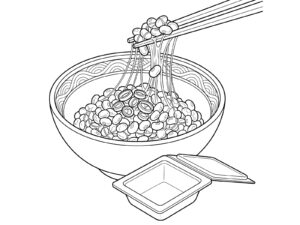
When you stir Natto round and round with chopsticks, white, sticky strings stretch out more and more.
These strings come from a part made by the Natto bacteria called polyglutamic acid. It is made of long chains of glutamic acid, which gives Natto its yummy flavor.
Stirring it well traps air inside and makes it feel soft in your mouth. Some people like to stir it before adding the sauce, while others stir it after. Everyone has their own favorite way!
Eat It on Top of Rice
The most popular way to eat Natto is Natto on rice, put right on top of hot rice.
Some people also like to add chopped green onions, seaweed, or a raw egg.
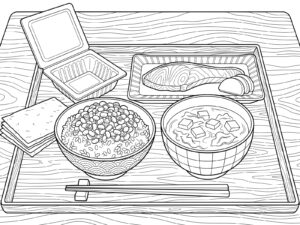
If you put it together with miso soup, grilled fish, and pickles, you have a classic Japanese breakfast ready to go. The third coloring page shows a tray with a breakfast like this!
Small Beans, Big Beans, and Crushed Beans
There are a few different types of Natto.
The one you see most often is small-grain Natto, made from small soybeans. It mixes really well with rice, so it is very popular.
Large-grain Natto is made from big soybeans. It has a strong bean flavor and is fun to chew.
Then there is hikiwari Natto, made by crushing soybeans and removing their skins. Since the pieces are small and soft, it is perfect for little kids and as a filling for sushi rolls.
It is fun to look at the different packs at the store and try them all to see which one you like best!
How to Color Natto
For Natto beans, layer light brown
Natto beans are light brown. First, color them with ocher or beige. Then, try adding a little bit of brown here and there.
If you change how dark the color is for each bean, they will look packed close together.
If you make the small, round spot on each bean a little darker brown, it will look just like real Natto.
Leave the sticky strings white
It is best to leave the sticky strings white without coloring them.
If you color the beans and bowl around them first, the white strings will stand right out.
In the picture where the Natto is being mixed, try to carefully leave the strings stretching from the chopsticks to the small bowl white.
Add shadows to the white container with light gray
The Natto container is white, so you can leave it all white.
But if you add light gray or light blue only on the inside walls and grooves, the shape of the square box will look clear.
If you color the small sauce packet light brown and the mustard packet yellow, the top of the lid will look fun and colorful.
Enjoy picking colors for the dishes at breakfast
In the breakfast picture, coloring the patterns on the dishes is the most fun part.
Try picking a color for each dish! You can make the wave pattern on the rice bowl indigo blue, and the square pattern on the soup bowl red and black.
Grilled salmon is orange, pickled radish is yellow, miso soup is light brown, and seaweed is green. If you color the tray and table like real wood, your breakfast table will look nice and warm.
Fun Facts About Natto
Why Mito's Natto became famous
When you think of Natto, many people think of Mito in Ibaraki Prefecture.
Mito's Natto became known all over Japan back in 1889, when the railroad reached Mito. When people started selling Natto made from small soybeans in front of the station, it became super popular with train riders.
More and more people bought it as a gift to take home, and soon everyone was saying, "When you think of Mito, you think of Natto!"
July 10th is "Natto Day"
July 10th is "Natto Day"! It comes from a Japanese wordplay on the numbers: "na" (7) and "to" (10).
At first, it was made a special day in the Kansai region to get people to eat more Natto. Then in 1992, it became a nationwide holiday.
Also, January 10th is "Stringy Natto Day" because 1 can be "i" and 10 can be "to" for "ito" (string)!
Long ago, it was wrapped in straw
Long before plastic packs were made, Natto was made by wrapping it in straw.
Natto bacteria naturally live in straw. So when you put cooked soybeans inside a bundle of straw and keep it in a warm place, it turns into Natto all on its own!
Even today, you can still find "straw Natto" wrapped in real straw at souvenir shops.
Share These Natto Coloring Pages


More Other Food Coloring Pages
-
Nattō in a white foam container
-
Stirred natto
-
-
Natto on rice breakfast
-