Hiragana "Bu" Coloring Pages


About Hiragana "Bu"
"Bu" as in "Budou" (Grapes)
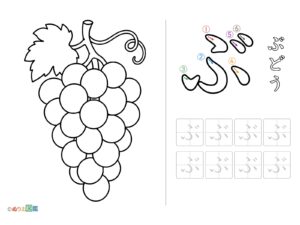
The character on this coloring page is the Hiragana "Bu".
The word is "budou" (grapes). Grapes are delicious fruits that are in season from late summer through autumn.
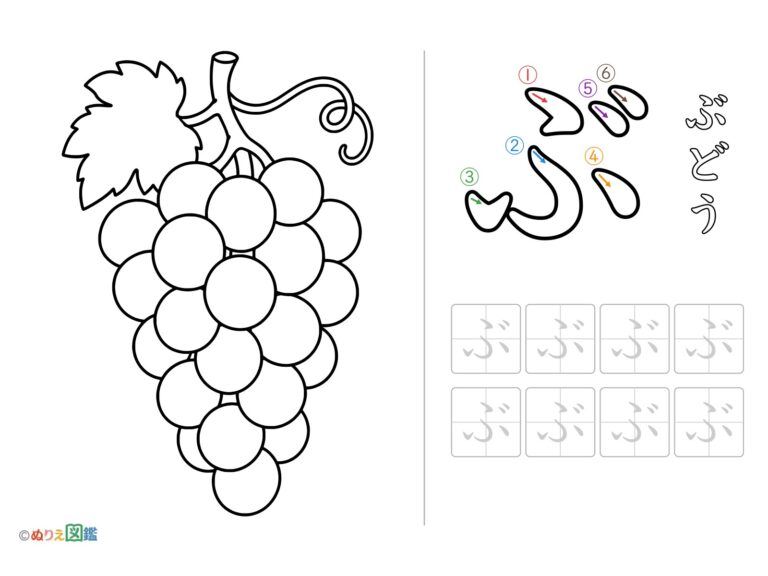
The picture on the left shows a bunch of grapes.
Lots of small round berries gather together, with a stem, a leaf, and curly tendrils at the top.
Grapes grow by stretching out their tendrils. In grape fields, farmers usually train the vines to grow along a trellis.
Hiragana "Bu" Was Born from "Fu"
Hiragana "Bu" is made by adding two little dots (tenten) to "fu".
The original "fu" changed into its current shape as people wrote the Kanji "不" in a fast, cursive way.
Adding these dots turns the "fu" sound into the voiced "bu" sound.
Say "fudou" and "budou" while looking in a mirror. It is fun to see how your lips move differently!
Tips for Writing
You write "fu" in 4 strokes.
For the 1st stroke, make a small dot at the top in the middle.
For the 2nd stroke, start below it, draw a gentle curve down toward the lower left.
The 3rd stroke is the left dot, and the 4th stroke is the right dot. Try to line up the left and right dots nicely across the middle line.
Finally, add two small dots on the upper right. Place them just above and to the right of the 4th stroke dot. Hiragana "Bu" has a lot of dots, so be careful they do not bump into each other!
Words with Hiragana "Bu"
Words that start with "bu" include buta (pig), buranko (swing), buutsu (boots), and budou (grapes).
Some words have "bu" in the middle or at the end, like kabu (turnip), kobu (bump), and abuku (bubbles).
"Bu" also pops up often in sound words, like bukubuku (bubbling) and buun (buzzing).
Try playing a game with your family to see who can find the most words!
How to Use This Coloring Page
This coloring page has a picture of grapes on the left, a big Hiragana "Bu" and the vertical word "budou" on the upper right, and tracing boxes on the lower right.
First, look at the picture and say "budou" out loud.
Next, color in the big Hiragana "Bu", and finish by tracing the letters. This way, you can learn the character in three ways: looking, saying, and writing!
It is also fun to put it next to the "fu" coloring page to compare having the dots and not having them.
How to Color Hiragana "Bu"
Color the Big Hiragana "Bu" in Grape Colors
Color the big Hiragana "Bu" in purple or red-purple to match the grapes.
If you use different colors for the 4 strokes—like purple, pink, light blue, and yellow-green—you can easily see how many dots it has.
Making the tiny dots yellow-green makes them look like sweet muscat grapes!
Color the Berries Dark and Light
Let's color the grape berries in purple.
If you leave a little bit of white on the top left of each berry, they will look shiny in the light!
Color the front berries light and the back berries dark to make the bunch look nice and round.
If you color them yellow-green, they turn into green grapes like muscats.
Don't Forget the Leaves and Vines
Color the leaves green, and add a little darker green along the lines of the leaf.
Using brown or ocher for the stem and vine makes them look real.
If you add a little bit of yellow or orange to the edges of the leaves, it looks like an autumn grape field!
Check the Dots When You Trace
Trace Hiragana "Bu" in the bottom-right box using a pencil.
Hiragana "Bu" has many small lines, dots, and tiny marks.
Use the middle line of the box to help you put the dot of the first stroke right above the center.
Write each one slowly and neatly.
When you finish writing the tiny marks, check them against the big Hiragana "Bu" model to see if your dots are in the right spot.
Fun Facts About Hiragana "Bu"
The White Powder on Grapes Is an Important Sign
Sometimes, you might see something like a white powder on the surface of grape berries.
This is called bloom, and the grapes make it all by themselves.
It repels water and works to protect the berries.
When grapes have a lot of bloom on them, it is a sign that they are fresh.
Places Where Lots of Grapes Are Harvested
In Japan, the place that harvests the most grapes is Yamanashi Prefecture.
Lots of grapes are also grown in neighboring Nagano Prefecture.
From late summer into autumn, there are farms where you can enjoy grape picking.
Many Different Kinds of Grapes
There are many kinds of grapes, such as big-berried Kyoho, small-berried Delaware, and green Shine Muscat.
They come in many colors, too, like purple, red, and green.
It is fun to try different kinds and compare their tastes.
Things Made from Grapes
Grapes are not only eaten as they are, but they are also made into juice, jam, and raisins.
Raisins are made by drying grape berries.
Have you ever seen them inside bread or sweets?
Share These Hiragana "Bu" Coloring Pages


-
Tracing the letter "ぶ" (Grape)
-