Hiragana "Kya" Coloring Pages


About Hiragana "Kya"
The "Kya" in "Kyabetsug (Cabbage)" for Hiragana "Kya"
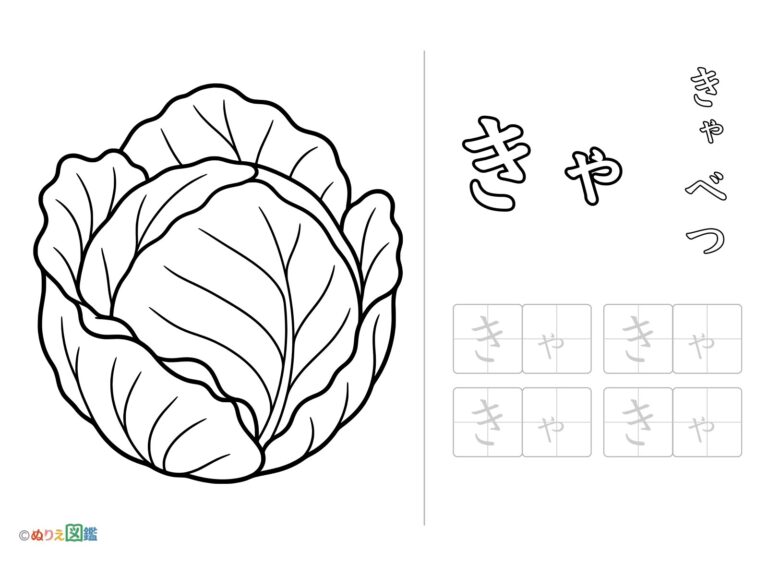
The character on this coloring page is the Hiragana "Kya".
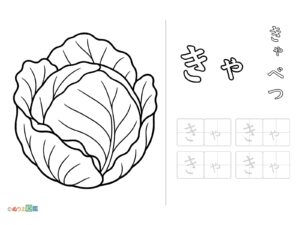
The word is "kyabetsu" (cabbage). Look at the picture on the left, you can see 1 round cabbage.
Can you see how the outer leaves are open a little bit, and the leaves have lines on them?
Cabbage is a vegetable where many, many thin leaves wrap over each other to make a round ball.
Usually, people write "kyabetsu" in katakana like "キャベツ", but we are writing it in hiragana here so you can practice Hiragana "Kya".
"Ki" and a small "ya" make one single sound
"Kya" is a letter you write by putting a small "ya" after "ki".
Even though it is made of two letters, you don't say "ki" and "ya" separately. You say "kya" as one sound.
Sounds like this are called youon.
If you write the "ya" big, it becomes "kiyabetsu" (cabbage), and the way you read it changes!
"Ki" came from the kanji 「幾」, and "ya" came from the kanji 「也」.
On the hiragana chart, youon that use small "ya", "yu", and "yo" are lined up in groups of three, like "kya", "kyu", and "kyo".
Try saying them out loud to a fun rhythm: "kya, kyu, kyo!"
Tips for Writing Beautifully
"Ki" is a character drawn in 4 strokes.
For the horizontal lines in strokes 1 and 2, tilt the right side up a little, and be careful with the different lengths of the two lines.
For stroke 3, pass through both horizontal lines and bring your line down at a tilt from the top.
For the round part at the bottom of stroke 4, textbook style leaves a space after stroke 3.
The small "ya" has 3 strokes. Draw it small in the next box, tucked into the bottom left of the box.
A good size to aim for is about half as big as "ki".
When you finish writing, compare the sizes of "ki" and "ya" to make sure the difference is clear!
Let's look for words that start with Hiragana "Kya"!
Words that start with "きゃ" include きゃく (guest), きゃたつ (stepladder), きゃらめる (caramel), and きゃんぷ (camping).
Hiragana "Kya" is also in the giggling sound "きゃっきゃっ" and the surprised yell "きゃー"!
Try reading "きゃ" and "きや" out loud to compare them.
Can you tell the difference?
Take turns with someone in your family to see how many words with Hiragana "Kya" you can say!
How to Color Hiragana "Kya"
Color the Big "Kya" in Your Favorite Colors
First, try coloring the big Hiragana "Kya" with the outline in the top right using your favorite colors.
If you color "Ki" and the small "Ya" in matching colors, like green and yellow-green, it will look fresh and bright just like a cabbage!
To keep inside the lines, color slowly near the edges, and color freely in the middle.
Color the Cabbage Green and Yellow-Green
Color the outer leaves of the cabbage with dark green.
For the tightly wrapped leaves inside, use yellow-green or light yellow-green to make a bright and juicy cabbage.
You can leave the leaf veins white without coloring them, or trace them thinly with light yellow.
If you color the edges of the leaves a little darker, the overlapping leaves stand out, making the cabbage look nice and round.
It is also fun to make a purple red cabbage by coloring it with purple and pink!
Tracing Practice: Two Boxes Make One Set
In the bottom right boxes, there are 4 sets of light gray Hiragana "Kya".
"Ki" is in the left box, and the small "Ya" is in the right box. Two boxes make one set.
Pencils like B or 2B are best, because they are not too dark or too light.
Use the vertical and horizontal lines in the middle of the boxes as a guide, and check where the letter starts before you write.
After you write one set, say "kya" out loud!
When you trace all 4 sets carefully one by one, you can try writing it all by yourself in the white space outside the boxes.
Fun Facts About Hiragana "Kya"
Cabbage was born on the European coast
People say cabbage ancestors grew on the seaside in Europe.
Back then, they were just wild plants that did not grow into round balls.
Over a very long time, people grew them carefully until they rolled up into the round cabbages we see today!
It is best friends with broccoli
Cabbage, broccoli, and cauliflower are all veggie cousins born from the very same ancestor!
We eat the leaves of a cabbage, but for broccoli and cauliflower, we eat the flower buds before they open.
They look so different, but they are in the same family. How cool is that?
Spring cabbage and winter cabbage
Spring cabbage harvested in spring has soft, light leaves wrapped loosely.
Winter cabbage harvested in winter has firm, tightly packed leaves and feels super heavy.
Cabbage leaves are also the favorite food of little white butterfly caterpillars!
Cabbage is a ball of wrapped leaves
When you cut a cabbage ball in half, you can see lots of leaves tightly packed inside.
The big outer leaves wrap up and protect the young leaves inside.
Next time you cut a cabbage at home, take a close look at the inside!
Share These Hiragana "Kya" Coloring Pages


-
"Kya" tracing (cabbage)
-