Hiragana "Re" Coloring Pages
 ~

About Hiragana "Re"
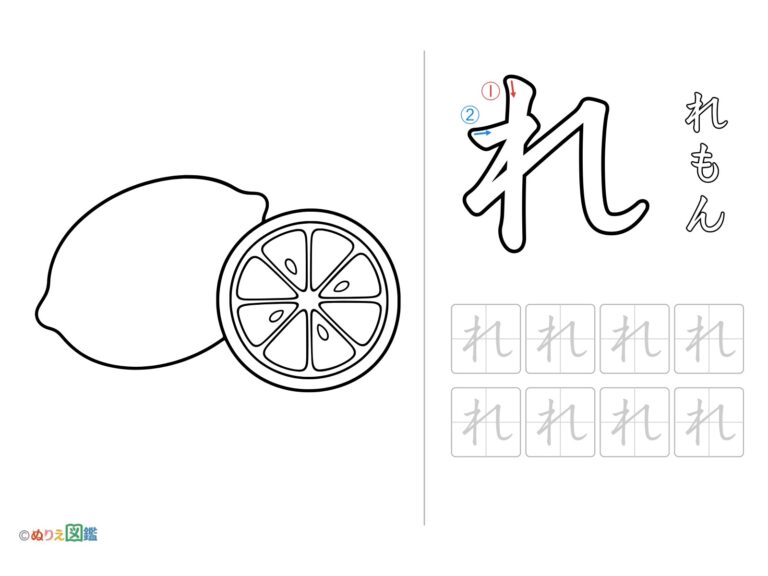
"Re" for "Lemon"
The letter on this coloring page is the Hiragana "Re".
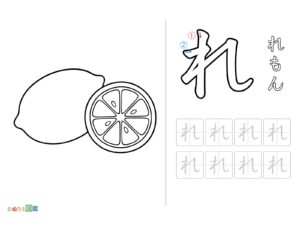
The word is "lemon". The picture on the left of the first page shows one whole lemon and one round slice of lemon.
The round lemon slice has lines for the segments and small seeds drawn on it.
Lemon is a very sour fruit when you put it in your mouth!
Hiragana "Re" Was Born from "礼"
The Hiragana "Re" became its current shape as people long ago wrote the Kanji character "礼" in a fast, cursive way.
Katakana "レ" was also born from the same Kanji "礼".
The sharply bent shape on the right side of "礼" stays in Katakana "レ"!
Tips for Writing It
You write Hiragana "Re" in 2 strokes.
For the 1st stroke, draw a straight vertical line down on the left side.
For the 2nd stroke, start to the left of the vertical line, go right across the line, turn down to the bottom left.
From there, go back up to make one peak, and smoothly stretch down to the right at the end.
"Wa" and "Ne" also have the same shape for the left vertical line. Compare how the last part is different!
The Second Page Is Full of Words with "Re"
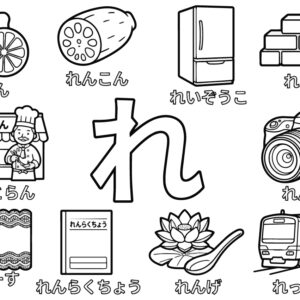
On the second coloring page, pictures of words starting with "re" are lined up around a big Hiragana "Re" in the middle.
There are drawings of a lotus root with holes, a refrigerator that keeps things cold, a communication notebook connecting school and home, and a renge (lotus flower and spoon).
They say the spoon was named "renge" because it looks like a lotus flower petal!
Let's Play with Words that Have "Re"
There are not many words that start with "re" among old Japanese words.
Many words on the second page are also written in Kanji or Katakana.
Instead, we use many words every day that end with "re", like "kore" (this), "sore" (that), "are" (that over there), and "dare" (who).
Point to things around you and try saying "kore" and "sore"!
How to Enjoy the Two Coloring Pages
The first coloring page lets you color the lemon and big Hiragana "Re", and practice writing Hiragana "Re" by tracing it.
The second coloring page lets you color slowly while finding various "re" words.
There is also a round lemon slice in the corner of the second page. Try to find it!
How to Color Hiragana "Re"
Color the Big Hiragana "Re" Any Color You Like
Try coloring inside the big Hiragana "Re" at the top right with your favorite colors.
If you use green for stroke 1 and yellow for stroke 2 to match the lemon, you get a nice, fresh Hiragana "Re".
Stroke 2 is a long line, so changing colors along the way to make a rainbow is fun too!
Color the Lemon with 2 Yellows
For the whole lemon, color it with lemon yellow, then make the edges a dark yellow or marigold to make it look nice and round.
If you mix a little yellow-green on the pointy ends, it will look like a real one!
For the sliced lemon, color the outer peel dark yellow, leave the white part on the inside as it is, and color the segments pale yellow.
If you make the seeds cream-colored, they will stand out nicely even though they are small.
For Page 2, Color Daily Tools Neat and Clean
For the refrigerator on page 2, you can leave it white, or color it pale light blue or pale green.
For the lotus root, make the outside a light ochre, and make the inside of the holes a little darker.
If you color the lotus flower pink and the leaves green, it will look lovely and bright.
Trace Each Letter Carefully, One by One
In the boxes at the bottom right, there are 8 light gray Hiragana "Re" lined up.
Hold your pencil the right way, and trace slowly over the gray lines without going outside the edges.
Using the lines in the middle of the box as your guide helps you balance your writing.
For stroke 2, try to finish it all in one go without stopping in the middle.
Every time you write one, compare it with the big example of Hiragana "Re"!
Fun Facts About Hiragana "Re"
Why lemons are sour
Lemons are sour because they have a lot of something called citric acid in them.
Lemons also have plenty of vitamin C, which is great for your body.
You can squeeze lemons over black tea or fried chicken before you eat them.
Japan's lemons come from Hiroshima
Hiroshima Prefecture grows the most lemons in Japan.
The islands in the Seto Inland Sea are pretty warm even in winter and do not get much rain, so lemons grow very well there.
However, many of the lemons you see in stores are shipped from other countries.
There are green lemons too
When lemons are still young, their skin is green.
As they ripen in the sun on the tree, they slowly turn yellow.
Lemons picked while they are still green are sometimes called green lemons.
The holes in lotus roots
The lotus root on the second page is actually the underground stem of a lotus plant.
It has many holes so that air can pass through it.
Because you can see right through the holes, people think of it as a lucky food that means "a clear view of the future." That is why it is used in traditional Japanese New Year food.
Share These Hiragana "Re" Coloring Pages


More Hiragana Coloring Pages
-
"Re" Tracing (Lemon)
-
Words that start with "Re"
-
-