Hiragana "De" Coloring Pages


About Hiragana "De"
"De" as in "Denwa" (Phone)
The letter on this coloring page is the Hiragana "De".
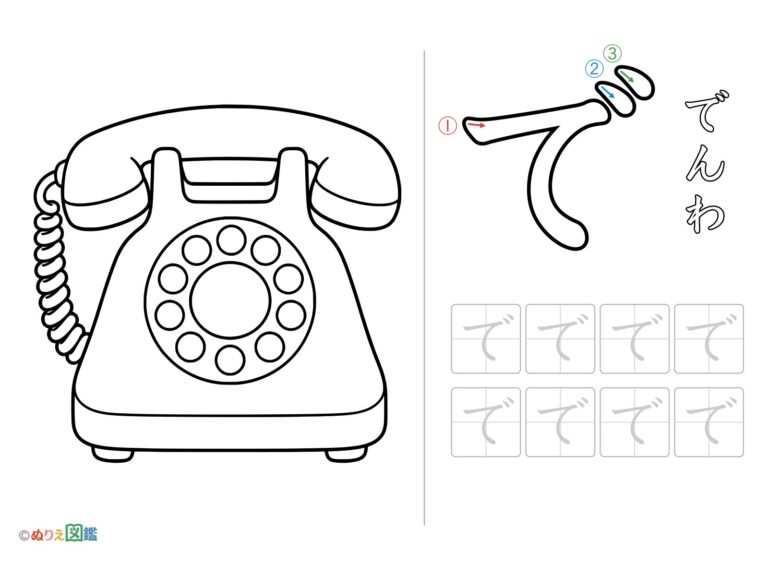
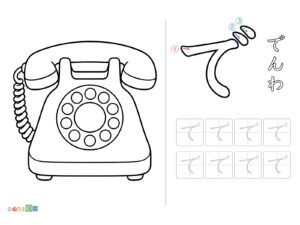
The word is "denwa" (phone). The picture on the left is a rotary phone, which people often had in their homes long ago.
It has a handset you put to your ear and mouth, a dial with a row of round holes, and a curly cord.
It looks very different from the smartphones we use today.
If you show it to your grandma or grandpa, they might tell you it brings back happy memories!
Hiragana "De" Came from "Te"
Hiragana "De" is the letter "te" with two little dots (tenten) added.
The original "te" took its current shape over time as people wrote the Kanji character "天" in a simple, flowing way.
When you add the two dots, the clear sound of "te" changes into the buzzing sound of Hiragana "De".
It is "denwa," not "tenwa." Be careful not to forget the two dots!
Tips for Writing
You write "te" in 1 stroke.
Draw a line from left to right, slanting slightly upward. Turn back at the right end and go down diagonally to the bottom left.
From there, draw a big, round curve going down, and gently sweep out to the bottom right.
If you make the top line a bit long and the bottom curve nice and full, it will look great!
Finally, add two little dots at the top right. Write them small, in the open space just below the right end of the top line.
Words with Hiragana "De"
Words that start with Hiragana "De" include densha (train), denki (electricity or light), deguchi (exit), and dendenmushi (snail).
"Dendenmushi" means a snail! It has Hiragana "De" in it twice.
There are also words with Hiragana "De" at the end, like ude (arm), sode (sleeve), and fude (writing brush).
Try looking for words with Hiragana "De" in body parts or clothing!
How to Use This Coloring Page
This coloring page has a picture of a phone on the left. On the top right, there is a big Hiragana "De" and the word "denwa" written top-to-bottom. On the bottom right, you will find boxes for tracing.
First, look at the picture and say "denwa" out loud.
Next, color in the big Hiragana "De", and finish by tracing the letters. This way, you can learn the letter by looking, saying, and writing!
It is also fun to put this page next to the "te" coloring page and compare whether they have two dots or not.
How to Color Hiragana "De"
Color the Big "De" with a Gradient
The big Hiragana "De" is a character made with just 1 stroke. Try changing the color bit by bit from where you start to where you finish!
For example, if you go from yellow-green to green, and then to blue-green to make it darker and darker, you can really see the flow of the stroke.
If you color the dots red or pink, they will really stand out!
The Rotary Phone Doesn't Have to Be Black
A real rotary phone is black just like its name in Japanese, but you can use any color you like on your coloring page!
When you color it black, leave a little bit of white at the top where the light hits it. That will make it look shiny!
If you use red, cream, or light green, it becomes a super cute phone.
If you leave the round holes on the dial white, the holes will really stand out!
Have Fun with the Swirly Cord
If you color the swirly cord the same color as the phone body, everything will look nice together.
It is also fun to color every other swirl a different color to make a striped cord!
You can even draw a stand or a table under the phone and color it brown.
Be Careful at the Turn When You Trace
Trace Hiragana "De" in the bottom-right boxes with a pencil.
When you turn back at the right end of the flat line, do not lift your pencil off the paper. Just turn it sharply!
Look at the center line of the box. Try not to let the curve bulge too far to the left of the middle, and it will look great.
Take your time and write all 8 of them, one by one!
Fun Facts About Hiragana "De"
Turning the dial to make a phone call
For a rotary phone, you put your finger in a hole on the dial and turn it round and round to enter a phone number.
When you let go of your finger, the dial goes back to where it was with a whirring sound.
You had to turn it for every single number, so making a call took a lot longer than it does now!
How "Moshi Moshi" started
The phrase "Moshi Moshi" that people say when answering the phone comes from the old words "Mousu, mousu."
It is like a signal that means, "I am going to speak now!"
People started using it way back when phones were first made.
How phones started in Japan
People first began talking on phones in Japan during the Meiji period.
At first, the phone lines only connected Tokyo and Yokohama.
Now, we live in a time where anyone can carry a phone around with them!
The secret of the receiver
For the rotary phone's receiver, you put the top part to your ear and the bottom part to your mouth.
You hear the other person's voice from the ear part, and the mouth part picks up your own voice.
Look at the receiver in the coloring page and try to find which side goes to your ear!
Share These Hiragana "De" Coloring Pages


-
Tracing "で" (Telephone)
-