Hiragana "Di" Coloring Pages


About Hiragana "Di"
The "Di" in "Hanadi"
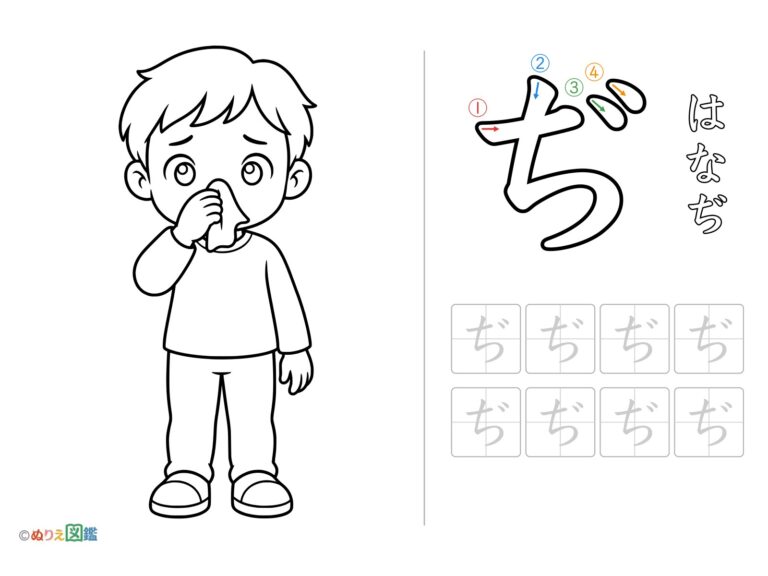
The letter on this coloring page is the Hiragana "Di".
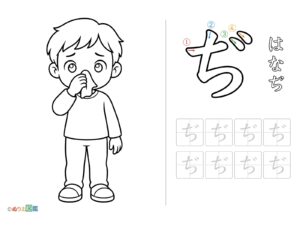
The word is "Hanadi" (nosebleed). It means blood coming out of your nose.
The picture on the left shows a child holding a tissue to their nose with a slightly worried face.
They are looking straight ahead instead of looking up, which is very smart!
Hiragana "Di" comes near the end of the word, so try to find where it is inside "Hanadi."
Hiragana "Di" Was Born from "Chi"
Hiragana "Di" is the letter "chi" with two dots (dakuten) added.
The original letter "chi" took its current shape over time from a simplified Kanji character, "知".
Hiragana "Di" makes the exact same sound as "ji."
Because of this, we almost always use "ji" instead, and almost no words start with Hiragana "Di".
When Do We Use Hiragana "Di"?
We use Hiragana "Di" mostly in two situations.
The first is when a word starting with "chi" combines with another word and its sound changes, like when "hana" and "chi" (blood) join together to make "hanadi."
The second is when the "chi" sound repeats and the second one changes its sound, like in "chijimu" (to shrink) or "chijireru" (to curl).
Since the original word had "chi," we write it as Hiragana "Di"!
Tips for Writing
You write "chi" in 2 strokes.
The first stroke is a horizontal line that goes up slightly to the right.
The second stroke goes straight down through the horizontal line, turns around, curves out into a big round belly on the right, and sweeps down to the left.
If you make that rounded part big, your letter will look nice and bold!
Finally, add two small dots on the top right. Write them small, right above the right end of the horizontal line.
Words with Hiragana "Di"
Some words with Hiragana "Di" are hanadi (nosebleed), chijimu (to shrink), chijireru (to curl), and mijika (familiar or close to you).
"Mijika" comes from combining "mi" (self) and "chika" (near).
If you look closely at all these words, a hidden "chi" is inside them!
Line up this page with the "chi" coloring page and compare them with and without dots.
We do not use Hiragana "Di" in many words, but it has a special reason for being used!
When you learn how to write this rare letter, you can be proud of yourself!
How to Color Hiragana "Di"
Use two colors for the big Hiragana "Di"
Try coloring the big Hiragana "Di" with two different colors! Use one color for the first side-to-side line, and another for the second curvy line.
For example, if you make the first line light blue and the second line dark blue, it is easy to see where the lines split.
If you color the dots pink or yellow, they will stand out and look super cute!
Colors for the child and the tissue
Color the child's hair black or brown, and their face and hands light peach.
If you add a little light pink to their cheeks, they will look extra sweet.
Leave the tissue on their nose white to make it look real.
For their clothes, try bright colors like yellow or light blue.
Make the troubled face look gentle
This child looks a little troubled, but do not worry, they are okay!
You can draw a family member or a teacher around them, too.
If you color the background a light cream color, your picture will feel warm and gentle.
Trace slowly around the curves
Use your pencil to trace Hiragana "Di" in the boxes at the bottom right.
Do not rush the big round curve in the second line. Take your time and move your pencil slowly.
Look at the center lines in the box. Try not to push the round part too far down so it stays in a nice shape.
Trace all 8 boxes, one by one, very carefully.
At the end, check if your dots fit nicely in the top right part of the box.
It is also great practice to write "Chi" and Hiragana "Di" side by side!
Fun Facts About Hiragana "Di"
If your nose bleeds, lean forward a little
If you get a nosebleed, first sit down and lean forward a little.
Then, pinch the soft part of your nose with your fingers and hold it for a while.
If you look up, the blood will flow down your throat, so try not to look up.
If it does not stop easily, please tell an adult in your house.
Thin blood vessels at the entrance of your nose
Near the entrance of your nose, there is a spot where many thin blood vessels gather.
This area gets hurt easily if you touch it with your finger or blow your nose too hard.
It is said that most nosebleeds come from around here.
How do you type "ji" and Hiragana "Di"
When you type letters using Romaji on a computer, "ji" is "ji", but Hiragana "Di" will appear if you type "di".
Even though they sound the same, the letters are different, so the way you type them is different too.
It is fun to ask an adult in your house to try it out for you.
Hiragana "Di" is a rare letter today
It is thought that long ago, there was a time when "ji" and Hiragana "Di" were spoken with different sounds.
Now they have the same sound, so "ji" is used for almost all words.
If you find Hiragana "Di", try to think if a "chi" is hiding behind it.
Share These Hiragana "Di" Coloring Pages


More Hiragana Coloring Pages
-
Tracing the Hiragana "ぢ" (Nosebleed)
-
-