Hiragana "Pyo" Coloring Pages


About Hiragana "Pyo"
“Pyo” in “Pyon-pyon”
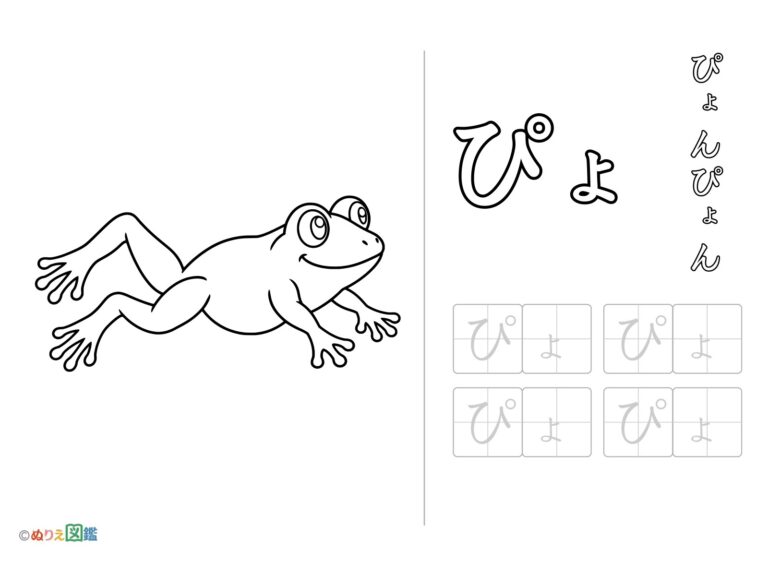
The letters on this coloring page are the Hiragana "Pyo".
The word is "pyon pyon." It is a sound word that shows how something light hops over and over.
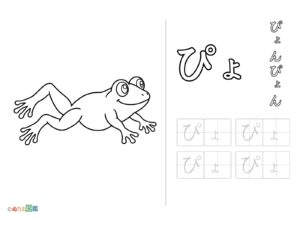
In the picture on the left, one frog is facing sideways, hopping pyon pyon.
It has 2 front legs, 2 back legs, and big eyes.
It is pushing off the ground strongly with its long back legs.
One Sound Made of Two Letters
You write Hiragana "Pyo" by combining two characters: a regular "pi" and a small "yo".
Even though you write two characters, you do not say "pi" and "yo" separately. You say them together as one single sound.
Sounds like this are called youon.
If you write "piyo" with a big "yo", it becomes two sounds, and it can turn into a different word!
The sound changes depending on whether the character is small or not.
How Hiragana "Pyo" Came to Be
Hiragana "Pyo" is the character "hi" with a little circle (handakuten) added to it.
Hiragana characters were born a long time ago when people started writing kanji in a simplified way.
"Hi" came from simplifying the kanji character 「比」.
The small "yo" is just a normal "yo" written smaller, and "yo" came from simplifying the kanji character 「与」.
Kanji from a long, long time ago changed over many years to become the easy shapes we use today!
Tips for writing
"Hi" is written with 1 stroke.
Start writing from the top left, go way down in a big curve, go up to the top right, and finally bring it down just a little bit.
It looks pretty if you make the middle bulge even on both sides.
For the circle, after you finish writing the character, draw 1 small ring on the top right.
For the small "yo", write it small in the bottom left of the box when writing horizontally. When writing vertically, write it small in the top right.
Make sure you put the circle and the "yo" in the right places!
Words with Hiragana "Pyo"
Many words that start with "pyo" show jumping or popping out, like "pyon pyon" (boing boing), "pyokon" (pop), and "pyoko pyoko" (hop hop).
The word "happyou" (presentation), which means talking in front of everyone, has "pyo" in it too.
Pretend you are a frog or a rabbit and try saying it while hopping "pyon pyon"!
Count how many times you can hop!
How to Color Hiragana "Pyo"
Color the Big Hiragana "Pyo" in Lively Colors
Try coloring inside the lines of the big Hiragana "Pyo" on the top right with your favorite colors.
If you use green or yellow-green to match the frog, the letter will look like it is hopping with energy.
If you change the colors for "pi" and "yo", it is easy to see how the letter is made.
Color the Frog with Green Shading
Color the frog's back green or yellow-green, and make its belly light yellow or white.
If you make the color lighter from its back to its belly, its body will look round and real.
For its big eyes, color around the pupils with gold or yellow, and leave the shiny spots white.
If you add dark green or brown dots on its back, it will look like a real frog.
Color its toes a little darker so you can clearly see their shape.
You can also draw lotus leaves or grass around its feet.
Trace the Letters with a Pencil
In the boxes on the bottom right, there are 4 sets of light gray Hiragana "Pyo".
Hold your pencil the right way and trace over the gray lines slowly so you do not go outside the lines.
Use the center lines inside the boxes as your guide to see how big to write and where to put the letter.
Pay attention to where things go: put the small circle on the top right, and the little "yo" on the bottom left of the box.
Every time you trace 1 set, say "pyo" out loud.
Once you trace all 4 sets, try writing Hiragana "Pyo" by yourself outside the boxes.
Fun Facts About Hiragana "Pyo"
From Tadpoles to Frogs
Baby frogs are called tadpoles.
At first, they do not have legs. They live by swimming in the water with their tails.
Soon, their back legs grow, and then their front legs come out. Once their tails disappear, they become frogs that can go up on land!
Toes on Front and Back Legs
Most frogs have 4 toes on their front legs and 5 toes on their back legs.
Their back legs are very long and strong. They use these legs to jump far away!
In the water, they swim smoothly using the webbing between their back toes.
Gulping Down Food with Their Eyes
When Hiragana "Pyo" swallows its food, it pulls its big eyes down into its mouth. This helps push the food down!
That is why it looks like Hiragana "Pyo" is squeezing its eyes shut when it swallows.
Frogs Love Rain
A frog's skin is always wet and damp.
They do not like drying out, so they love rainy days and wet places.
People say frogs often croak before it rains.
Make sure to wash your hands well after you touch Hiragana "Pyo".
Share These Hiragana "Pyo" Coloring Pages


-
Tracing the "ぴょ" sound (Pyon-pyon)
-