Hiragana "Gya" Coloring Pages


About Hiragana "Gya"
The "Gya" in "Gyao"
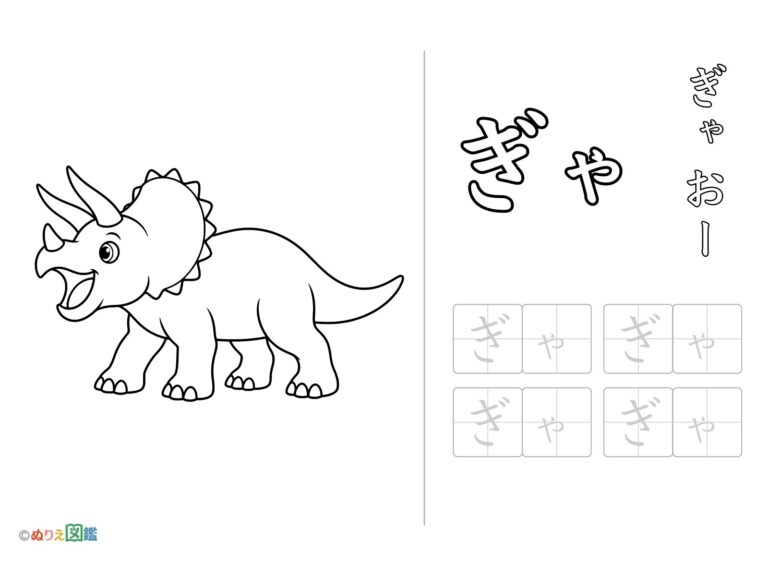
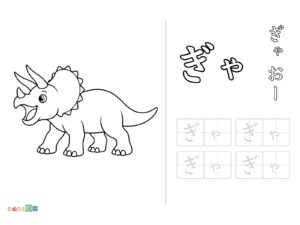
The character on this coloring page is the Hiragana "Gya".
The word here is "Gyao". It is a sound word for when monsters or dinosaurs roar in a big voice.
In the picture on the left, a dinosaur called Triceratops opens its big mouth and roars "Gyao!"
It has 3 horns on its head and stands strong on 4 legs.
It looks scary, but it is also a little bit cute!
Two letters for one sound
You write Hiragana "Gya" by combining two letters: "Gi" and a small "Ya".
Even though you write two letters, you say them together as one sound instead of splitting them into "Gi" and "Ya".
This kind of sound is called a contracted sound.
If you write it with a big "Ya" as "Gi-ya", it becomes two sounds and can make a different word.
The sound changes whether the small letter is there or not!
How Hiragana "Gya" was made
The letter "Gi" is the letter "Ki" with two dots (a voiced mark).
Hiragana was born long ago when people wrote Kanji in a smooth, simple way.
The letter "Ki" came from simplifying the Kanji "幾".
The small "Ya" is just a normal "Ya" written small, and "Ya" came from simplifying the Kanji "也".
Kanji from very long ago took a long time to become the easy shapes we use today!
Tips for writing
You write "Ki" in 4 strokes.
First, draw two lines across, pointing slightly up to the right. For the 3rd stroke, draw a slanting line that crosses them from above.
The 4th stroke is the rounded part at the bottom.
After you finish writing the letter, add the two short dots at the top right.
When writing sideways, put the small "Ya" in the bottom left of the box. When writing top-to-bottom, put it in the top right.
Be careful not to mix up where the dots and "Ya" go!
Words with Hiragana "Gya"
Words that start with Hiragana "Gya" include "Gyaku" (reverse) and "Gyakuten" (comeback).
Sound words like "Ogya", the happy cry of a baby, and "Gyat!", when you are surprised, also have Hiragana "Gya" in them.
Pretend you are a dinosaur and try roaring "Gyao!" in all kinds of voices.
It is fun to change your voice to a big voice, a quiet voice, or a low voice!
How to Color Hiragana "Gya"
Color the big Hiragana "Gya" in bold colors
Try coloring inside the lines of the big Hiragana "Gya" on the top right with any color you like.
It is great to use bold colors like red or dark green to match its roar.
If you use different colors for "gi", "ya", and the dots, you can easily see how the letter is made.
Colors for the Triceratops
Nobody knows the real colors of dinosaurs yet.
So, you can color it any color you like!
If you make the body green or brown and the tummy light yellow, it will look like a real dinosaur.
If you add patterns with orange or red on the frill spread behind its head, it will look very fancy.
Try coloring the three horns cream or white, and the inside of the big mouth pink or red.
If you color the toenails gray and the area around the pupils yellow, its face will look lively!
Trace with a pencil
In the box on the bottom right, there are 4 sets of light gray Hiragana "Gya".
Hold your pencil correctly and trace over the gray lines slowly so you do not go outside the lines.
Using the vertical and horizontal center lines in the box as guides makes it easy to see the size and position of the letters.
Pay attention to where things go: the dots are on the top right, and the small "ya" is on the bottom left of the box.
Every time you trace 1 set, say Hiragana "Gya" out loud.
When you trace all 4 sets, try writing it by yourself outside the box, too!
Fun Facts About Hiragana "Gya"
"Face with Three Horns"
The name Triceratops means "face with three horns."
It has two long horns above its eyes and one short horn on its nose.
It was a plant-eating dinosaur. People think it protected itself with its horns and frill.
In Ancient North America
Triceratops lived in what is now North America, a little more than 66 million years ago near the end of the dinosaur era.
It was about 8 to 9 meters long and even bigger than an elephant!
Tyrannosaurus lived around the same time, too.
Dinosaur Roars Are a Mystery
To tell the truth, we still do not know what kind of voices dinosaurs had.
That is because sound does not stay in fossils.
The "Gyao!" roars you hear in movies and cartoons were made up by people!
What Was the Frill For?
Behind the head of a Triceratops, there is a large, plate-like frill.
Was it to protect its neck? Or was it to show off to its friends? People have many ideas, and they are still studying it.
When you look at fossils, you learn the mysteries of ancient creatures little by little!
Share These Hiragana "Gya" Coloring Pages


-
"Gya" Tracing (Gyao)
-