Hiragana "Pya" Coloring Pages


About Hiragana "Pya"
"Pyat!" and Hiragana "Pya"
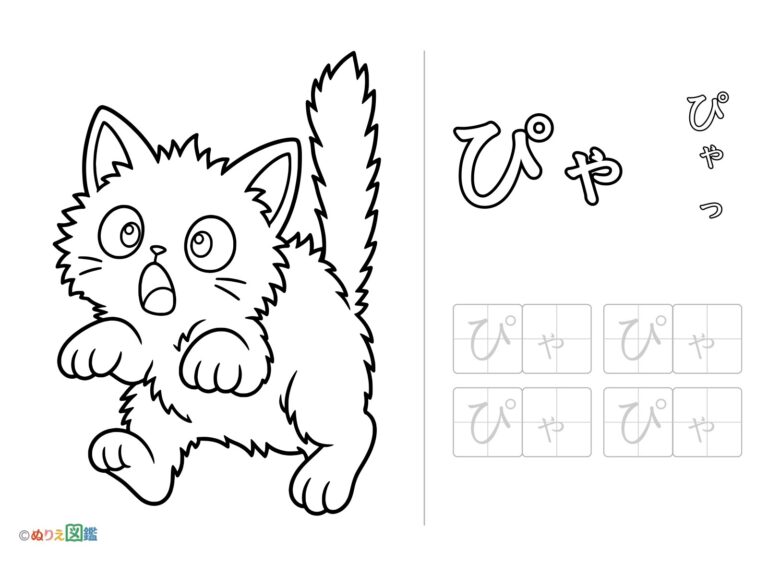
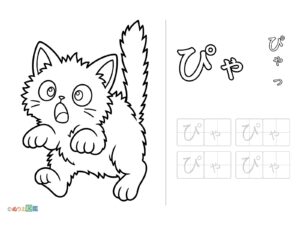
The character on this coloring page is the hiragana "Pya".
The word is "Pyat!". It is a sound word that shows how you jump up quickly when you get surprised.
In the picture on the left, one kitten is surprised and jumping up with a "Pyat!" sound.
Its tail and fur are standing straight up, too.
I wonder what surprised it so much!
Two Letters for One Sound
To write Hiragana "Pya", you combine two letters: "Pi" and a small "Ya".
Even though you write two letters, you do not say "Pi" and "Ya" separately. You say them together as one sound.
Sounds like this are called youon.
If you use a big "Ya" and write "Pi-ya", it becomes two sounds and can make a different word.
The sound changes if you have a small letter or not!
How Hiragana "Pya" Came to Be
To make "Pi", you add a circle (handakuten) to "Hi".
Hiragana characters were made long ago by simplifying Kanji.
"Hi" was made by simplifying the Kanji character 「比」.
The small "Ya" is just a smaller version of a normal "Ya", and "Ya" came from simplifying the Kanji character 「也」.
Kanji from a long, long time ago changed over many years to become the friendly shapes we use today!
Tips for Writing
You write "Hi" with 1 stroke.
Start at the top left, curve way down and around, go up to the top right, and bring it down a little at the end.
It looks nice if the curve in the middle is balanced on both sides.
For the circle, draw one little ring at the top right after you finish writing the letter.
When writing sideways, put the small "Ya" in the bottom left of the box. When writing top-to-bottom, put it in the top right.
Be careful not to put the circle and the small "Ya" in the wrong spots!
Words with Hiragana "Pya"
There are almost no Japanese words that start with Hiragana "Pya".
But Hiragana "Pya" is hiding inside some numbers!
Look at "Roppyaku" (600) and "Happyaku" (800).
The sound "Hyaku" changes to "Pyaku" after "Rop" or "Hap".
Try counting from Hyaku, Nihyaku, Sanbyaku... all the way to Kyuhyaku, and clap your hands when you say Hiragana "Pya"!
How to Color Hiragana "Pya"
Color the big "Pya" with a surprising color
Try coloring inside the outline of the big "Pya" at the top right with your favorite colors.
To match the surprised feeling, bright colors that pop like yellow, orange, or pink are great.
If you use different colors for "Pi" and "ya", you can easily see how the letter is made!
Color the kitten with your favorite pattern
For the kitten's fur, use orange and dark orange stripes if it is a tabby. Use black or dark gray if it is a black cat.
If you want to make a calico cat, add orange and black patches on its white body!
Color the tips of the sticking-up fur a little darker, so you can really tell it is standing on end.
The inside of the ears and the nose look like a real cat if you color them light pink, and the eyes look great in yellow or yellow-green.
If you leave a white space under the feet without coloring it, the cat will look like it is floating in the air!
Trace the letters with a pencil
In the boxes at the bottom right, there are 4 sets of Hiragana "Pya" written in light gray.
Hold your pencil correctly and trace over the gray lines slowly so you do not go outside the lines.
Use the vertical and horizontal center lines in the boxes as guides to easily see the size and place of the letters.
Be careful with where they go: the little circle goes at the top right, and the small "ya" goes at the bottom left of the box.
Every time you trace 1 set, say "Pya" out loud!
When you trace all 4 sets, try writing Hiragana "Pya" by yourself outside the boxes, too!
Fun Facts About Hiragana "Pya"
Why Cats' Fur Stands On End
When a cat gets surprised or scared, the fur on its back and tail stands on end.
When its fur stands up, its body looks bigger.
People say cats do this to show others, "I am big and strong!"
Cats Are Great at Jumping
Cats have very strong back legs, so they can jump many times higher than their own body size.
They can easily hop onto high shelves or fences.
When they get surprised and jump right up with a "pya!", it is all thanks to these strong legs.
Spinning Around to Land on Their Feet
Even if a cat falls from a high place, it often spins its body around in the air and lands on its feet.
This is because their bodies are very flexible, and they are great at keeping their balance.
However, places that are too high are dangerous even for cats, so let's keep an eye out for them.
Whiskers Are Important Sensors
A cat's whiskers are not just hair; they work like sensors to feel what is around them.
People say cats even use their whiskers to feel if they can fit through narrow spaces.
Make sure you never pull or cut a cat's whiskers.
Share These Hiragana "Pya" Coloring Pages


-
Tracing the hiragana "pya" (pya)
-