Hiragana "Mo" Coloring Pages
 ~

About Hiragana "Mo"
"Mo" for "Momo" (Peach)
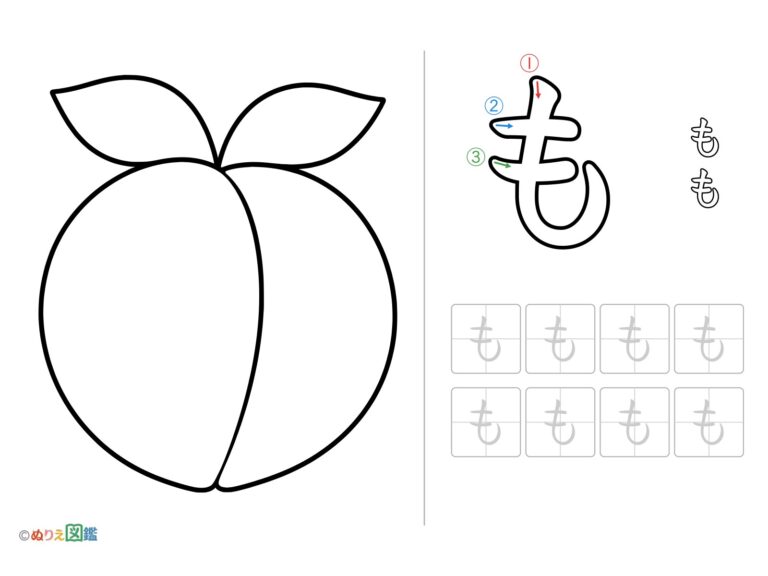
The character on this coloring page is the Hiragana "Mo".
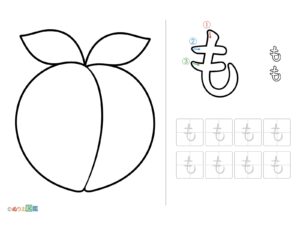
The word is "momo" (peach). The picture on the left of the first page shows one plump, round peach with two leaves on top.
A peach has a vertical crease line down the middle. Try to find it in the picture too!
"Momo" is a word with two "mo"s in a row. Say it out loud: "Mo, mo!" Try saying it twice.
Hiragana "Mo" Came from the Kanji for "Hair"
Hiragana "Mo" got its current shape long ago when people started writing the kanji character "毛" (hair) in a quick, flowing way.
If you look closely at "毛", you will see a few horizontal lines and a line at the bottom that curves up.
That shape slowly became simpler and simpler until it turned into Hiragana "Mo".
Katakana "モ" also came from the very same kanji "毛"!
Tips for Writing
You write Hiragana "Mo" in 3 strokes.
For the 1st stroke, start from the top, go straight down, curve softly at the bottom, and flick up to the top right.
For the 2nd and 3rd strokes, you write two horizontal lines. Making the bottom line a little shorter than the top line makes it look super neat!
Unlike Katakana "モ", the trick to Hiragana "Mo" is to write the vertical stroke first.
Try to keep the rounded part at the bottom neatly inside the box without making it too big!
The 2nd Page is Full of Words Starting with "Mo"
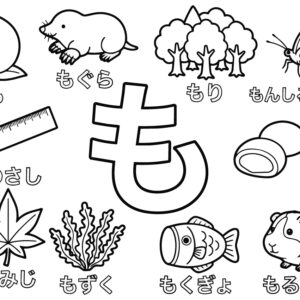
On the 2nd coloring page, you will see many pictures of things that start with "mo" all around the big Hiragana "Mo" in the middle.
There is a mogura (mole) that lives underground, a mori (forest) full of trees, mozuku (seaweed), and a mokugyo (wooden fish drum) used at temples.
Their names are written below each picture. Try tracing them with your finger as you read!
Let's Play with "Mo" Words
Other words that start with "mo" include mochi (rice cake), momiji (maple leaves), monosashi (ruler), and momoiro (pink).
There are also lots of words with "mo" at the end, like "kumo" (cloud or spider) and "imo" (potato)!
Take turns saying words with "mo" in them with someone in your family.
If you can name a lot, you are a Hiragana "Mo" expert!
How to Enjoy the 2 Coloring Pages
The 1st page is a coloring page for practicing letters where you color the peach, color the big Hiragana "Mo", and trace the letter at the end.
The 2nd page is a coloring page where you can take your time coloring while finding all kinds of "mo" words.
You can color one page a day, or start with your favorite picture!
How to Color Hiragana "Mo"
Color the Big Hiragana "Mo" in Any Color You Like
Try coloring inside the lines of the big Hiragana "Mo" at the top right with your favorite colors.
If you change colors for each stroke, like pink for the 1st stroke, yellow for the 2nd stroke, and light green for the 3rd stroke following the stroke order, it will be easier to remember how to write it.
It would also be cute to make a pink Hiragana "Mo" to match the color of the peach.
Color the Peach Pink and Cream
We recommend coloring the peach fruit with light pink and cream color.
If you make the top part dark pink, the bottom part light yellow or cream color, and blend them in the middle, it will look like a real peach.
If you make it a little darker pink around the dent line, it will look soft and round.
Color the leaves green, and try making the leaf veins a little darker green.
On the 2nd Page, Change Colors for Each Picture
On the 2nd page, the mole will look cute in dark brown or gray, with light pink hands.
If you use different shades of green for the trees in the forest, it will become a lively forest.
Color while thinking of their real colors, like dark brown for mozuku seaweed and reddish brown for the wooden fish drum.
Trace Each Character Carefully, One by One
In the boxes at the bottom right, there are 8 light gray Hiragana "Mo" lined up.
Hold your pencil correctly and trace slowly over the gray lines without going outside.
Using the vertical and horizontal lines in the center of the boxes as clues will help you balance the character well.
If you start the 1st vertical stroke a little to the left of the center line, the shape will turn out nicely.
Every time you write one, compare it with the big example Hiragana "Mo".
Fun Facts About Hiragana "Mo"
Peaches Came from China
Peaches are fruits that came to Japan from China a very long time ago.
In Japan, a lot of peaches are grown in Yamanashi Prefecture and Fukushima Prefecture.
Summertime around July and August is when you can see lots of yummy peaches in stores!
Hinamatsuri is Called "Peach Festival"
Hinamatsuri on March 3rd is also called "Momo no Sekku" (Peach Festival).
That is because peach blossoms start to bloom right around that time.
Since long ago, people believed that peaches have the power to chase away bad things.
Momotaro Was Born from a Peach
The famous fairy tale "Momotaro" is a story about a boy who was born from a huge peach floating down a river.
Momotaro makes friends with a dog, a monkey, and a pheasant, and sets off to defeat the ogres.
It is fun to ask someone in your family to read you the story while you work on your Hiragana "Mo" coloring page!
Soft Fuzz on the Peach Skin
If you touch a peach's skin, you can feel soft, tiny little fuzz growing on it.
Before you eat it, gently rub the peach in water to wash the fuzz off, and it will taste much smoother!
Peaches are very soft and bruise easily if you press them, so hold them gently, okay?
Share These Hiragana "Mo" Coloring Pages


More Hiragana Coloring Pages
-
Tracing the letter "Mo" (Peach)
-
Words that start with "Mo"
-
-