Hiragana "Gu" Coloring Pages


About Hiragana "Gu"
"Gu" in "Gumi"
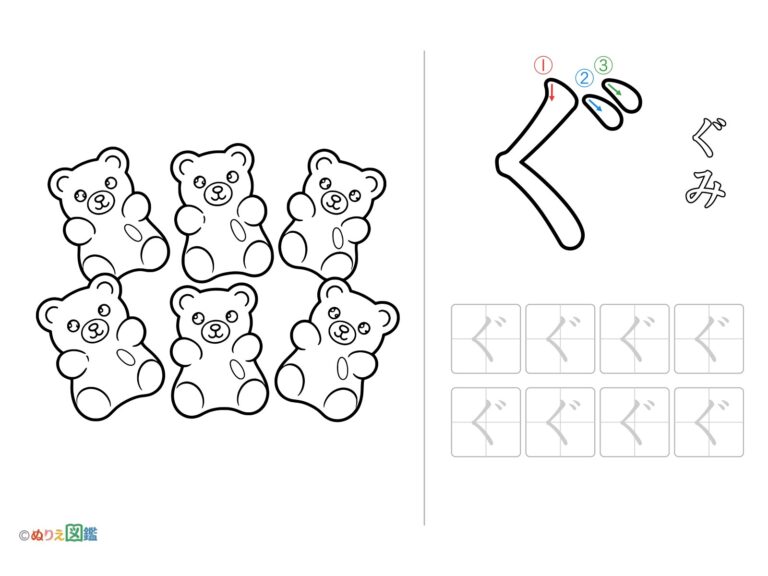
The letter on this coloring page is the hiragana Hiragana "Gu".
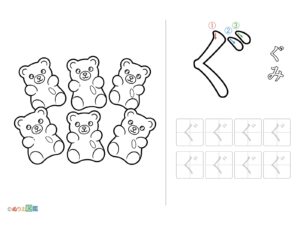
The word is "gumi" (gummy candy). The picture on the left of the first page shows 5 or 6 bear-shaped gummy candies lined up nicely.
Gummies have a squishy shape, and you can see small, shiny lights on them.
They are fun candies with a chewy texture when you bite them!
Hiragana "Gu" Came from "Ku"
Hiragana "Gu" is made by adding two small dots (tenten) to "ku".
The original "ku" became its shape today as people long ago wrote the kanji character "久" in a quick, relaxed way.
When you add the two dots, the clear "ku" sound changes to a buzzy "gu" sound.
Put your hand on your throat and say "ku" and Hiragana "Gu" out loud to compare them! Can you feel your throat vibrate when you say Hiragana "Gu"?
Tips for Writing
The original "ku" is written in 1 stroke.
Start from the top right, go down to the left at a slant, bend at the middle corner, and stop towards the bottom right.
To make it look pretty, round the bent corner just a little bit so it is not too sharp.
A great tip is to keep the top line and the bottom line about the same length!
At the end, write two small dots at the top right. Place them in the open space on the top right, a little away from the corner of "ku".
The Second Page Has Lots of Words with Hiragana "Gu"
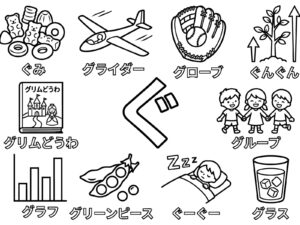
The second coloring page has pictures of words starting with Hiragana "Gu" around the big Hiragana "Gu" in the middle.
On the top left, you can find the same gummy candy from the first page.
There are also words for sounds and feelings, like "gungun" for a growing tree, and "guu-guu" for a sleeping child.
Words written in Katakana are there too, like "guroobu" (glove) and "gurasu" (glass)!
Let's Play with Words that Have Hiragana "Gu"
Hiragana "Gu" often appears in action words like "guruguru" (round and round), "gussuri" (sound asleep), and "guragura" (wobbly).
It is also in the middle or end of words, like "dougu" (tools), "tebukuro" (gloves), and "kagu" (furniture).
Try saying "guruguru" out loud while drawing a big spiral in the air with your finger!
How to Enjoy the Two Coloring Pages
On the first coloring page, you can color the gummies and the big Hiragana "Gu", and practice writing Hiragana "Gu" by tracing it.
On the second coloring page, you can take your time coloring while finding different Hiragana "Gu" words.
It is fun to color the gummies on both pages using colors for the same flavor!
How to Color Hiragana "Gu"
Color the big Hiragana "Gu" in your favorite colors
Try coloring inside the lines of the big Hiragana "Gu" at the top right with any color you like.
If you change the color from red to orange as you go from top to bottom on the "く" part, it is easy to see which way to write it.
If you make the dots a different color to stand out, you can easily see how it is different from "く".
Color the gummies like real fruit
If you color each gummy in a different color, they will look fun and exciting.
We recommend red for strawberry, orange for orange, yellow for lemon, purple for grape, and yellow-green for melon.
Leave the shiny spots white.
If you color the edges a little darker and the middle lighter, your gummies will look clear and squishy!
Color each picture differently on the second page
On the second page, make the baseball glove brown, the ball white, and the stitches red.
For the fast-growing tree, color the leaves green and the arrows yellow or orange to make it look full of energy.
For the sleeping child, color the blanket in soft colors like light blue or pink.
Trace each letter carefully one by one
In the boxes at the bottom right, there are 8 light gray Hiragana "Gu".
Hold your pencil correctly and trace over the gray lines slowly without going outside the lines.
Use the lines in the middle of the boxes as guideposts to help you balance your letter.
If you stop your pencil for a moment at the corners, the shape will look very neat.
Every time you finish writing one, compare it with the big example Hiragana "Gu".
Fun Facts About Hiragana "Gu"
Gummies Were Born in Germany
Bear-shaped gummies were born in Germany about 100 years ago.
"Gummy" means rubber in the German language.
It got this name because it stretches and bounces back just like rubber.
The Secret to the Chewy Texture
The fun, squishy texture of gummies is made with things like gelatin.
Gelatin is also used when you make jelly.
The more gelatin you add, the firmer and chewier the gummy becomes.
The "Gumi" Fruit
There is also a tree fruit called "gumi" (silverberry).
It is a small red fruit that tastes sweet and sour.
Even though it has the same name, it is totally different from gummy candy!
Chew Well Before You Swallow
Gummies are hard to swallow if you do not chew them well, so people say they help build your chewing power.
But if you eat too many, they can give you cavities.
Do not forget to brush your teeth after eating them.
Decide with a grown-up how many you can eat, and enjoy every bite!
Share These Hiragana "Gu" Coloring Pages


-
Tracing "ぐ" (Gumi)
-
Words that start with "Gu"
-