Hiragana "Ji" Coloring Pages


About Hiragana "Ji"
"Ji" as in "Jitensha" (Bicycle) for Hiragana "Ji"
The character on this coloring page is the Hiragana "Ji".
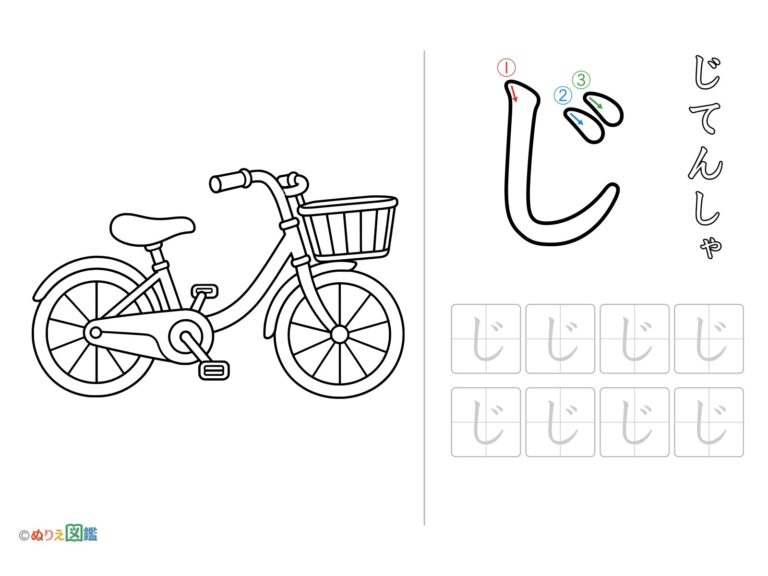
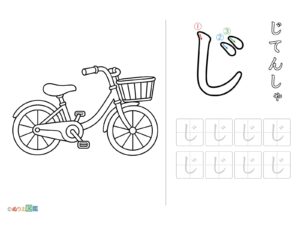
The word is "jitensha" (bicycle). The picture on the left shows a children's bicycle from the side.
It has two wheels in the front and back, handlebars, a seat, pedals, and a basket in the front for your things.
When you push the pedals with your feet, the chain turns, and that makes the back wheel go round and round.
Hiragana "Ji" came from "Shi"
"Ji" is the letter "Shi" with tenten (voiced sound marks) added.
The original "Shi" turned into its current shape as people wrote the kanji "之" in a flowing style.
When you add tenten, the clear sound of "Shi" changes into the buzzing sound of "Ji".
The word "Jitensha" (bicycle) also has "Sha", which combines "Shi" with a small "Ya". You write the small "Ya" tiny in the bottom left of the box.
Tips for writing Hiragana "Ji"
You can write "Shi" in 1 stroke.
Start from the top, go straight down, gently curve at the bottom, and sweep up to the right.
If you draw the straight line a little to the left of the middle of the box, you will have room on the right side to write the dots.
Finally, draw two small dots on the upper right. The trick is to draw them a little higher up so they do not touch the end of the sweep on "Shi".
Words that start with Hiragana "Ji"
Words that start with "ji" include jishaku (magnet), jikan (time), jidousha (car), and jagaimo (potato).
The "ja" in "jagaimo" is made by combining "ji" and a small "ya" into one sound.
There are also many words with "ji" in the middle or at the end, like Fujisan (Mount Fuji), niji (rainbow), and momiji (autumn leaves).
Let's see how many you can find!
How to view the coloring page
This coloring page has a picture of a bicycle on the left. On the top right, there is a big "Ji" and the vertical word "Jitensha". On the bottom right, you will find boxes for tracing.
"Jitensha" is a word made of 4 sounds: "Ji," "Te," "N," and "Sha."
Try clapping your hands and counting the sounds as you say "Ji, Te, N, Sha."
Even though "Sha" uses 2 letters, it is 1 sound, so you only clap 1 time.
Put this next to the "Shi" coloring page and compare them to see if they have dots or not!
How to Color Hiragana "Ji"
Color the big Hiragana "Ji" in 2 Colors
The big Hiragana "Ji" is written with 1 stroke. So if you change the color little by little from top to bottom to make a 2-color gradient, it will look super pretty!
For example, try making it darker step by step, like light blue on top and dark blue on the bottom.
If you color the dots in a different color, like yellow or pink, they will really stand out!
Color the Bicycle Any Color You Like
Color the bicycle frame (the body part) in a color you want to ride, like red, blue, or yellow-green.
If you color the tires black or dark gray, and the thin lines inside the wheels silver or light gray, it will look just like a real one!
Black or brown works great for the seat and the handlebar grips.
For the basket, it looks cute whether you use the same color as the frame or a different one!
Pay Attention to the Sweeping Stroke When Tracing
Trace the light gray Hiragana "Ji" in the bottom-right boxes with your pencil.
Draw the vertical line straight down, using the center line of the box to guide you.
For the last sweep, let go of your strength gently as you sweep up to the right.
Write all 8 of them carefully one by one, and you will get better and better!
Draw a Road and a Park Too
Try adding a road or a grassy field under the bicycle.
If you color the road light gray and the grass yellow-green, it will look like a picture of you going out on your bicycle!
Lightly color the sky light blue and leave some white clouds to make it a nice, sunny day.
It is also fun to draw things like a ball or flowers inside the basket!
Fun Facts About Hiragana "Ji"
The First Bicycle Had No Pedals
About 200 years ago, the very first bicycle made in Germany did not have pedals.
You sat on it and pushed off the ground with your feet to move. It was called the "Draisienne" after the person who made it.
It looks a lot like the kick bikes without pedals that young children ride today!
We Count Bicycles with "Dai"
In Japanese, we count bicycles as 1-dai, 2-dai, using the word "dai".
It is the same way we count cars and phones.
A bicycle with two wheels is called a "nirinsha" (two-wheeled vehicle), and one with three wheels is called a "sanrinsha" (tricycle).
May 5th is Bicycle Day
May 5th is Children's Day, but it is also "Bicycle Day"!
May is also the month to think about riding your bicycle safely.
When you ride a bicycle, put on your helmet and check that your brakes work before you go!
Practice with Training Wheels
When you start learning to ride a bicycle, you can put small training wheels on both sides of the back wheel.
Training wheels keep you from falling over, so you can practice pedaling.
Once you get used to pedaling, take the training wheels off. Next, it is time to practice your balance!
Share These Hiragana "Ji" Coloring Pages


-
Tracing "じ" (Jitensha - Bicycle)
-