Hiragana "Ba" Coloring Pages


About Hiragana "Ba"
"Ba" in "BATTA"
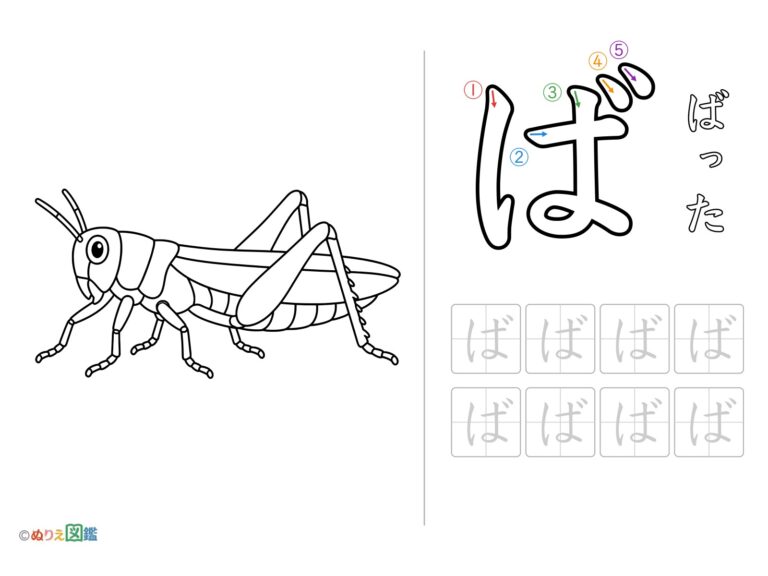
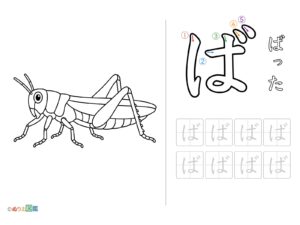
The letter on this coloring page is the Hiragana "Ba".
The word is "batta" (grasshopper). The picture on the left shows a side view of a migratory locust.
The migratory locust is big and impressive among the grasshoppers you often see in Japan.
They live in grassy fields and riverbeds, and you can find them from summer through autumn.
If you get close, they hop way up and spread their wings to fly far away!
Hiragana "Ba" Was Born from "Ha"
Hiragana "Ba" is made by adding two dots (dakuten) to "ha".
The original "ha" took its shape as people wrote the Kanji "波" faster and simpler over time.
When you add the dots, the "ha" sound turns into a voiced "ba" sound.
Try saying "hatta" and "batta" out loud to compare them! Can you feel how your lips move differently?
Tips for Writing Hiragana "Ba"
You write "ha" in 3 strokes.
The 1st stroke is the vertical line on the left. Bring it down, and finish with a quick upward flick to the top right.
The 2nd stroke is a short horizontal line on the right.
The 3rd stroke goes down through the horizontal line, makes a small loop at the bottom, and sweeps out to the right.
Finally, add two dots at the top right! Write them small in the open space to the right of the 3rd stroke's vertical line.
Words with Hiragana "Ba"
Words starting with Hiragana "Ba" include banana, basu (bus), baketsu (bucket), and bara (rose).
Some words have Hiragana "Ba" in the middle or at the end, like kotoba (word), hanabatake (flower field), and kuchibashi (beak).
Let's look for words with "batta" or living things that start with Hiragana "Ba".
You can find animal names like baku (tapir) and baison (bison), too!
Let's Look at Its Body
A grasshopper's body is divided into 3 parts: the head, thorax, and abdomen.
It has 6 legs, and the 2 back legs are very big and thick.
On its head, it has 2 antennae and big eyes.
It has folded wings on its back, which it spreads out when it flies.
It is fun to put this next to the "ha" coloring page and compare if it has dots or not!
The word "batta" also has a small "tsu". The small "tsu" shows a paused sound, and you write it smaller than regular letters.
How to Color Hiragana "Ba"
Color the big Hiragana "Ba" like grass
To match the grasshopper, try coloring the big Hiragana "Ba" in yellow-green or green.
If you make the color a little darker green for Stroke 1, Stroke 2, and Stroke 3, it will help you learn the stroke order too.
If you color the dots brown, they will match the grasshopper's wings, too!
Color the grasshopper green or brown
Some migratory locusts have green bodies, and others have brown bodies.
If you choose green, color the head and chest yellow-green or green, and the wings light brown to make it look real!
If you choose brown, color the whole body ochre or brown, and add dark brown spots to the wings.
If you make the eyes dark brown and the lower back legs a little reddish, it will look like a real locust you looked at closely.
Make the back legs look strong
For the big back legs, layer a slightly darker color on the thighs to show off their big muscles!
If you use a dark color to dot on the leg spikes, they will stand out nicely.
You do not need a background, but if you want to draw one, you can color some grass leaves green.
Pay attention to the hook and loop when tracing
Trace Hiragana "Ba" in the bottom-right boxes with a pencil.
The hook at the end of Stroke 1 and the bottom loop of Stroke 3 are the key points for this letter!
Make sure the left vertical line and the right vertical line line up on both sides of the center line.
Write all 8 of them, one by one, very carefully.
Once you write them carefully, jump up and down with joy, just like a grasshopper!
Fun Facts About Hiragana "Ba"
Grasshopper Ears Are on Their Tummy
A migratory locust's ears are not on its head. They are actually on the side of the base of its tummy!
It has a tiny membrane stretched there that feels sounds.
If you look closely at Hiragana "Ba", you might be able to find them!
Body Colors Match Where They Live
Green grasshoppers are hard to spot when they are in green grass because they blend right in.
Brown grasshoppers are hard to see on dry grass or soil.
This helps keep Hiragana "Ba" safe from enemies like birds!
Insects That Do Not Become Pupae
When Hiragana "Ba" hatches from an egg, it already looks a lot like an adult.
It does not turn into a pupa like a butterfly does. Instead, it sheds its skin a few times to grow bigger and bigger.
After it sheds its skin for the last time, it becomes an adult grasshopper with fine wings!
Why Are They Called "Tonosama"?
The migratory locust, called Tonosama-batta in Japan, is big and looks very grand.
People say it got this name because it looks like a grand feudal lord (tonosama) from long ago.
It sounds like a very strong name, doesn't it?
It is also fun to look up the names of different grasshoppers!
Share These Hiragana "Ba" Coloring Pages


-
Tracing the letter "ば" (Grasshopper)
-