Hiragana "Ni" Coloring Pages
 ~

About Hiragana "Ni"
"Ni" as in "carrot"
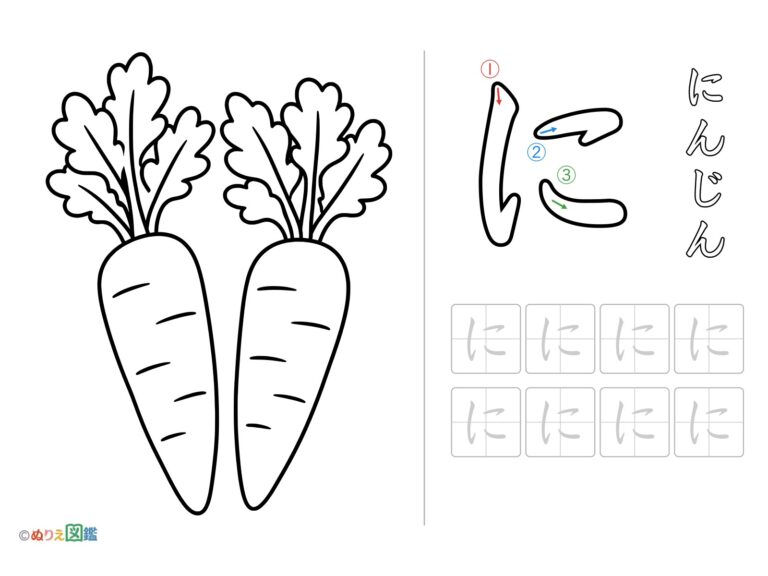
This coloring page is for the Hiragana "Ni"Hiragana "Ni"This is for practicing Hiragana "Ni".
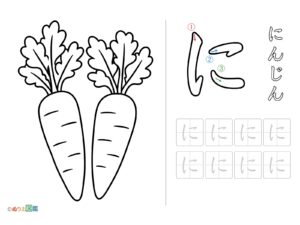
On the left is "CarrotThere are two "」", aren't there?
It has bushy leaves on top, and short horizontal stripes on its surface!
On the top right, there is a big outlined "に" and the word "にんじん", and on the bottom right, there are tracing boxes.
2 Coloring pages
The first sheet is a new coloring page that brings together a picture on the left, a big "に", and tracing practice all in one.
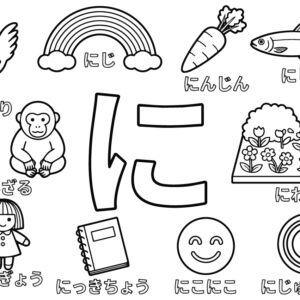
The second one is a coloring page with a big Hiragana "Ni" in the middle, surrounded by lots of pictures of things that start with Hiragana "Ni".
Rainbow,Carrot,Smiles,diaryand other names are written under the pictures, too.
There is also a carrot on the second page, so try comparing it with the carrot on the first page.
"Ni" came from the kanji "仁"
Hiragana were created by people a long time agoMade from simplified kanjiThis is a character created by combining others.
The kanji that Hiragana "Ni" came from is "Hiragana "Ni"" it is.
The character "仁" is written with the "person" radical and the number "two", isn't it?
It is said that the left part turned into a standing line, and the right "二" turned into two side-to-side lines, making the shape of Hiragana "Ni" today.
That is why the right side of Hiragana "Ni" looks just like the number "2"!
Writing tips
"Ni" is3 strokesThis is the character you write in Hiragana "Ni".
The first stroke is the vertical line on the left side. Bring your line down from top to bottom, and make a small hook toward the top right at the end.JumpNda.
The 2nd stroke is the short horizontal line on the top right, and the 3rd stroke is the horizontal line below it.
If you draw the 3rd stroke a little longer than the 2nd stroke, Hiragana "Ni" will look nice and sturdy.
The secret is not to leave too much space between the vertical line and the two lines on the right.
Words starting with Hiragana "Ni"
Words that start with "Ni" includeChicken,luggage,doll,Japanese macaque…and more!
Some words repeat the same sound, like "nikoniko."
"Ni" is "parkHiragana "Ni"It is also used when you show a destination, like "ikue" (go to)!
Try saying a place you want to go, like "I want to go to [place]".
The word "carrot"
"Carrots" grow under the groundRootIt is a vegetable where you eat the .
The orange part of the carrot that we eat is actually the root!
They are used in many different dishes, like curry, stew, salad, and kinpira.
The word "ninjin" has two "ni"s and two "n"s in it!
Say it out loud and read it with a nice rhythm!
How to Color Hiragana "Ni"
Color the big Hiragana "Ni" with 3 colors
Color the big outlined Hiragana "Ni" with any colors you like.
Hiragana "Ni" has 3 strokes. If you use a different color for each stroke, you can easily see the stroke order!
It is also nice to use orange and green to match the carrot.
Carrots are orange and green
Let's color the carrot root orange.
If you trace the edge with a slightly dark orange or reddish-brown, it will look nice and plump!
Color the leaves green or yellow-green.
If you make the base of the leaves a slightly darker green, your carrot will look fresh and lively.
For the second sheet, think about real colors
Try coloring the rainbow with 7 colors from the outside: red, orange, yellow, green, blue, indigo, and purple.
For the Japanese macaque, color the body brown or gray and the face light pink to make it look real!
The smiling face looks cute in yellow.
Tracing practice
In the bottom right boxes, there are 8 light gray Hiragana "Ni".
Hold your pencil the right way. Trace slowly so you do not go outside the gray lines.
The dotted lines going up, down, and across inside the boxes show the middle of the letter. Use the dotted lines to check where to start writing and where to stop.
After you write one, compare it with the big sample letter.
You do not have to write all 8 at once. Take your time and write carefully at your own pace, like doing 2 every day.
Fun Facts About Hiragana "Ni"
Carotene got its name from carrots
The orange color of carrots comes from tiny bits of color called carotene.
The English word for にんじん is carrot.
The name carotene came from the word carrot because it was first found inside a carrot.
You can eat the leaves too
Did you know you can eat carrot leaves too?
People fry them as tempura or chop them up to make tasty stir-fries.
Most stores cut the leaves off before selling carrots. But if you ever find one with leaves, take a close look at how they are shaped!
Carrots come in many colors
Most carrots are orange, but there are carrots in other colors too!
The Kintoki carrot, often used in New Year dishes, is a deep red color.
In other countries, you can even find purple, yellow, and white carrots!
Where are carrots grown?
The place in Japan that grows the most carrots is Hokkaido.
Chiba and Tokushima also grow a whole lot of carrots.
Check the bag with an adult at home to see where your carrots came from!
Share These Hiragana "Ni" Coloring Pages


More Hiragana Coloring Pages
-
Tracing practice for "Ni" (Carrot)
-
Words starting with "Ni"
-
-