Hiragana "Do" Coloring Pages


About Hiragana "Do"
"Do" as in "Donguri" (Acorn)
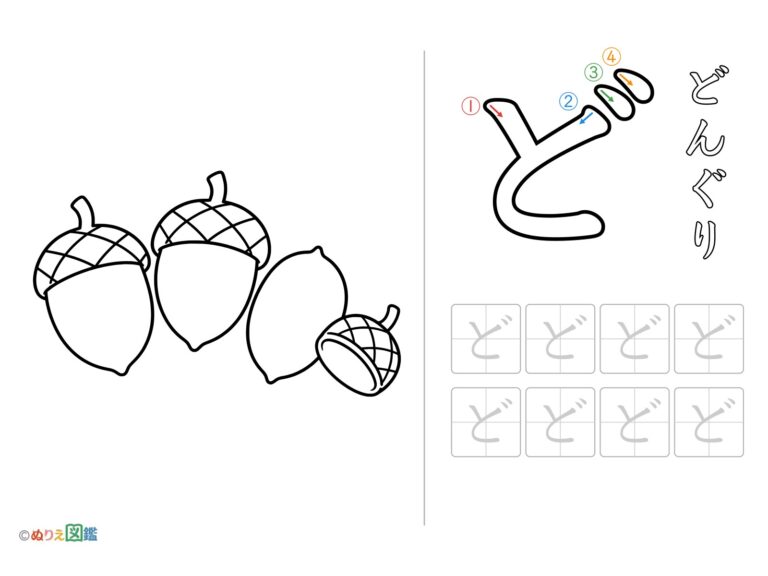
The letter on this coloring page is the Hiragana "Do".
The word is "donguri" (acorn). When autumn comes, you can find lots of these tree nuts dropped on the ground in parks and woods.
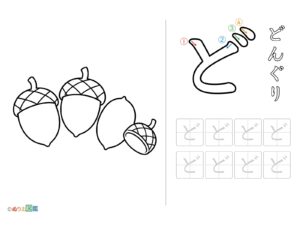
There are 3 acorns drawn in the picture on the left.
2 of them are wearing caps, and 1 lost its cap, which is lying right next to it.
"Donguri" is a general name for the nuts that come from trees like sawtooth oaks, konara oaks, and evergreen oaks.
Hiragana "Do" Was Born from "To"
Hiragana "Do" is the letter "To" with two dots (voiced sound marks) added.
The original letter "To" turned into its shape today as people simplified writing the kanji character "止".
When you add the dots, the clear sound of "To" changes into the buzzing sound of Hiragana "Do".
It is "donguri," not "tonguri." Try saying it out loud to check the difference!
Tips for Writing
You write "To" in 2 strokes.
For the 1st stroke, make a short line from top to bottom, slanting slightly down to the right, and stop.
For the 2nd stroke, start halfway down the 1st line. Bring your pencil down diagonally from top-right to bottom-left, curve round at the bottom, and stretch smoothly to the right.
If you make the bottom line stretching to the side a bit longer, it gives the letter a solid, steady shape.
Finally, write two dots at the top right. Draw them small in the open space to the right of the 1st stroke.
Words with Hiragana "Do"
Words that start with Hiragana "Do" include doubutsu (animal), doro (mud), doa (door), and doonatsu (donut).
There are also words with Hiragana "Do" at the end, like mado (window), kado (corner), and udo (herbal plant).
Hiragana "Do" also pops up a lot in words that express feelings or sounds, like doki-doki (thump-thump / excited) and don-don (boom-boom / fast).
When you go for an autumn walk to find acorns, try searching for words that use Hiragana "Do", too!
How to Use This Coloring Page
On this coloring page, you will find pictures of acorns on the left, a big Hiragana "Do" and the vertical word "donguri" on the top right, and tracing boxes lined up on the bottom right.
First, look at the picture and try saying "donguri" out loud.
Next, color in the big Hiragana "Do". Finally, trace the letters! By looking, saying, and writing, you can learn the letter in 3 fun ways.
It is also great to place this next to the "To" coloring page to compare whether it has the two dots or not.
How to Color Hiragana "Do"
Color the Big Hiragana "Do" in Autumn Colors
Try coloring the big Hiragana "Do" in brown or orange to match the acorns.
If you change colors for each stroke—like dark brown for the 1st stroke and orange for the 2nd stroke—it is easy to see the stroke order.
If you color the dots in yellow or yellow-green, they look cute like autumn leaves!
Acorns Are Shiny Brown
Color the acorn fruits in brown or dark brown.
If you leave a thin, long white line down the middle, it looks shiny and bright!
Making the pointed tip and the part near the cap a bit darker gives the acorn a round shape.
Young acorns are green, so it is fun to color just one acorn green, too!
Follow the Pattern on the Cap
Color the acorn cap in ocher or light brown.
If you add dark brown along the pattern lines here and there, it looks just like a bumpy cap!
Draw some fallen leaves by the acorn's feet and color them red and yellow to make an autumn scene!
Trace Freely Along the Bottom Line
Trace Hiragana "Do" in the bottom-right box using a pencil.
Make the 1st stroke short. For the 2nd stroke, curve roundedly and stretch smoothly to the right.
Look at the center line in the box. If you curve the 2nd stroke just below the middle, it will look great!
Write each one carefully!
Fun Facts About Hiragana "Do"
What the Cap Really Is
The cap of an acorn is a part called a cupule.
It wraps around the acorn and protects it when the acorn is still small.
Depending on the type of tree, some caps have scale-like patterns, some have stripes, and some look shaggy!
A Forgetful Animal Makes the Forest
In autumn, squirrels and birds called Eurasian jays gather acorns and hide them under the ground.
When winter comes, they eat the hidden acorns, but they forget about some of them.
Those forgotten acorns sprout in spring and can eventually grow into big trees!
Comparing Acorn Heights
There is a saying called "comparing acorn heights."
Acorns are all about the same size, so there is not much difference even if you compare them.
Because of that, people use this saying when things are all very similar and no one stands out.
Donguri Korokoro
There is a song featuring Hiragana "Do" called "Donguri Korokoro."
It is a song about an acorn that falls into a pond and a loach fish.
Try singing it while you color!
Share These Hiragana "Do" Coloring Pages


-
Tracing the Hiragana "Do" (Acorn)
-