Hiragana "ぞ" Coloring Pages


About Hiragana "ぞ"
"Zo" in "Zou"
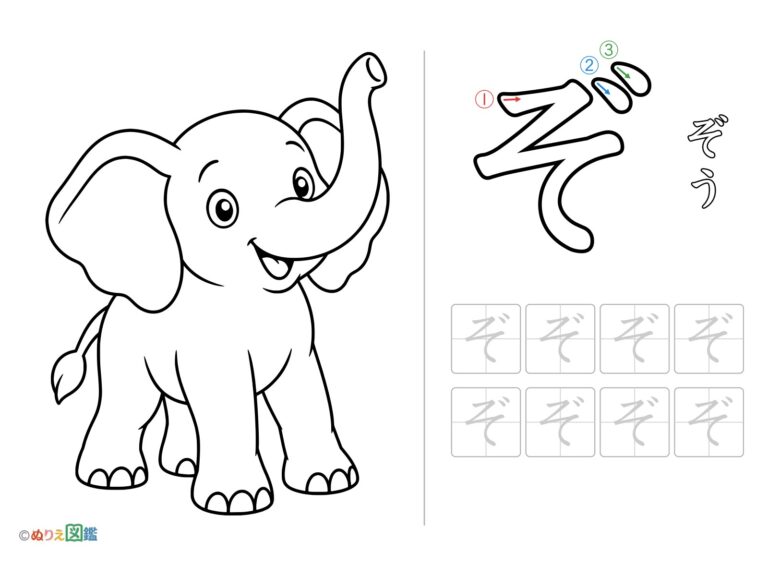
The letter on this coloring page is the Hiragana "ぞ".
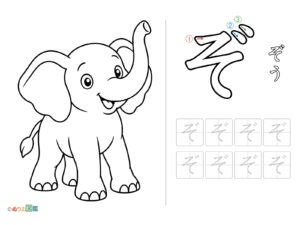
The word is "zou" (elephant). The picture on the left shows a cute baby elephant standing on all four legs, lifting its long trunk high in the air.
Elephants are the biggest animals that live on land.
A long trunk, big ears, thick legs, and white tusks are an elephant's main features.
Hiragana "ぞ" Comes From "そ"
Hiragana "ぞ" is the letter "そ" with two dots (dakuten) added.
The original "そ" came from the kanji "曽", which changed into today's shape as people wrote it more loosely.
When you add two dots, the clear "so" sound changes to the buzzy "zo" sound.
If you say "sou" and "zou" out loud, you can really tell the difference!
How to Write It
The "そ" you learn at school is written in 1 stroke.
At the top, make a small zigzag to the right and down to the left. Then make a long line to the right in the middle, curve back, and make a rounded turn to the right at the bottom.
It is tricky to write it all in one go without stopping!
If you make the side-to-side line in the middle the longest part, your letter will look neat.
At the end, write two dots at the top right. Put them small in the empty space on the right side of the top zigzag.
Words with Hiragana "ぞ"
Words starting with Hiragana "ぞ" include zoukin (dustcloth), zouri (sandals), zorozoro (in a crowd), and zokuzoku (thrilling).
Some words have Hiragana "ぞ" in the middle or at the end, like nazonazo (riddle) and mizo (ditch).
How about playing "Zou" Shiritori, where you look for words that start with "zou"?
It is fun because lots of "zou" words like "zoukin" and "zouri" come out!
How to Enjoy This Coloring Page
This coloring page has a picture of a baby elephant on the left. On the top right, you will see a big Hiragana "ぞ" and the word "zou" written vertically. On the bottom right, there are tracing boxes.
The elephant looks so happy raising its trunk up high!
It is fun to color while making elephant sounds like "Paoooh!"
A baby elephant still has small tusks, and its ears and trunk are smaller than a big elephant's.
Put this next to the "そ" coloring page and compare whether it has two dots or not!
How to Color Hiragana "ぞ"
Color the Big Hiragana "ぞ" Like an Elephant
Try coloring the big Hiragana "ぞ" in gray or light blue, just like an elephant's body!
If you change the color to a darker shade little by little from top to bottom, you can really see how the stroke flows in one line.
If you color the dots pink or yellow, they will look cute and stand out!
Color the Elephant in Soft Gray
Coloring the elephant's body in gray makes it look like a real one!
Hold your colored pencil gently and color lightly first. Then, add a little darker layer under the belly and where the legs meet the body to make it look nice and round.
If you color the inside of the ears light pink, it will look cute like a baby elephant!
Leave the tusks white.
It is also wonderful to color it light blue or light purple to make it look like an elephant from a picture book!
Tracing Hiragana "ぞ": Don't Stop in the Middle
Trace Hiragana "ぞ" in the bottom-right box with a pencil.
It is a one-stroke character, so try not to lift your pencil from the paper at the zig-zags.
Look at the center lines of the box. If you place the line that stretches across the middle a little bit above the center, the shape will look great!
It is okay to go slow, so write each one carefully.
Draw a Savanna or Water Hole Around It
Try adding a grassy field or a puddle by the elephant's feet!
Use yellow-green or ocher for the grass, and light blue for the water. It will look like the elephant came to splash around!
It is also fun to draw splashes of water coming out of its trunk!
Fun Facts About Hiragana "ぞ"
An elephant's trunk has no bones
An elephant's long trunk has no bones at all.
It is made of lots of muscles, so they can move it freely just like a hand.
They use their trunk to grab grass and carry it to their mouth, suck up water to drink, or spray water on their body.
Babies stay in the tummy for almost 2 years
Baby Hiragana "ぞ" stay in their mommy's tummy for almost 2 years.
When they are born, they already weigh about 100 kilograms!
Baby Hiragana "ぞ" drink their mommy's milk with their mouth, not their trunk.
Asian elephants and African elephants
There are two main types of Hiragana "ぞ": Asian elephants and African elephants.
African elephants have bigger bodies and very big ears.
They flap their big ears to help their bodies stay cool.
The bottom of an elephant's foot
On the bottom of an elephant's foot, there is a soft part like a cushion.
Thanks to this, they can walk without making much noise, even with their big bodies.
Hiragana "ぞ" are very heavy, but they are great at walking quietly.
Take a close look at how Hiragana "ぞ" walk when you visit the zoo!
Share These Hiragana "ぞ" Coloring Pages


-
Tracing "ぞ" (Elephant)
-