Hiragana "Mi" Coloring Pages

About Hiragana "Mi"
How Hiragana "Mi" Sounds and Feels
Hiragana "Mi" combines the "m" sound made with your lips and the vowel sound "i". You pull your mouth to the side and let the sound go through your nose. It sounds cool, smart, and fresh! In Japanese grammar, you can put it at the end of words to show how something feels, like "deepness" or "weight". Hiragana "Mi" plays a big role in making Japanese fun and rich to use.
How the Character Was Made: From Kanji "美"
Hiragana characters came from Kanji written in a very loose, flowing way. Hiragana "Mi" comes from the Kanji "美", which means beautiful.
-
First stroke: The top and middle of the Kanji joined together. It turned into a big curved line that goes from the left, loops down, and shoots out to the right.
-
Second stroke: The bottom part of the Kanji became a simple, short straight line that cuts down through the first stroke.
Now you can see how Hiragana "Mi" has a smooth strength. It truly shows the beauty of its name!
A Fun World of Words Starting with Hiragana "Mi"
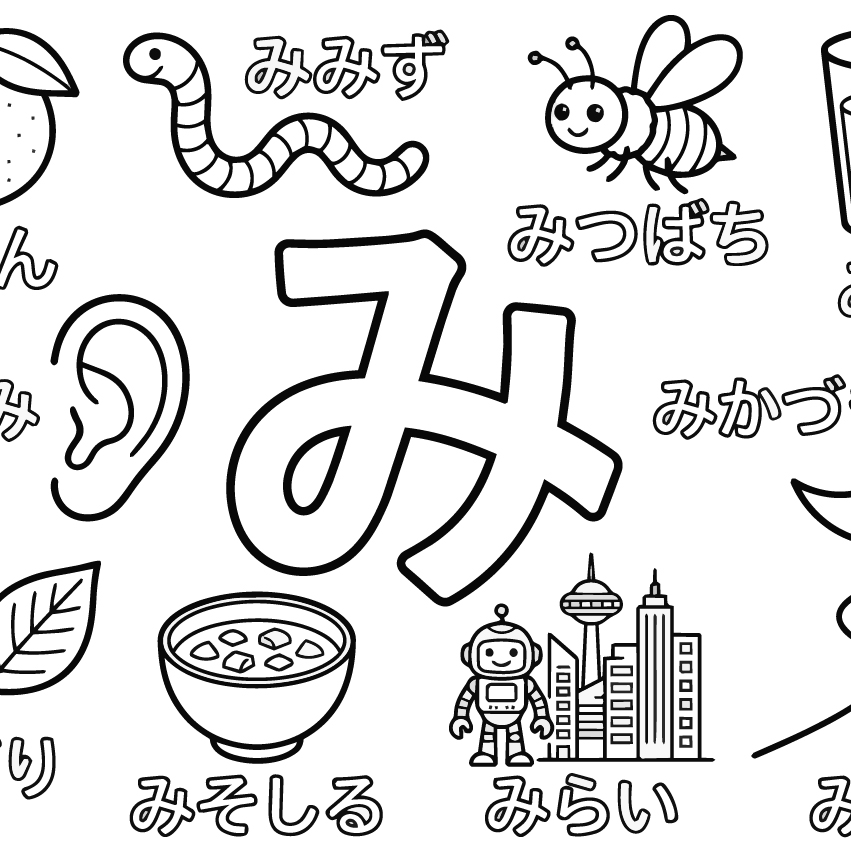
Our learning coloring pages have lots of great words starting with Hiragana "Mi". You can find things from daily life, nature, and even cool future worlds!
| Category | Things in the Picture |
| Nature & Food | Mikan (mandarin orange), Mizu (water), Misoshiru (miso soup) |
| Living Things | Mitsubachi (honeybee), Mimizu (earthworm) |
| Body & Space | Mimi (ear), Michi (road) |
| Sky & Light | Mikazuki (crescent moon) |
| Colors & Tools | Midori (green crayon) |
| Time & Science | Mirai (future city and robot) |
Looking at these pictures helps you connect shapes with their meanings. It is a great way to learn new words while having fun!
How to Color Hiragana "Mi"
Coloring the Shapes and Rhythm of the Character
When you color the big Hiragana "Mi" in the center, try to show off its cool crosses and curves!
-
Compare the Two Strokes: Use a bright color for the big curve of the first stroke. Then use a darker color for the straight line of the second stroke. This makes it easy to see how Hiragana "Mi" is built!
-
Show the Stroke Flow: Start from where your pencil begins and smoothly shift the color toward the loop. Blending colors like this makes Hiragana "Mi" look like it is moving!
-
Fun Design Ideas: Inside the thick outline of Hiragana "Mi", you can draw orange polka dots like a mandarin orange! Or color it with shiny metallic silver to make it feel like the future.
Cool Coloring Tips to Bring Pictures to Life
Here are some fun tips to make all the fun drawings look extra cool!
-
Textures and Shine: Color the mandarin orange bright orange. Add little dots of darker orange to show its bumpy skin! For water in a glass, color the edges light blue and leave the center white to make it look clear.
-
Cute Creatures: Give the honeybee bold yellow and black stripes. Color its wings light blue or purple to make it super cute! Use light pink or brown for the earthworm, and color its body segments carefully.
-
Light and Shadows: Color the inside of the crescent moon bright yellow and the outside a darker orange. This makes it glow in the night sky! For a robot or city from the future, use bright neon colors as cool accents.
-
Everyday Scenes: For miso soup, make sure the colors of the bowl and the soup stand out from each other. Color the tofu and seaweed neatly! For the road, use colors that show it getting narrower into the distance.
Finishing Your Whole Page
When your coloring page has lots of pictures, a fun background makes the main stars pop!
-
Green color: You can draw leaves or a forest next to the green crayon using that same color!
-
Gently color the empty background with soft sky blue or lemon yellow. This helps Hiragana "Mi" and all the pictures blend together nicely into a wonderful work of art!
Fun Facts About Hiragana "Mi"
It Came from the Kanji "美"
The Hiragana "Mi" comes from the Kanji "美" (mi / utsukushii), which means pretty or beautiful! People say that as people wrote the many straight lines of the Kanji quickly, the lines joined together and turned into the shape of Hiragana "Mi" we use today.
Does It Look Like the Number "2"?
The start of the character looks a bit like the number "2", doesn't it? But unlike the number "2", you finish the first part with a little loop, and then add a nice diagonal stroke at the end.
Lift Your Pencil at the End
Hiragana "Mi" is made of 2 strokes. Once you draw the loop, lift your pencil! The main tip is to start the very last stroke from a "separate spot". Try writing it with a nice rhythm!
What Words Have "Mi" in Them?
Sweet and yummy "mikan" (mandarin orange), "mimi" (ears) for listening to sounds, and cold "mizu" (water) are all around us! The word "michi" (road), which leads to new places, starts with Hiragana "Mi" too.
Share These Hiragana "Mi" Coloring Pages


-
Hiragana "Mi"
-