Hiragana "Pi" Coloring Pages


About Hiragana "Pi"
"Pi" in "Piiman"
The letter on this coloring page is the Hiragana "Pi".
The word is "piiman" (bell pepper). It is a green summer vegetable that tastes a little bitter.
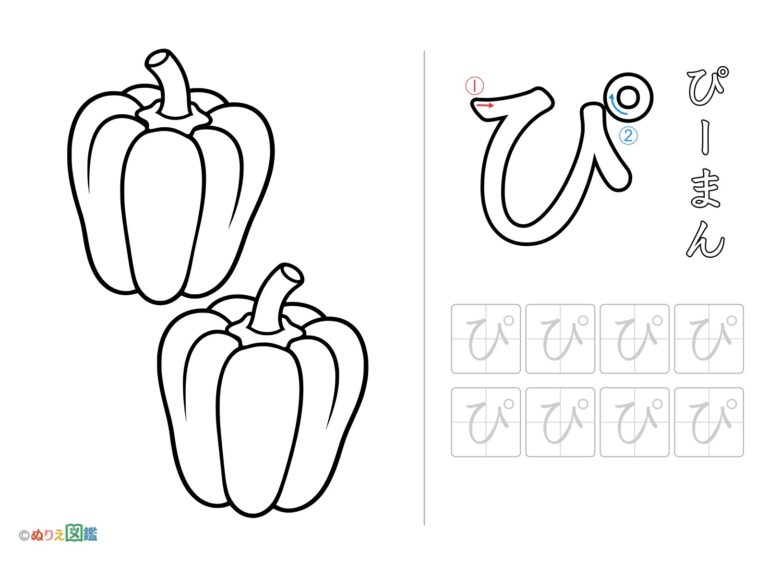
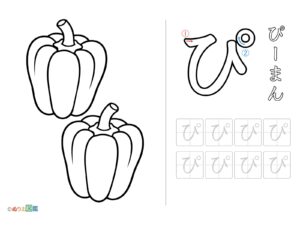
The picture on the left shows two bell peppers.
On top, there is a cap and a short stem, and there are bumpy grooves going down the side.
The inside of a bell pepper is almost empty, with white pith and little seeds.
Letters with a "Little Circle"
Hiragana "Pi" is made by adding a small circle (handakuten) to the top right of "hi".
The original "hi" got its current shape long ago when people wrote the Kanji "比" in a quick, flowing way.
If you add two dots to "hi", it becomes "bi". If you add a circle, it becomes Hiragana "Pi".
Only 5 letters get a little circle: ha, hi, fu, he, and ho.
A long, long time ago, people think that the "ha" group of letters sounded closer to today's "pa" sound!
Tips for Writing
You write "hi" with just 1 stroke.
Start at the top left, go a little to the right, then slide down to the left, and make a big, round curve at the bottom.
Keep going up to the top right, and finally make a little stroke down to the bottom right.
If you make the bottom curve big and relaxed, your letter will look nice and neat!
At the end, draw a small circle on the top right. Leave a little space so it does not touch the letter.
Words with Hiragana "Pi"
Words that start with Hiragana "Pi" include piano (piano), pinku (pink), pikapika (shiny), and piyopiyo (chirping).
Many words starting with Hiragana "Pi" come from other countries, or describe sounds and feelings.
Hiragana "Pi" can also be in the middle of a word, like in enpitsu (pencil) or ippiki (one small animal).
The "ー" in "piiman" is a long vowel bar that stretches out the sound before it. You read it as "pii".
How to Use This Coloring Page
On this coloring page, you will find a picture of bell peppers on the left. On the top right, there is a big Hiragana "Pi" and the word "piiman" written downwards. On the bottom right, there are tracing boxes in a row.
First, look at the picture and say "piiman" out loud.
Next, color in the big Hiragana "Pi". Finally, trace the letters. This way, you can learn the letter in 3 ways: seeing, saying, and writing!
It is also fun to put this next to the "hi" coloring page to compare if it has a circle or not.
How to Color Hiragana "Pi"
The big Hiragana "Pi" has a green gradient
The big Hiragana "Pi" is made with just 1 stroke. Let's color it to match the bell pepper, changing the color bit by bit from yellow-green to dark green.
It looks so pretty when the color changes along your stroke!
If you make the small circle red or yellow, it looks cute, just like a red bell pepper or a yellow paprika!
The bell pepper is shiny green
Color the bell pepper in dark green.
If you make the grooves a little darker and the bumpy parts a little lighter, the fun shape will pop out!
If you leave a thin white line going down on the bumpy parts, it will look shiny.
Color the stem and top in yellow-green or light brown.
Red and yellow are great too
If a bell pepper grows big in the field, it can turn red.
It is fun to color the 2 peppers in green and red to compare them!
You can even draw a plate or a cutting board to make a kitchen picture.
Trace slowly around the curved part
Trace Hiragana "Pi" in the bottom right box with a pencil.
It is a 1-stroke letter, so write it in one go without lifting your pencil!
Use the middle line of the box as a guide. Make the rounded part swell below the line to get a nice shape.
Draw the small circle at the end carefully, too.
Once you write 8 of them, show your best Hiragana "Pi" to your family!
Fun Facts About Hiragana "Pi"
Bell peppers are in the same family as chili peppers
Bell peppers are vegetables in the same family as spicy chili peppers.
But bell peppers were grown so they wouldn't be spicy.
It is said that the Japanese word "piman" came from a French word that means chili pepper.
Green bell peppers are still young
The green bell peppers you often see at the store are actually young peppers before they get fully ripe.
If you keep growing them, they turn red and ripe! They become less bitter and taste sweeter.
Have you ever seen a red bell pepper at the store?
The white spongy part and seeds
People usually take out the white spongy part and seeds inside the bell pepper before cooking.
But you can actually eat the spongy part and seeds too!
There are dishes where you grill or simmer the whole pepper.
It's okay if you don't like them
Some children don't like the bitter taste of bell peppers.
If you slice them thin and stir-fry them in oil, or cook them with meat, the bitterness won't bother you as much.
Stuffed bell peppers with meat is a very popular dish.
Try taking just one little bite!
Share These Hiragana "Pi" Coloring Pages


-
Tracing "ぴ" (Bell Pepper)
-