Hiragana "To" Coloring Pages
 ~

About Hiragana "To"
"To" for "Tokei" (Clock)
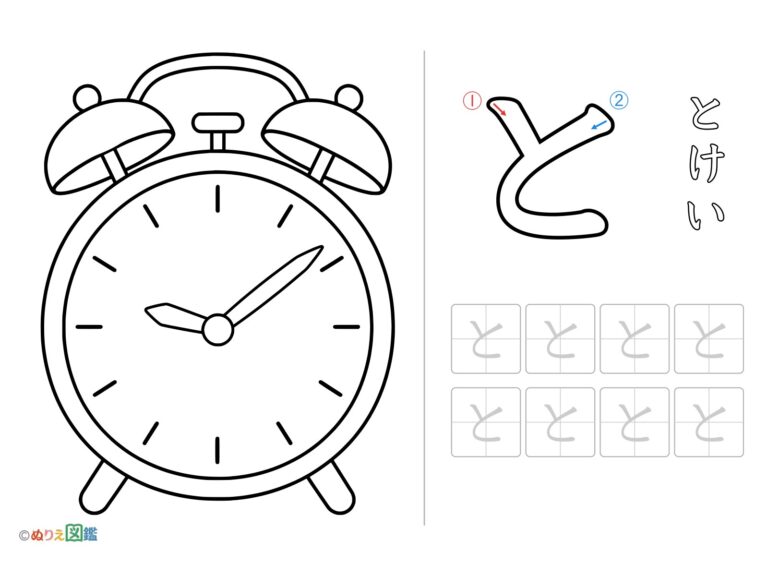
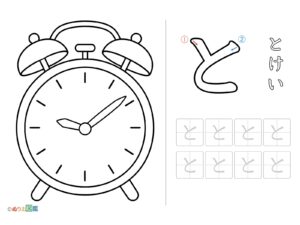
This coloring page is for practicing the hiragana "To".
On the left, there is a round alarm clock. It has two bells on top and two feet on the bottom.
The clock face has no numbers, just tick marks and a long hand and short hand.
On the top right, there is a big outlined Hiragana "To", and on the bottom right, there are boxes for tracing.
2 Coloring pages
The 1st page is a coloring page with a picture of an alarm clock, a big "To", and tracing practice.
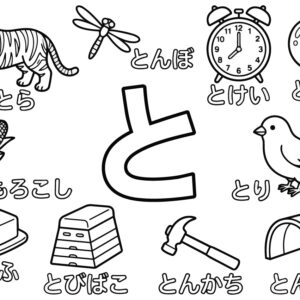
The 2nd page is a coloring page with a big "To" surrounded by pictures of words that start with "To".
You will find a tiger, a dragonfly, a bird, a vaulting box, and a hammer!
There is also a clock on the 2nd page, so try comparing it with the 1st page.
Hiragana "To" Was Born from "止"
Hiragana are letters that people long ago created by simplifying Kanji.
The Kanji that became Hiragana "To" is "止", which is read as "tomaru".
It is said that as people wrote "止" quickly over and over, it lost some lines and became the shape of Hiragana "To" we use today.
Tips for writing Hiragana "To"
Hiragana "To" is a character you write in 2 strokes.
The 1st stroke is a short slanted line going from top to bottom right.
The 2nd stroke starts near the top right of the 1st stroke, goes down to the left while making a round curve, and smoothly stretches out to the right.
If you stretch the bottom part of the 2nd stroke a bit long to the side, you will get a nice, stable Hiragana "To".
The trick is to make the 2nd stroke much longer and bigger than the 1st stroke.
Words starting with "と"
Words that start with "to" include tomato, tofu (bean curd), tomodachi (friend), and toumorokoshi (corn).
If you add two small dots (voiced sound mark) to "to", it becomes "do". Like the "do" in "donguri" (acorn)!
You also use "to" to connect things, like "pan to gyunyu" (bread and milk).
Try saying your favorite things together using "__ to __"!
The word "To-ke-i" (Clock)
"Tokei" means a clock or a watch that tells you the time.
There are many kinds of clocks, like wall clocks, wristwatches, and alarm clocks that wake you up in the morning.
The clock in this coloring page is an old-fashioned alarm clock with bells that ring out loud!
How many clocks do you have at home? What kind are they?
As you look for clocks, try to remember Hiragana "To" too!
How to Color Hiragana "To"
Color the big Hiragana "To" with two colors
Color the big outlined Hiragana "To" in any color you like.
If you change the color for the 1st stroke and the 2nd stroke, you can easily see that Hiragana "To" is made of 2 strokes.
We recommend choosing clearly different colors, like red for the 1st stroke and blue for the 2nd stroke.
Color the alarm clock in bright colors
Color the frame and bells around the clock in bold colors like red, blue, or yellow.
If you leave the clock face white, you can see the hands clearly.
It is also fun to color the long hand and the short hand in different colors.
Coloring the feet the same color as the frame, or in gray, makes it look nice and neat.
For the 2nd page, think of real object colors
The tiger on the 2nd page is yellow or orange with black stripes.
For the dragonfly, you can color it red to make a red dragonfly, or color it blue to make a skimmer dragonfly.
For the vaulting box, if you make the top white and the layers brown, it will look just like a real vaulting box in your school gym.
Tracing practice
In the bottom right box, there are 8 light gray Hiragana "To" lined up.
Hold your pencil correctly and trace them slowly so you stay inside the gray lines.
The dotted vertical and horizontal lines inside the box show the center of the letter. Use these dotted lines as a guide to check where to start writing and where to stop.
After you write 1 letter, compare it with the big sample letter.
You do not have to write all 8 at once. Try writing carefully at your own pace, like 2 letters a day.
Fun Facts About Hiragana "To"
Why Clock Hands Turn Right
The hands on a clock move from the top to the right, turning clockwise.
Long ago, clocks were sundials that measured time using the shadow made by sunlight.
In countries in the northern part of the Earth, like Japan, a sundial's shadow moves clockwise. That is why people made clock hands turn in the same direction.
June 10th is "Time Commemoration Day"
June 10th is Time Commemoration Day.
Long ago, an emperor named Emperor Tenji measured and announced the time for the first time in Japan using a water clock.
It is a day to remember to value our time.
The Long Hand and the Short Hand
The short hand on a clock shows the "hour," and the long hand shows the "minute."
The long hand goes around once in 1 hour, and the short hand goes around twice in 1 day.
Try to guess what time the hands on the first clock are showing!
Alarm Clock Bells
Old alarm clocks work by having a small hammer quickly hit back and forth between two bells.
That is why they make a loud ringing sound!
Today, many clocks use electronic beeps or music to wake you up instead.
Share These Hiragana "To" Coloring Pages


More Hiragana Coloring Pages
-
Tracing the letter "To" (Clock)
-
Words That Start With "To"
-
-