Hiragana "no" Coloring Pages
 ~

About Hiragana "no"
"No" in "nokogiri" (saw) - Hiragana "no"
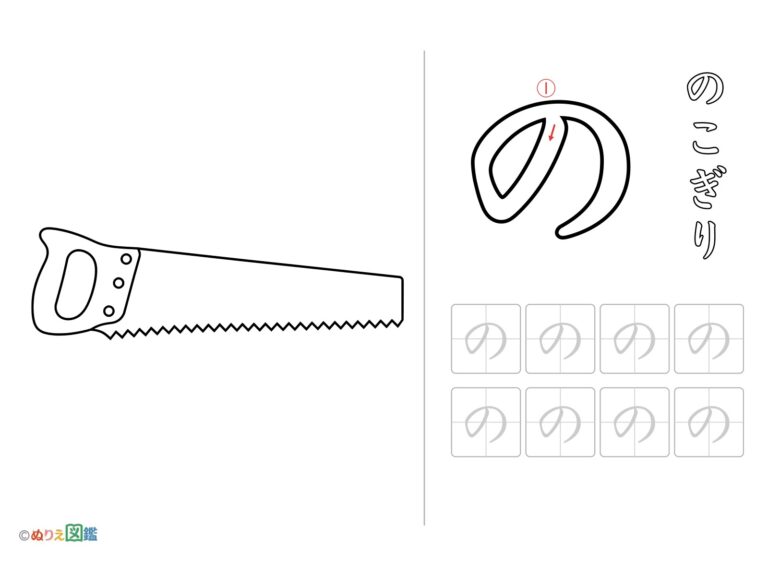
This coloring page is for the Hiragana "no"Hiragana "no"This is for practicing Hiragana "no".
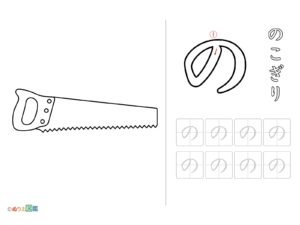
On the left, you can see a carpenter's "Saw" is drawn pointing sideways.
A wooden handle and a jaggedBladehas a mark on it!
In the top right, you will find a big "の" with an outline and the word "のこぎり". In the bottom right, there are boxes for you to trace Hiragana "no".
2 Coloring pages
The 1st sheet is a new coloring page that combines the picture on the left, a big "Hiragana "no"", and tracing practice all together!
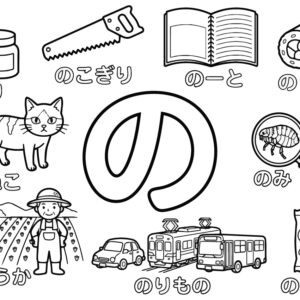
The second one is a coloring page with a big Hiragana "no" in the middle, surrounded by lots of pictures of words that start with Hiragana "no".
Saw,notebook,Hiragana "no",VehiclesThe names are written under the pictures, too!
There is a saw on the second page too, so try comparing it with the first page!VehiclesThe Hiragana "no" coloring page shows a car, a train, and a bus all lined up!
Hiragana "no" came from "乃"
Hiragana "no" was made by people long agoSimplify the kanjiIt is a made-up character.
The Kanji that Hiragana "no" came from is "Hiragana "no"" Hiragana "no"".
People say that as the character "乃" was written continuously in a single smooth loop with a brush, it gradually became the shape of Hiragana "no" we use today.
Both "乃" and Hiragana "no" have a nice round loop, so they look a lot alike, don't they?
Tips for writing Hiragana "no"
"no" is1 strokeIt's a character you write in .
Start writing near the middle of the box, and first bring your line down diagonally to the bottom left.
From there, go around the left side, curve up, make a big loop around the right side, and finish at the bottom right.
Try to draw it so the whole shape is a round circle that is a little tall.
If you start the slanted line a little to the left of the center, your Hiragana "no" will look beautiful!
Words that start with "の"
Words that start with Hiragana "no" includeNori,field,drinks,farmerand more!
"No" is the Hiragana "no" from "watashi" (me)Hiragana "no"It is also used a lot when connecting words, like in "Hiragana "no" hat."
It is also fun to count how many Hiragana "no" you can find in the books around you!
I'm sure you will find a lot of them!
The word "Nokogiri"
"Saw" is a tool used for cutting things like wood.
Push and pull the blade to cut little by little.
The jagged edge is because each sharp tooth shaves away a little bit of wood as it goes.
Saws have sharp blades, so always use them together with an adult.
How to Color Hiragana "no"
For the big "no", change colors as you go around
Color the big outlined Hiragana "no" with any colors you like.
If you change the color little by little from where you start writing and follow the loop, it will look like a rainbow Hiragana "no".
Trace it with your finger to check where to start writing before you start coloring.
The saw uses wood and metal colors
Try coloring the handle with wooden colors like light brown or ochre.
If you make the blade gray or silver, it will look just like real metal.
If you make the top of the blade a bit lighter and the jagged teeth a bit darker, it will look 3D.
Adding brown wood grain lines to the handle is a great idea, too!
For the second page, remember the colors of real things
Color the cover of the notebook with your favorite color, and leave the pages inside white.
For the vehicles, color the car, train, and bus with different colors to make it look lively.
For the cat and the farmer, think about the colors of their clothes and fur while you color.
Tracing practice
In the boxes on the bottom right, there are 8 light gray Hiragana "no".
Hold your pencil the right way and trace them slowly so you do not go outside the gray lines.
The vertical and horizontal dotted lines in the boxes show the middle of the character. Use the dotted lines to see where to start writing and where to stop.
After writing one, compare it with the big example character.
You do not have to write all 8 at once. Try writing carefully at your own pace, like doing 2 each day.
Fun Facts About Hiragana "no"
Japanese Saws Cut on the Pull
Japanese saws are made to cut when you pull them toward you.
In many other countries, saws cut when you push them forward.
It is fun to see how the same tool can be used differently in other places!
The Double-Edged Saw with Two Blades
In Japan, there is a double-edged saw with blades on both the top and bottom sides.
One side is for cutting along the wood grain, and the other side is for cutting across the grain.
You switch the blade you use depending on which way you want to cut.
Animals Named After Saws
Animals with jagged edges that look like blades are sometimes named after saws.
For example, there is the sawshark, which has teeth lined up on both sides of its long snout.
There is also the sawtooth stag beetle with jagged jaws.
Making Music with a Saw
A saw can also be used as a musical instrument!
When you bend the blade and rub it with a violin bow, it makes a cool, high sound.
It is called a "musical saw," and it makes a beautiful, floating sound.
Share These Hiragana "no" Coloring Pages


-
Tracing the letter "No" (Saw)
-
Words Starting with "No"
-