Hiragana "Gi" Coloring Pages


About Hiragana "Gi"
"Gi" in "Gyoza" (Hiragana "Gi")
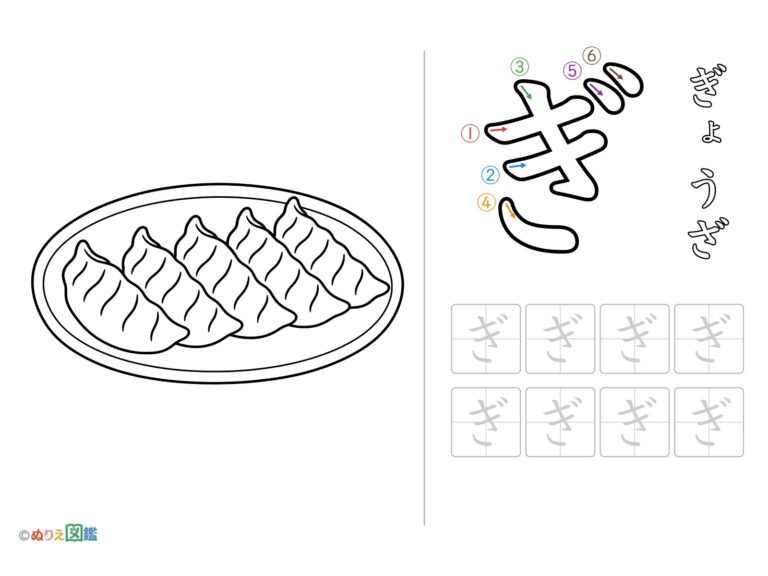
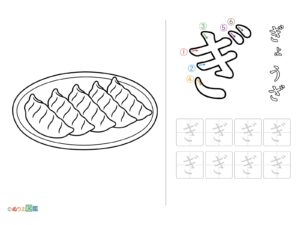
The character on this coloring page is the Hiragana "Gi".
The word is "gyoza". The left picture on the first page shows 5 fried gyoza on a round plate.
Each one has pleats, and they are lined up overlapping a little bit.
Have you ever eaten gyoza at home or at a restaurant?
The Hiragana "Gi" comes from "Ki"
"Gi" is the letter "ki" with ten-ten (voiced sound marks) added.
Long ago, people wrote the kanji character "幾" in a cursive way, and over time it became the "ki" we use today.
When you add ten-ten, the clear sound of "ki" changes to the voiced sound of "gi".
Put your hand on your throat and say "ki" and "gi" out loud to compare them. Do you feel your throat vibrate when you say "gi"?
Tips for writing Hiragana "Gi"
The original "き" is written in 4 strokes.
For strokes 1 and 2, write 2 horizontal lines that go slightly up to the right. It is good to make the bottom line a little longer.
For stroke 3, go from the top, through the 2 horizontal lines, and down to the bottom right at a slant.
For stroke 4, leave a little space, and write from left to right as if making a curve.
Finally, let's draw 2 small dots on the top right, first left, then right.
"Gi" with a small "yo" makes "gyo"
To read "Gyōza," you put "Gi" and a small "Yo" together to make one sound: "Gyo."
Sounds made with a small "Ya," "Yu," or "Yo" like this are called Youon.
The rule is to write the small "Yo" in the bottom left of the box.
Try not to read it as "Gi-yo-u-za," but read it smoothly as "Gyo-u-za."
The second page is full of words that start with Hiragana "Gi"
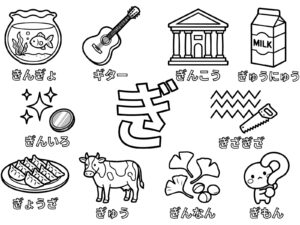
The second coloring page has a big "ぎ" in the middle, surrounded by pictures of words that have "ぎ" in them.
You can see a ぎんこう (bank) where you keep your money, a carton of ぎゅうにゅう (milk), a ぎんなん (ginkgo nut) from a ginkgo tree, and a question mark for ぎもん (question).
On the bottom left, there is also ぎょうざ (gyoza), just like on the first page.
Try looking for words with a little "ゅ" in them too, like "ぎゅう" or "ぎゅうにゅう".
How to enjoy these 2 coloring pages
The first page is a coloring page where you can color a gyoza and a big "ぎ", and practice writing "ぎ" by tracing it.
The second page is a coloring page you can take your time to color while finding different words that have Hiragana "Gi" in them.
Some words have Hiragana "Gi" right in the middle, like "kingyo" (goldfish)!
How to Color Hiragana "Gi"
Color the Big "Gi" Your Favorite Color
Try coloring inside the lines of the big Hiragana "Gi" on the top right with your favorite colors.
It has 4 strokes, so if you change colors for each stroke, you will get a colorful Hiragana "Gi".
If you make the dots a different color to stand out, it is easy to see how it is different from "Ki".
Color the Gyoza Golden-Brown
Color the gyoza skin with cream color or light yellow.
If you make the bottom part touching the plate a golden-brown or ocher, it will look like real fried gyoza.
If you add a slightly darker color along the fold lines, the folds will show up clearly.
You can leave the plate white, or add blue or red patterns to the rim.
On the Second Page, Color Shiny Things Carefully
On the second page, if you color the silver coin with gray and leave white streaks, it will look shiny.
If you color the ginkgo leaves yellow and the nuts cream color, it will feel like autumn.
For the cow, draw black or brown patterns on the white parts.
Trace Carefully One by One
In the boxes on the bottom right, there are 8 light gray Hiragana "Gi".
Hold your pencil the right way, and trace slowly over the gray lines without going outside.
Use the lines in the middle of the box as guides to make your character look well-balanced.
If you start the 4th stroke away from the 3rd stroke, it will look super neat.
Every time you write one, compare it with the big Hiragana "Gi" model.
Fun Facts About Hiragana "Gi"
Gyoza Came From China
Gyoza is a food that came to Japan from China.
In China, boiled gyoza is eaten a lot.
In Japan, pan-fried gyoza cooked in a frying pan is super popular!
Gyoza Towns
There are towns in Japan known for eating lots of gyoza.
Utsunomiya City in Tochigi Prefecture and Hamamatsu City in Shizuoka Prefecture are famous as "Gyoza Towns."
There are so many gyoza shops in each town!
The Secret of the Pleats
The pleats on a gyoza are made by folding the edge of the wrapper bit by bit to seal it tight.
Making pleats keeps the filling inside from spilling out.
It is fun to wrap gyoza together with someone in your family!
Ginko Nuts Come From Ginkgo Trees
The ginkgo nuts on the second page are the seeds inside the fruit that grows on ginkgo trees in autumn.
The outside of the fruit smells very stinky.
It can give you a rash if you touch it, so wear gloves when you pick them up!
People eat ginkgo nuts roasted with salt, or put them in savory egg custard.
Share These Hiragana "Gi" Coloring Pages


More Hiragana Coloring Pages
-
Tracing "Gi" (Gyoza)
-
Words starting with "Gi"
-
-