Hiragana "Myo" Coloring Pages


About Hiragana "Myo"
"Myo" as in "Myoga"
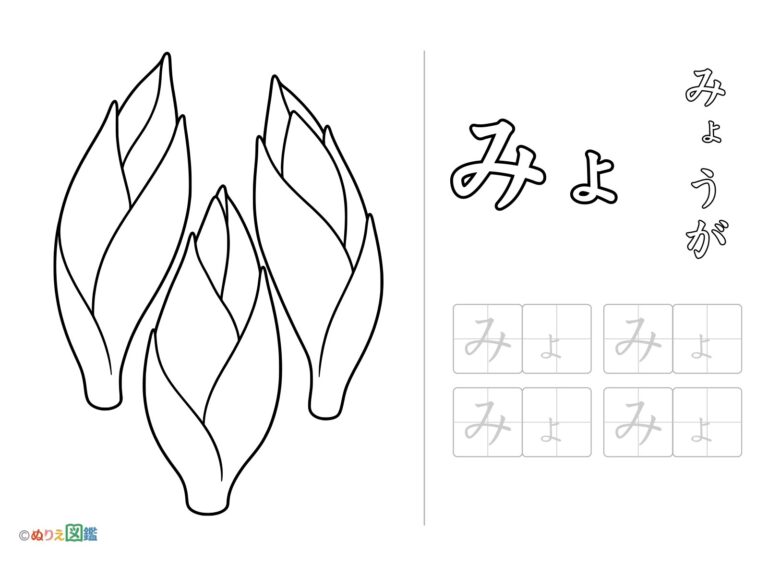
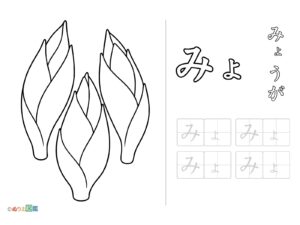
The character on this coloring page is the Hiragana "Myo".
The word is "myoga" (Japanese ginger). In the picture on the left, three plump myoga are drawn.
Myoga is a Japanese vegetable that gets tasty from summer to autumn.
It has many thin layers of skin and has a fresh, slightly spicy scent.
People eat it on top of somen noodles or cold tofu, or put it in miso soup.
Two characters for one sound
To write "Myo", you combine two letters: "Mi" and a small "Yo".
Even though you write two letters, you say them together as one sound, instead of separating them into "Mi" and "Yo".
A sound like this is called a contracted sound.
If you write "Miyo" with a big "Yo", it becomes two sounds and can make a totally different word.
The sound changes depending on whether the letter is small or not!
How Hiragana "Myo" Came to Be
Hiragana are letters that were born long ago when people simplified Kanji characters.
"Mi" came from a simplified form of the Kanji 「美」.
The small "yo" is a tiny version of the regular "yo", and "yo" came from a simplified form of the Kanji 「与」.
Kanji from a long, long time ago changed over many years to become the easy shapes we use today!
Tips for writing Hiragana "Myo"
"み" is written in 2 strokes.
For the 1st stroke, start writing to the right, go down to the bottom left, make a small loop, and then stretch it out to the right.
For the 2nd stroke, let's write from the top right down toward the bottom left.
Small "ょ" has 2 strokes just like "よ". Write the short horizontal line for the 1st stroke, then bring down the vertical line for the 2nd stroke, and make a small loop at the bottom.
When writing horizontally, write it small in the bottom left of the box. When writing vertically, write it small in the top right.
Words that contain Hiragana "Myo"
Words that start with "myo" include "myoga" (Japanese ginger), as well as "myoji" (last name) and "myonichi" (a polite way to say tomorrow).
There is also a fun word, "myochikirin," which means strange or weird!
What is your family's "myoji"?
Ask someone in your family to teach you, and try saying it slowly.
How to Color Hiragana "Myo"
Color the Big "Myo" in Any Color You Like
Try coloring inside the lines of the big "Myo" in the top right with your favorite colors.
If you use different colors for "み" and "ょ", you can clearly see that it is made of two letters joined together.
It would also look lovely if you use pink for "み" and yellow-green for "ょ" to match the Japanese ginger!
Use Pink and Yellow-Green for the Japanese Ginger
Color the tips of the Japanese ginger skin in pink or red-purple.
If you use light yellow-green or cream color near the bottom, it will look just like real Japanese ginger!
Changing the color little by little from pink to yellow-green makes it look nice and plump.
Try adding a line of darker pink where the layers of skin overlap.
It is also fun to color the 3 Japanese gingers in slightly different shades, like dark pink and light pink.
Trace the Letters with a Pencil
In the boxes at the bottom right, there are 4 sets of light gray "Myo".
Hold your pencil the right way and trace over the gray lines slowly so you do not go outside the lines.
Using the vertical and horizontal center lines in the box as guides makes it easy to see the size and position of the letters.
Be careful to write the small "ょ" small in the bottom-left part of the box.
Every time you trace 1 set, try saying "Myo" out loud.
When you trace all 4 sets, try writing Hiragana "Myo" by yourself outside the boxes, too!
Fun Facts About Hiragana "Myo"
The part you eat is a flower bud
The part of Hiragana "Myo" you usually eat is actually a flower bud.
The buds pop up from the dirt, and people pick them to eat.
If you do not pick them, pale yellow flowers will bloom from the tips.
A vegetable that loves the shade
Hiragana "Myo" is a plant that prefers damp spots and shade, like under a tree, over strong sunlight.
Japan is almost the only country in the world where people grow and eat it as a vegetable.
In Japan, a lot of it is grown in Kochi Prefecture.
The legend about being forgetful
For a long time, there has been a legend that says, "If you eat Hiragana "Myo", you will become forgetful."
But this is just a story, and it will not really make you forget things.
So do not worry, and enjoy your summer Hiragana "Myo"!
Spring's "Myogatake"
In spring, if you grow Hiragana "Myo" sprouts away from sunlight, they become long and thin, called "Myogatake".
The base is pale pink, and it also has a lovely, fresh smell.
With buds in summer and sprouts in spring, you can enjoy tasty Hiragana "Myo" twice a year!
Share These Hiragana "Myo" Coloring Pages


-
Tracing "Myo" (Japanese Ginger)
-