Hiragana "ze" Coloring Pages


About Hiragana "ze"
"Ze" as in "Zenmai"
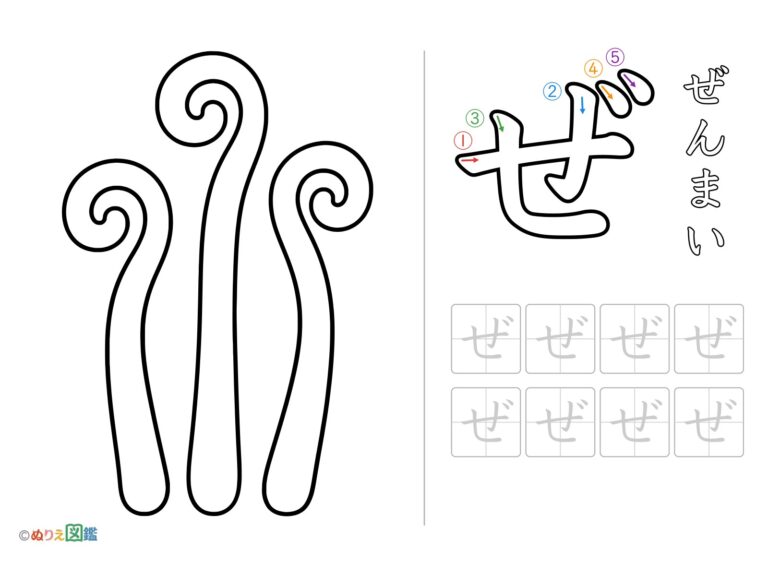
The letter on this coloring page is the Hiragana "ze".
The word is "zenmai" (flowering fern). It is a type of edible wild plant that grows in the mountains and fields in spring.
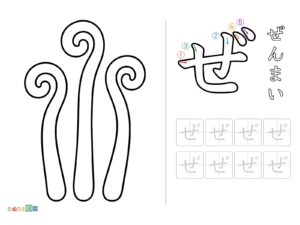
The picture on the left shows three flowering ferns.
You can tell it is a flowering fern because the tip of the stem curls around like a spiral.
The flowering fern is part of the fern family and does not grow flowers. As it grows bigger, the curled tip unrolls and the leaves open up.
Hiragana "ze" comes from "se"
Hiragana "ze" is made by adding two little dots (dakuten) to "se".
The original "se" became its current shape as people wrote the Kanji character "世" in a simple, cursive way.
If you look at the Kanji character "世" and "se" side by side, you might find some parts that look similar.
When you add the two dots, the clear "se" sound changes to the buzzy "ze" sound.
How to write it
You write Hiragana "ze" in 3 strokes.
The 1st stroke is a long horizontal line that goes up a little to the right.
The 2nd stroke goes straight down from the top right side of the horizontal line.
The 3rd stroke goes down from the left side of the horizontal line, curves gently at the bottom, stretches to the right, and stops.
Finally, write two small dots in the upper right. Make sure to write them small in the open space so they do not overlap with the 2nd stroke!
Words with Hiragana "ze"
Words that start with Hiragana "ze" include zenbu (all), zettai (definitely), zeri- (jelly), and zekken (number bib).
There are also words with Hiragana "ze" at the end, like kaze (wind or a cold), naze (why), and haze (goby fish).
"Kaze" can mean the wind that blows, or a cold that makes you sneeze and gives you a runny nose.
It is also fun to make sentences using words that have Hiragana "ze"!
How to look at the coloring page
On this coloring page, you will find a picture of flowering ferns on the left, a big Hiragana "ze" and the word "zenmai" written top-to-bottom on the top right, and boxes for tracing practice on the bottom right.
All three flowering ferns have curled tips.
Try tracing the spirals with your finger from the outside to the inside, round and round!
The word "zenmai" has "n" as well as Hiragana "ze". Try coloring the "n" coloring page too.
It is also fun to place it next to the "se" coloring page to compare the one with dots and the one without!
How to Color Hiragana "ze"
Color the Big Hiragana "ze" with 3 Colors
Try coloring each of the 3 strokes of the big Hiragana "ze" in a different color.
If you use colors from the same family—like light green for the 1st stroke, green for the 2nd stroke, and dark green for the 3rd stroke—it will match the fiddlehead fern picture nicely.
Color the dots brown or orange to make them pop out cute and small!
Color the Fiddlehead Fern with Green and Brown
Color the stem of the fiddlehead fern in light green or green.
When fiddlehead ferns just start to grow, they have brownish downy hair on their curled tips.
If you layer light brown on the spiral part, it will look like the real thing!
Going from the outside of the spiral toward the center with darker colors will make the curled shape stand out.
It is also fun to add soil and grass around its feet to make a spring mountain scene.
Tracing Starts from the Horizontal Line
Trace the Hiragana "ze" in the bottom right box with a pencil in the correct stroke order.
First is the horizontal line, then the right vertical line, and last is the left curving line.
Use the middle line of the box as a guide so the 1st horizontal line goes a little above the center.
Write each one carefully!
Let's Make a Spring Mountain
If you add soil and fallen leaves around the fiddlehead fern, it will look like the ground on a spring mountain.
Color the soil brown, and color the fallen leaves ocher or orange.
Drawing small horsetails or dandelions next to it will make it feel extra like spring!
Fun Facts About Hiragana "ze"
Where Clockwork Gets Its Name
A spring made from a thin, coiled metal strip is also called a "zenmai" in Japanese.
It is the winding mechanism that powers old toys and clocks.
This spring looks like the curled tip of the fiddlehead fern, so people started calling it by the same name!
Male Ferns and Female Ferns
There are two types of Hiragana "ze" leaves: those with spores, and those without.
The ones with spores are called male ferns, and the ones without are called female ferns.
The female ferns are the ones people pick to eat!
You Cannot Eat It Raw
Hiragana "ze" has a sharp, bitter taste called aku.
So, you must boil it and soak it in water to remove the bitterness before you can eat it.
If you dry it in the sun after boiling it to make dried Hiragana "ze", it will stay good for a long time!
Hiragana "ze" and Bracken
Another spring wild vegetable that looks a lot like Hiragana "ze" is bracken.
They are both types of ferns that sprout with curled tips.
The tip of Hiragana "ze" is rolled up tight like a spiral, while the tip of bracken looks like a little closed fist.
Check out your Nurie Zukan to compare the two shapes!
Share These Hiragana "ze" Coloring Pages


-
Tracing the letter "ぜ" (Zenmai)
-