Hiragana "Chu" Coloring Pages


About Hiragana "Chu"
The "Chu" in "Chuurippu" (Tulip)
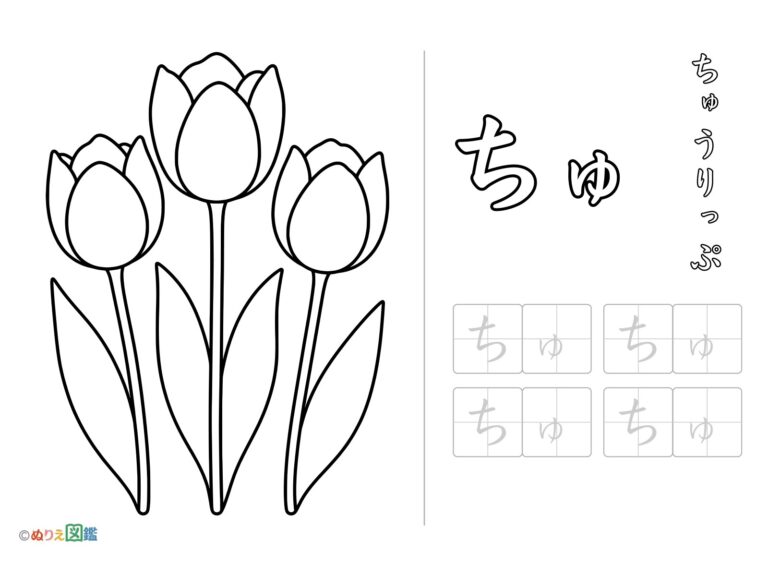
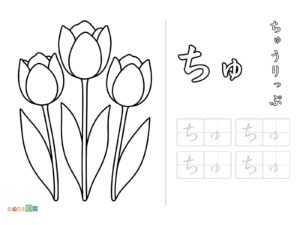
The character on this coloring page is the Hiragana "Chu".
The word is "Chuurippu" (tulip). In the picture on the left, there are three tulip flowers.
Can you see the round petals that look like cups, and the long, thin leaves?
Tulips bloom in spring. You can often see them in flower beds at preschools, kindergartens, and schools.
Usually, "tulip" is written in Katakana as "チューリップ", but we wrote "ちゅうりっぷ" here so you can practice your Hiragana "Chu".
"Chi" and a small "yu" make one sound together
"Chu" is a character you write by adding a small "yu" after "chi".
Even though there are two characters, you do not split them into "chi" and "yu" when you read it. Instead, you read it as one sound: "chu".
A sound like this is called a contracted sound.
If you write the "yu" big, it becomes "chiyoorippu", and the way you read it changes!
"Chi" comes from the kanji 「知」, and "yu" comes from the kanji 「由」.
Contracted sounds that use small "ya", "yu", and "yo" are lined up in groups of three on the hiragana chart, like "cha", "chu", and "cho".
Say them out loud and try reading "cha, chu, cho" with a nice rhythm!
Tips for writing Hiragana "Chu" neatly
"ち" is a character you write in 2 strokes.
The 1st stroke is a short line going across.
For the 2nd stroke, start above the line going across and go down at a slant. After you pass through the line going across, turn back and make a big curve to the right.
At the end of the curve, sweep down softly to the left. This makes a pretty "ち".
The small "ゅ" has 2 strokes. Draw it small in the next box, near the bottom left of the box.
A good size is about half the size of "ち".
The word "ちゅうりっぷ" also has a small "っ". Draw the small "っ" small in the bottom left of the box, too.
When you finish writing, compare the sizes of "ち" and "ゅ" to make sure you can clearly see the difference!
Let's find words with Hiragana "Chu"
Words that start with "ちゅ" include ちゅうしゃ (injection), ちゅうい (caution), ちゅうがえり (somersault), and ちゅうもん (order).
Hiragana "Chu" is also in "ちゅうちゅう" (chu-chu), the sound a mouse makes, and "ちゅーっ" (chuuu), the sound of drinking through a straw!
There are lots of words where "う" comes right after "ちゅ".
How many can you find?
Try playing a word game with your family and take turns saying them!
How to Color Hiragana "Chu"
Color the Big Hiragana "Chu" in Your Favorite Colors
First, try coloring the big Hiragana "Chu" with the outline in the top right using any colors you like.
If you match the tulip flowers and make "chi" red and "yu" yellow, your letters will look bright and lovely, just like a flower bed!
To stay inside the lines, color slowly near the edges and feel free to color smoothly in the middle.
Color the 3 Flowers in 3 Different Colors
Tulip flowers come in many colors, like red, white, yellow, pink, and purple.
If you color the 3 flowers in different colors, you will get a cheerful flower bed!
If you make the bottom of the petals a little darker and the tips a little lighter, the flowers will look nice and round.
Color the stems yellow-green and the leaves green. Try adding a little darker green along the line in the middle of each leaf.
It also looks stylish if you color just the edges of the petals a different color!
Tracing Is 1 Set in 2 Boxes
In the bottom right boxes, there are 4 sets of light gray Hiragana "Chu" in a row.
There is a "chi" in the left box and a small "yu" in the right box, so 2 boxes make 1 set.
Pencils in B or 2B that are not too dark and not too light are best.
Use the vertical and horizontal lines in the middle of the boxes as a guide. Check where the letter starts before you write!
Once you write 1 set, read it out loud and say "chu."
When you trace all 4 sets carefully one by one, it is also great to try writing Hiragana "Chu" all by yourself in the white space outside the boxes!
Fun Facts About Hiragana "Chu"
Tulips Grow from Bulbs
Tulip bulbs look like onions. You plant them in the soil in autumn.
They stay cold in the dirt all through winter. When spring comes, they sprout and bloom!
In Japan, lots of tulip bulbs are grown in Toyama Prefecture and Niigata Prefecture.
Opening and Closing
Tulip flowers open up on warm days. They close when it gets cooler in the evening and at night.
They repeat this for a few days while they stay in bloom.
Try looking at tulips in a flower bed in the morning and again at noon to see the difference!
The Netherlands Is the Land of Tulips
Tulips originally grew around Central Asia.
Later, they made their way to Europe. People started growing a lot of them, especially in the Netherlands.
Even today, the Netherlands is famous as the land of tulips.
Try singing the Japanese tulip song that starts with "Saita, saita," too!
The Name Comes from a Turban
People say the name "tulip" comes from a word that means turban, the cloth people wrap around their heads.
They say it is because the shape of the flower looked like a turban.
When you look at its round shape, it really does look like one!
Share These Hiragana "Chu" Coloring Pages


-
Tracing "Chu" (Tulip)
-