Katakana "Kyo" Coloring Pages


About Katakana "Kyo"
The "Kyo" in "Kyoryu"
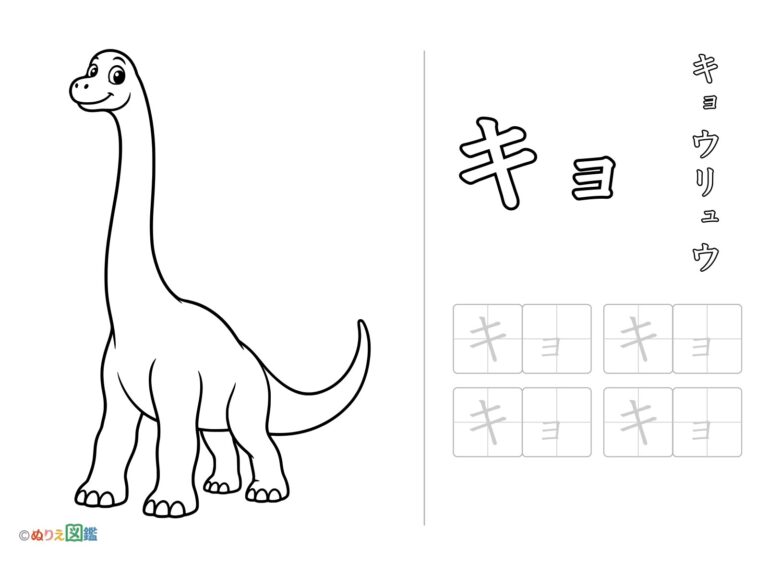
The letters on this coloring page are the Katakana "Kyo".
The word is "Kyoryu" (dinosaur). It starts with Katakana "Kyo".
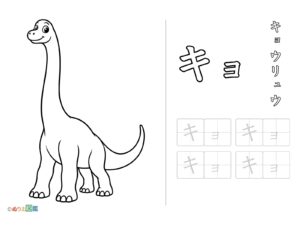
The picture on the left shows a long-necked dinosaur called Brachiosaurus. It stands firm on four thick legs, stretches out its long tail, and has a big smile.
Katakana is often used for words from other countries, names of animals and plants, and sounds or noises.
In picture books, living things are usually written in Katakana. "Kyoryu" is written in Katakana because it is the name of a group of living things, too.
"Ki" and a small "yo" make 1 sound
You write Katakana "Kyo" by adding a small "yo" after "Ki".
You write two letters, but you say them together as 1 sound: "kyo". This kind of sound is called a youon.
If you write a big "Yo" to make "Kiyo", it becomes two separate sounds: "Ki" and "Yo". Writing it small or big changes how you read it!
Try saying "Kyoryu" while clapping your hands. For "Kyo", you only need to clap once!
The Kanji that made Katakana "Kyo"
Katakana letters were made by taking pieces of Kanji or using their shapes.
Long ago, monks started using them to quickly write down how to read Kanji in holy books.
"Ki" comes from taking a piece of the Kanji "幾".
The small "yo" is a smaller version of the big "Yo", which comes from the Kanji "与".
How to write Katakana "Kyo"
make "Ki" in 3 strokes.
Strokes 1 and 2 are flat lines. Write them both slanted a little bit up to the right. Make the bottom line a little longer than the top line to make it look nice!
Stroke 3 is a straight line going down through both flat lines. Be sure to stop at the end.
You write the small "yo" in the same order as the big "Yo", using 3 strokes.
When writing across the page, put it in the bottom left corner of the box. Be careful not to make it the same size as "Ki"!
Words with Katakana "Kyo" in them
Words starting with Katakana "Kyo" include kyorokyoro, which means looking all around, and kyoton, which describes being surprised and looking blank.
People say the call of a bird named the lesser cuckoo sounds like tokkyokyo-kakyoku. It sounds like a tongue twister, and it has lots of Katakana "Kyo" in it!
Try it with your family and see who can say it the fastest!
How to Color Katakana "Kyo"
Color the big "Kyo" with two different colors
The big "Kyo" on the top right is a letter for you to color inside the outline.
If you color the big "Ki" and the small "yo" in different colors, it is easy to see that it is made of two letters.
If you make "Ki" a grassy green, and the small "yo" a yellow-green or orange, it will look super bright and cheerful!
It is also fun to change colors line by line, like for the 1st stroke and 2nd stroke of the stroke order.
Color the dinosaur's body any color you like
We still do not really know the real colors of most dinosaurs. So, you can color it in any color you like!
If you want to make it look like a real Brachiosaurus, try coloring its body green or greyish brown.
If you make its back a little darker and its belly pale yellow or cream color, its body will look nice and round.
Color the eyes black, and leave the area around its smiling mouth white to give it a gentle face.
Tracing comes in pairs of two
In the boxes on the bottom right, there are 4 pairs of light grey "Kyo" lined up. There is a "Ki" in the left box, and a small "yo" in the right box.
Hold your pencil correctly, and trace slowly over the grey lines so you do not go outside them.
Use the vertical and horizontal center lines in the boxes as a guide, and it will be easy to get the position and size of the letters just right.
Check to see if the small "yo" fits nicely in the bottom left of its box, too.
Every time you trace 1 pair, say "Kyo" out loud, and you will learn the letter and its sound together!
Fun Facts About Katakana "Kyo"
Brachiosaurus Has Long Front Legs
The name Brachiosaurus means "arm lizard."
Just like its name says, its front legs were longer than its back legs.
Because of this, its back sloped downward toward the tail.
People think it stretched its long neck to eat leaves high up in the trees.
The Word "Dinosaur"
The English word "dinosaur" comes from an ancient Greek word that means "terrible lizard."
The Japanese word for dinosaur was made by combining two kanji characters based on that meaning: one for "fearful" or "terrible," and one for "dragon."
Birds Are Relatives of Dinosaurs
The giant dinosaurs disappeared a very long time ago.
However, today's research shows that birds are descendants of dinosaurs.
Isn't it exciting to think that pigeons and sparrows in the park are actually relatives of dinosaurs?
Let's Compare Katakana "Kyo" with Hiragana "Kyo"
If you write Katakana "Kyo" in hiragana, it becomes "きょ."
Actually, both the hiragana "き" and the katakana "キ" came from the same kanji character, "幾."
Hiragana was made by smoothing out the whole kanji character, while katakana was made from a small part or shape of it. That is why they look different even though they came from the same kanji!
The small "ょ" and "ョ" also came from the same kanji character, "与," so they are like brother and sister letters.
Share These Katakana "Kyo" Coloring Pages


-
Tracing the Katakana "キョ" (Dinosaur)
-