Katakana "ヂ" Coloring Pages


About Katakana "ヂ"
The "ヂ" in "Chijimi"
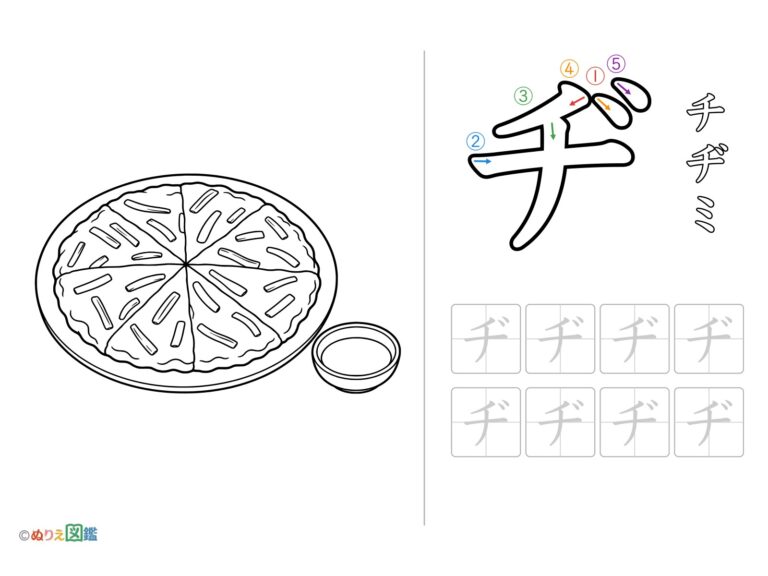
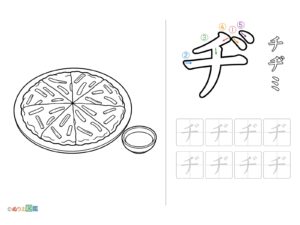
This coloring page lets you trace Katakana "ヂ".
The picture on the left shows chijimi on a plate.
It is a round chijimi with green onions, cut into triangles, and there is a small dish of sauce next to it.
Chijimi is a dish from our neighboring country, Korea.
We often use Katakana when writing words from other countries, names of animals and plants, or words for sounds and feelings like "woof-woof" or "thump-thump."
Chijimi is the name of a food from another country, so we write it in Katakana.
In the word "chijimi," Katakana "ヂ" comes second.
Katakana "ヂ" is a very rare character
Actually, there are almost no words that start with Katakana "ヂ".
Also, Katakana "ヂ" is rarely used inside words, too.
Usually, the same sound is almost always written as "ジ".
For the Hiragana "ぢ", you use it when words combine and the sound softens, like "はなぢ" (nosebleed) from "はな" and "ち". You also use it when "ち" repeats and the second sound softens, like in "ちぢむ" (to shrink).
The Katakana word "チヂミ" (chijimi) also has a "ヂ" right after "チ".
It is a rare character, but you can be proud if you can write it!
The Kanji Katakana "ヂ" Comes From
Katakana "ヂ" is the katakana "チ" with tenten (voiced sound marks) added.
The original "チ" came from the shape of the kanji "千".
It is said that long ago, monks created katakana by taking just a part of kanji characters so they could quickly write down how to read books and scriptures written only in kanji.
When you add tenten, the clear "チ" sound changes into the buzzy "ヂ" sound.
Tips for writing Katakana "ヂ"
You write Katakana "ヂ" in 5 strokes. Add 2 little dots to the 3 strokes of "チ".
The 1st stroke is a short line from the top right curving down to the left.
The 2nd stroke is a horizontal line across the middle.
The 3rd stroke goes from top to bottom and curves to the left at the end.
It looks a lot like the kanji "千", doesn't it?
Finally, let's write 2 dots at the top right.
Be careful not to bump the dots into the right end of the 1st stroke!
How to Color Katakana "ヂ"
Color the Big Katakana "ヂ" in Your Favorite Colors
Color inside the big Katakana "ヂ" at the top right with any color you like.
If you use one color for "チ" and a different color for the two dots, you can clearly see where the dots go.
You can also color it in tasty colors like golden yellow, brown, and green onion green to match the chijimi.
Color slowly near the edges so you do not go outside the lines, and feel free to color the middle softly and smoothly.
Color the Chijimi to Look Nice and Crispy
Color the chijimi light yellow first, and then add some light brown here and there to make it look nice and toasted.
If you make the edges a little darker brown, it will look super crispy!
Color the green onions inside with green or yellow-green.
You can also add a little red or orange here and there for red peppers or carrots.
Color the sauce dark brown, and leave the plate white, or add neat patterns in light blue or yellow.
Trace the Letters Slowly with a Pencil
In the boxes at the bottom right, there are 8 light gray Katakana "ヂ"s lined up.
Use a pencil instead of a crayon, and trace right over the gray lines.
Use the vertical and horizontal dashed lines inside each box to guide you.
For the 3rd stroke, go straight down along the center dashed line, and sweep to the left at the very end.
Write each one carefully, and show them to your family when you finish writing them nicely!
By the time you finish writing all 8, your hand will surely remember how to draw it.
Fun Facts About Katakana "ヂ"
Chijimi is a Korean pancake
Chijimi is a dish made by mixing flour batter with green onions, vegetables, and seafood, and frying it flat.
In Japan, the name "chijimi" is common, but in Korea, it is often called "jeon."
When it has lots of green onions, it is called "pajeon."
It is different from the word "chijimu"
There is also a word "chijimu" in Japanese.
When something gets smaller, we say "chijimu," and Japan also has a crinkly cloth called "chijimi."
But the food chijimi comes from Korea, so it is a different word from the Japanese "chijimu."
It is neat how words can sound the same but mean totally different things!
How to type Katakana "ヂ" on a computer
When you type in Romaji on a computer, "ジ" is usually JI, but Katakana "ヂ" is often typed as DI.
Even if they sound the same, they are different characters, so you type them differently.
It might be fun to ask an adult at home to try typing it for you.
"ヅ" is often typed as DU.
Share These Katakana "ヂ" Coloring Pages


-
Tracing the Letter "ヂ" (Buchimgae)
-