Katakana "Sha" Coloring Pages


About Katakana "Sha"
"Sha" in "Shirt", Katakana "Sha"
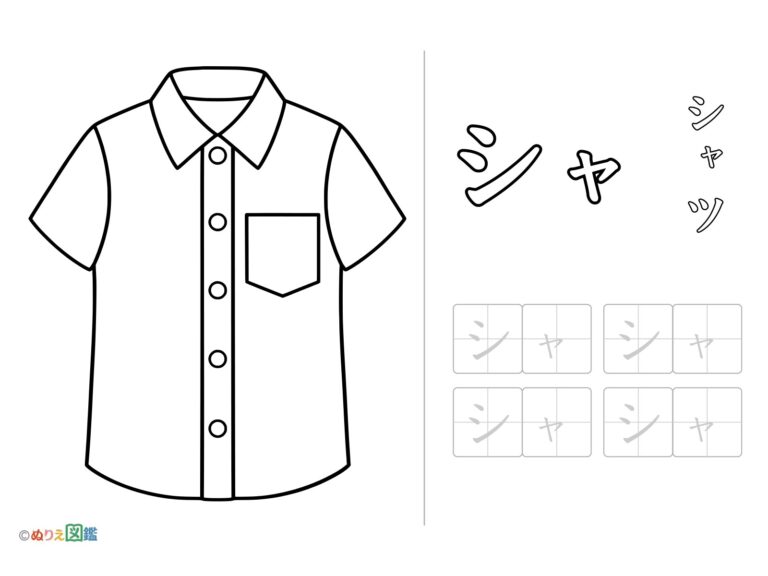
The letters on this coloring page are Katakana "Sha".
The word is "Shirt". It starts with "Sha"!
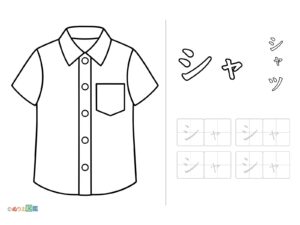
The picture on the left shows a short-sleeved shirt laid out flat. It has a collar around the neck, buttons down the front, and a pocket on the chest.
Katakana is a special set of letters used for words from other countries, names of animals and plants, and sounds or animal noises. "Shirt" comes from English!
"Button" and "pocket" are also words from other countries, so we write them in Katakana, too.
"Shi" and a small "Ya" make 1 sound
Katakana "Sha" is written by putting a small "ャ" after "シ".
Even though you write it with two letters, it makes one single sound when you read it, like "Sha". This kind of sound is called a youon (contracted sound).
If you write "ャ" big and make it "シヤ", it becomes two separate sounds: "Shi" and "Ya". The way you read it changes depending on whether you write it small or big.
Try clapping your hands while saying "shirts" in Japanese ("シャツ"). For Katakana "Sha", you only need to clap your hands once.
The Kanji that Katakana "Sha" came from
Katakana are characters made by taking a part of a Kanji or using the shape of a Kanji.
It is said that they started when monks long ago used them to write down the readings of Kanji in scriptures quickly.
"シ" was made from the Kanji "之".
The small "ャ" is a smaller version of the big "ヤ", and "ヤ" was made from the Kanji "也".
Tips for writing Katakana "Sha"
"シ" takes 3 strokes.
Strokes 1 and 2 are short dots drawn one above the other on the left side.
For stroke 3, sweep upward from the bottom left to the top right.
The similar character "ツ" has its dots side-by-side, and stroke 3 goes from top to bottom. Pay attention to how the dots line up and which way the last line goes!
Small "ャ" uses the same stroke order as big "ヤ" and takes 2 strokes.
When writing horizontally, draw it small in the bottom left of the box. Be careful not to make it the same size as "シ".
Words that start with Katakana "Sha"
There are lots of words that start with Katakana "Sha"!
Some examples are bubbles that you blow, a warm shower in the bath, shampoo for washing your hair, a big orca swimming in the ocean, and a shovel for digging sand.
When you take a bath, it can be fun to look for things that start with Katakana "Sha"!
How to Color Katakana "Sha"
For the big Katakana "Sha", change colors between the two letters
The big Katakana "Sha" on the top right has outlined letters for you to color in.
If you color the big "シ" and the small "ャ" in different colors, it is easy to see that it is made of two letters.
Coloring "シ" a sky-like light blue and the small "ャ" blue or purple gives it a fresh look.
It is also fun to change colors line by line, like stroke 1 and stroke 2 in stroke order!
For the shirt, you can even make your favorite pattern
You can leave the shirt white, or color it light blue, yellow, or pink.
If you color just the collar or pocket in a different color, it becomes a stylish shirt.
If you color the buttons brown or dark blue, they will really stand out.
It is also a great idea to add patterns to make a striped or polka dot shirt. Try designing your very own shirt!
Tracing is a set of two
In the bottom right boxes, there are 4 sets of light gray Katakana "Sha". "シ" is in the left box, and the small "ャ" is in the right box.
Hold your pencil correctly and trace slowly over the gray lines so you do not go outside them.
If you use the vertical and horizontal center lines in the boxes as a guide, it is easy to get a feel for the position and size of the letters.
Also check if the small "ャ" fits in the bottom left of its box.
Every time you trace 1 set, read Katakana "Sha" out loud, and you can learn the letters and the sound together!
Fun Facts About Katakana "Sha"
What Does the "Y" in "Y-shirt" Mean?
The Y-shirt that adults wear under a suit comes from the English word "white shirt."
"White" sounded like "Y" when shortened, so it became "Y-shirt."
That is why even colored dress shirts are called Y-shirts in Japan!
"Botan" Comes from Portugal
The word botan (button) on a shirt came to Japan from Portugal a long, long time ago.
Other words that came from Portugal around the same time include pan (bread) and castella (sponge cake).
T-shirts Look Like the Letter "T"
A T-shirt got its name because it looks like the letter "T" when you lay it out flat.
If you spread out the sleeves on the shirt in this coloring page, it looks like a "T" too!
Let's Compare Katakana "Sha" to Hiragana "Sha"
When you write "sha" in Hiragana, it is 「しゃ」.
Actually, both Hiragana "shi" and Katakana "shi" were born from the same Kanji, 「之」.
Hiragana was made by smoothing out the whole Kanji, while Katakana was made from just a part or shape of it. That is why they look different even though they came from the same Kanji!
The small "ya" in Hiragana and Katakana were both born from the Kanji 「也」, so they are like brother and sister characters.
Share These Katakana "Sha" Coloring Pages


-
Tracing the letter "Sha" (Shirt)
-