Katakana "Ta" Coloring Pages


About Katakana "Ta"
"Ta" in "Tambourine"
Katakana "Ta" is the very first letter in the T-row.
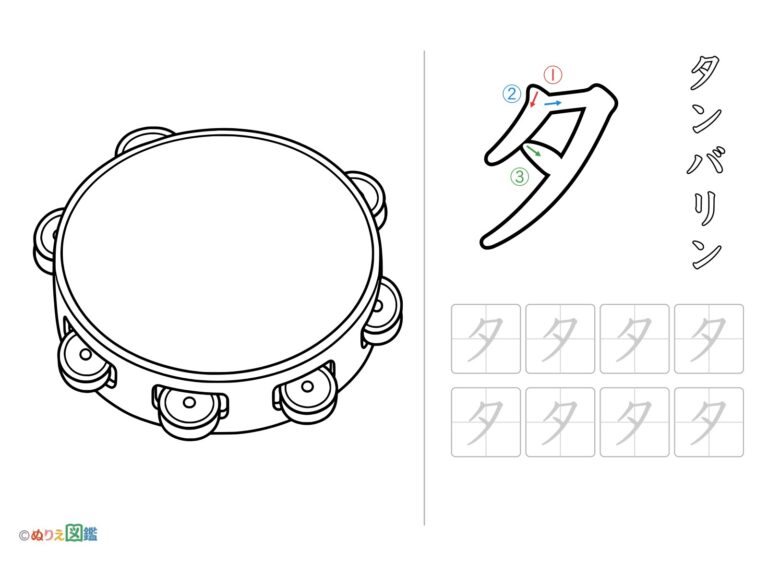
The word for this coloring page is "Tambourine". It is a percussion instrument that makes sound when you hit or shake it.
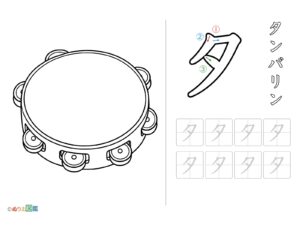
On the left side, we drew one tambourine.
Around its round frame, a few small metal disks are lined up.
When these disks jingle, they make a bright jingling sound.
Katakana "Ta" comes from the kanji "多"
Katakana characters were made by taking a part of a kanji character.
Katakana "Ta" was born from the top part of the kanji "多", which is shaped like "夕".
The hiragana "た" came from simplifying the kanji "太".
So even though Katakana "Ta" and hiragana "た" make the same sound, their original kanji are different.
Katakana "Ta" also looks just like the kanji "夕".
How to write Katakana "Ta"
You write Katakana "Ta" with 3 strokes.
The 1st stroke is a short line that sweeps from the top right to the bottom left.
The 2nd stroke starts where the 1st stroke began, goes straight to the right, bends at the corner, and sweeps down long to the bottom left.
The 3rd stroke is a dot in the middle.
If you write this 3rd stroke dot pointing down to the right starting around the middle of the 1st stroke, your letter will look nice and neat.
Katakana "Ta", Katakana "Ku", and Kanji "夕"
If you take away the 3rd stroke dot from Katakana "Ta", it becomes Katakana "Ku".
Also, Katakana "Ta" and the kanji "夕" look almost exactly the same.
This "夕" is used in words like evening or sunset.
You can tell which one it is in a sentence by looking at the words around it.
Words that start with Katakana "Ta"
Tambourine is a word that came from a foreign language, so we write it in Katakana.
Other words starting with Katakana "Ta" include octopus (tako), raccoon dog (tanuki), towel (taoru), taxi (takushii), and tire (taiya).
Octopus and raccoon dog are names of living things, while towel, taxi, and tire are words that came from other countries.
The "Ba" in "Tambourine" is the letter "Ha" with two small dots added to it.
Try playing a word chain game using words that start with Katakana "Ta"!
Friends in the T-row
The 5 letters "Ta", "Chi", "Tsu", "Te", and "To" are called the T-row.
In the T-row, only "Chi" and "Tsu" sound a little different from the other three.
Try saying "Ta, Chi, Tsu, Te, To" out loud and notice how your mouth and tongue move!
How to Color Katakana "Ta"
Color the Big Katakana "Ta" in Lively Colors
Color the big Katakana "Ta" with your favorite colors.
If you make each of the 3 strokes a different color, like red, yellow, and blue, it will look lively just like an instrument.
If you change the color of just the 3rd stroke's dot, it is also easy to see how it is different from "Ku".
Color the Tambourine Frame and Jingles Separately
Let's color the tambourine frame with bright colors like red, yellow, or orange.
If you make the head in the middle white or cream color, it will look real.
Try coloring the metal jingles with yellow and ochre for gold, or gray for silver.
If you leave a little white on the jingles, they will look shiny.
It is also cute to draw extra patterns like stars or hearts on the frame.
How to Trace the Letters
Trace Katakana "Ta" in the boxes on the bottom right with a pencil.
Write it so the starts of the 1st and 2nd strokes stick right together.
Do not forget to write the 3rd stroke's dot at the end.
When you write all 8, let's check if the dot is right in the middle.
Finally, Let's Read the Word Too
On the top right, next to the big Katakana "Ta", the word "Tambourine" is written top to bottom.
When you finish coloring, try reading "Tambourine" out loud while tracing it with your finger.
When pictures, letters, and words connect, it becomes much easier to remember the letters.
It is also nice to keep your finished coloring page by sticking it on the wall or putting it in a folder.
Fun Facts About Katakana "Ta"
Names of the Tambourine Disks
The tiny metal disks on the tambourine frame are called jingles.
They are set facing each other in pairs. When you shake them, they bump together and make a shiny "clink-clink" sound.
Different tambourines have a different number of disks.
Different Ways to Play
If you tap the head with your hand, the tambourine makes a "pat" sound.
If you shake it, the jingles keep ringing with a "jingle-jingle" sound.
If you rub the edge of the head with your finger, it can even make a trembling "swish" sound.
Some Tambourines Do Not Have a Head
Some tambourines have a head stretched across the middle, while others have no head and are just a frame with jingles.
Tambourines without a head are mostly shaken so you can enjoy the happy "jingle-jingle" sound.
Check to see which kind you have at home or in your music room!
An Instrument from Long Ago
Drums with a head stretched over a frame, just like the tambourine, have been used all over the world for a very long time.
People used them to keep the rhythm for dance music.
The great thing about the tambourine is that anyone can make a sound easily!
Share These Katakana "Ta" Coloring Pages


-
Tracing the letter "Ta" (Tambourine)
-