Katakana "E" Coloring Pages


About Katakana "E"
"E" for "Apron"
Katakana "E" is the 4th letter in Katakana.
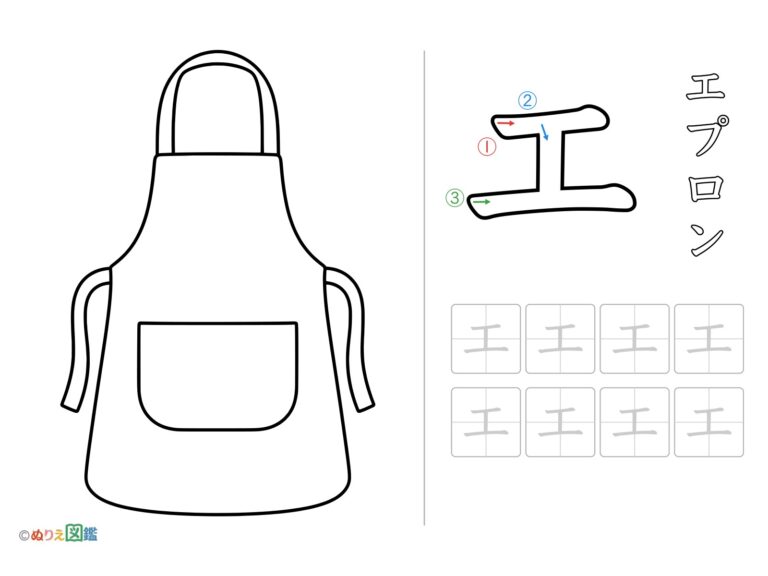
The word on this coloring page is "Apron" (Epuron). You wear it over your clothes to keep them clean when cooking or cleaning.
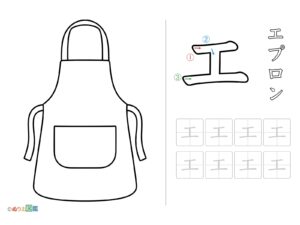
On the left side, we drew one kids' apron spread out flat.
Try to find the neck strap, the waist ties to tie behind your back, and the big pocket in front.
You can put a handkerchief or small tools in the pocket.
Katakana "E" Comes from the Kanji "江"
Katakana characters were made by taking small parts of Kanji.
Katakana "E" was born from the right side of the Kanji "江", which is the part "工".
The Kanji "江" means a big river or a place where the sea reaches into the land.
Hiragana "e" came from the Kanji "衣", so their original Kanji are different.
Katakana "E" looks just like the Kanji "工".
How to Write Katakana "E"
You write Katakana "E" with 3 strokes.
Stroke 1 is the top line going across.
Stroke 2 is the straight line going down from the middle of stroke 1.
Stroke 3 is the bottom line, and the trick is to make it longer than the top line.
Making the bottom longer gives Katakana "E" a strong base like a pyramid so it won't fall over.
If you draw the line going down right along the middle line of your practice grid, it will be nice and straight.
Words with Katakana "E"
The word "apron" comes from English, so we write it in Katakana.
Other words starting with Katakana "E" are Ebi (shrimp), Eakon (air conditioner), Erebētā (elevator), Enjin (engine), and Ezorisu (Ezo red squirrel).
"Eakon", "erebētā", and "enjin" are words from other countries, while "ebi" and "ezorisu" are names of living things.
"Eakon" is a short word made in Japan from a long English word.
Let's look around your house for things that start with Katakana "E"!
Watch Out for Letters That Look Alike
Katakana "E" can be easy to confuse with other letters.
For example, Katakana "Yu" has its straight line on the right side and takes 2 strokes.
Katakana "E" has its straight line right in the middle and takes 3 strokes.
Katakana "Ni" has only 2 lines going across and no line going down.
When letters look alike, write them side by side to see how different they are.
Try writing "エ" (E), "ユ" (Yu), and "ニ" (Ni) in your notebook to spot the differences!
How to Color Katakana "E"
Color the big Katakana "E" with 3 colors
Color the big Katakana "E" with any colors you like.
If you change the color for each stroke—like red, yellow, and green—it is super easy to understand the stroke order.
It is made of only straight lines, so try to color neatly inside the lines.
Color the apron with your favorite pattern
Color the apron in colors you would love to wear, like pink, light blue, or yellow.
Changing the color for just the pocket makes a cute little detail.
If you color the neck strap and waist ties a little darker than the apron, the shape will stand out clearly.
You can even draw your own patterns on the apron, like polka dots, checks, or flowers.
Try making your very own one-of-a-kind apron!
How to trace the letter
Trace Katakana "E" in the bottom right box with your pencil.
The rule is to write side-to-side lines from left to right, and top-to-bottom lines from top to bottom.
If you bring your pencil to a neat stop at the end of each line, it will look super clean.
Check each box to see if the bottom line is longer than the top line.
Finally, read the word out loud
In the top right, next to the big Katakana "E", the word "エプロン" (apron) is written vertically.
When you finish coloring, trace the word with your finger and read "apron" out loud.
When the picture, the letter, and the word all connect, it becomes much easier to learn the letter.
When your coloring page is finished, you can hang it on the wall or keep it in a folder!
Fun Facts About Katakana "E"
Katakana "E" and "工" Look Almost the Same
Katakana "E" and the kanji character "工" look almost exactly the same.
"工" is the kanji for making things, like in craft class or factories.
You can tell which one it is by reading the words around it.
Kappogi is a Type of Apron, Too
In Japan, people have used maekake and kappogi for a long time to keep their clothes clean.
A kappogi has long sleeves, so it covers your whole arms.
The white clothes you wear for school lunch duty also keep you clean and help you handle food safely.
Helping Out with an Apron
Putting on an apron makes you feel ready to go!
When you help with cooking, it is also important to wash your hands well and tie back your hair.
After you color Katakana "E", put on a real apron and try cooking with your family!
Pockets Make Aprons Super Handy
The big pocket on the front of an apron is super handy.
Lots of people wear aprons for work, like painters, florists, and cafe workers.
Aprons come in many shapes, and they have different numbers of pockets depending on the job.
When you see someone wearing an apron in town, check out what kind it is!
Share These Katakana "E" Coloring Pages


-
Tracing "エ" (Apron)
-