Katakana "Te" Coloring Pages


About Katakana "Te"
"Te" in "Televi" (Television)
This coloring page is for learning Katakana "Te".
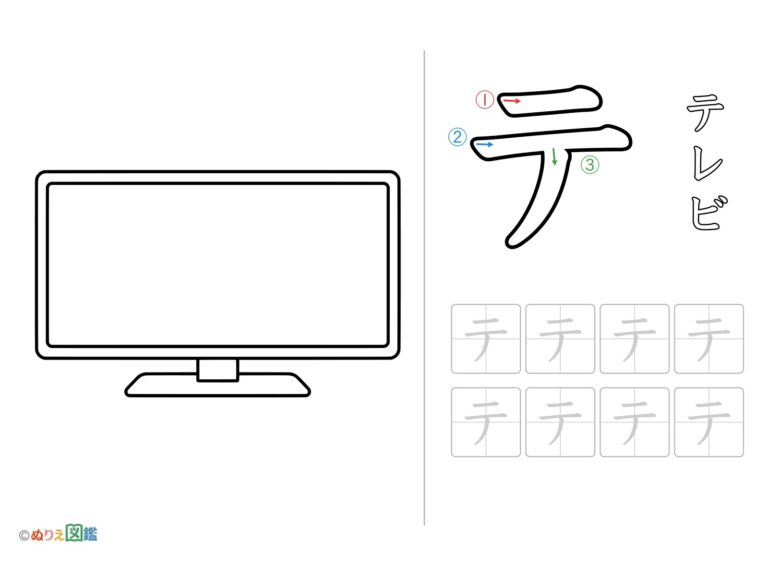
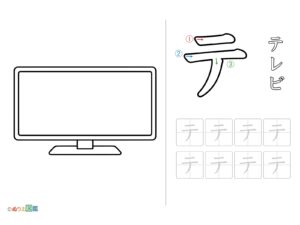
The word is "terebi" (TV). On the left, there is a TV sitting on a stand, drawn from the front.
The screen is blank, so try coloring it while thinking of your favorite show.
A TV is a cool tool that brings you news, anime, and scenes from far away with pictures and sounds.
Katakana is used for words from other countries
The word "TV" comes from the English word "television."
Words that come from other countries like this are usually written in Katakana instead of Hiragana.
Katakana "Te" is also often used for the names of animals and plants, as well as sound words like "bang" or "flash."
Katakana "Te" Comes from "天"
The Katakana "Te" was made from the top part of the kanji 「天」.
If you look at the top two straight lines of 「天」 and the line curving down to the left, you can see Katakana "Te" hiding inside!
People long ago started making katakana by taking small pieces of kanji to write tiny notes when reading holy books.
By the way, the hiragana "te" came from the very same kanji 「天」, too! That one was made by rounding out the whole kanji.
How to write Katakana "Te"
Katakana "Te" is written in 3 strokes.
The 1st stroke is the short horizontal line at the top. The 2nd stroke is the long horizontal line below it.
The 3rd stroke curves down to the left from around the middle of the long horizontal line.
If you make the top line shorter than the bottom line, it will look super neat!
Let's look for words that start with Katakana "Te"!
Words that start with "Te" include tent, table, tennis, and tape.
These are all written in Katakana.
Look around your house and race to see how many things starting with "Te" you can find!
Let's compare Katakana "Te" with "Chi" and "Ra"
Some Katakana characters look very similar to each other.
Katakana "Te" has two horizontal lines, and the bottom line curves down to the left.
"Chi" starts with a short slanted line at the top, and the straight line goes down through the middle line.
"Ra" has a shape like "Fu" under a short horizontal line at the top.
If you write them side by side, you can easily see how different they are!
How to Color Katakana "Te"
For the big Katakana "Te", change colors for each stroke
Color the big Katakana "Te" at the top right with your favorite colors.
If you change the color for each stroke order, like red for the 1st stroke, blue for the 2nd stroke, and yellow for the 3rd stroke, you can easily see how many strokes it takes to write.
The trick is to color slowly from the outside so you do not go over the outline!
For the TV, color the screen and the stand differently
If you color the frame around the TV with black, gray, or white, it will look like a real one.
If you color the screen with dark gray or navy blue and leave a tiny bit of white line in the corner, it looks shiny and bright!
It is also fun to draw your favorite picture or sky color on the screen to make your very own show.
Try making the stand look like wood with brown, or try coloring it white.
Trace carefully with a pencil
In the boxes at the bottom right, there are 8 light gray Katakana "Te".
Use a pencil to trace over the light letters, one by one.
If you use the vertical and horizontal lines inside the boxes as a guide, your letters will be the same size and in the right place.
For the last sweeping stroke, if you gently relax your strength as you write, it will make a pretty shape!
Layer from light colors
When you color the TV frame black, do not color it dark right away. It is good to layer it little by little, starting with light gray.
If you press harder later only on the parts you want to make dark, uneven spots will not stand out.
Try making the buttons and speaker holes stand out with silver or white!
Fun Facts About Katakana "Te"
When TV Broadcasts Started
TV broadcasts began in Japan in 1953.
At first, the screens were only in black and white, and very few homes had a TV.
Color broadcasts with full colors started many years later.
"Tele" Means "Far Away"
The "tele" in "television" comes from a word that means far away.
"Vision" means seeing. So, the name "television" means "a tool for seeing things far away."
The English word "telephone" also comes from the meaning "faraway sounds."
A TV Screen Is Made of Tiny Dots
If you look at a TV screen up close with a magnifying glass, you can see lots of tiny dots lined up.
Each dot gives off red, green, or blue light. They mix together so you can see many different colors.
It is amazing that lights of just 3 colors can make tens of thousands of colors!
How Big Is a TV?
A TV's size is measured by the diagonal length of the screen.
It uses a unit called "inches," and 1 inch is about 2.5 centimeters.
Share These Katakana "Te" Coloring Pages


-
Tracing "Te" (Television)
-