Katakana "ニュ" Coloring Pages


About Katakana "ニュ"
The "ニュ" in "New York"
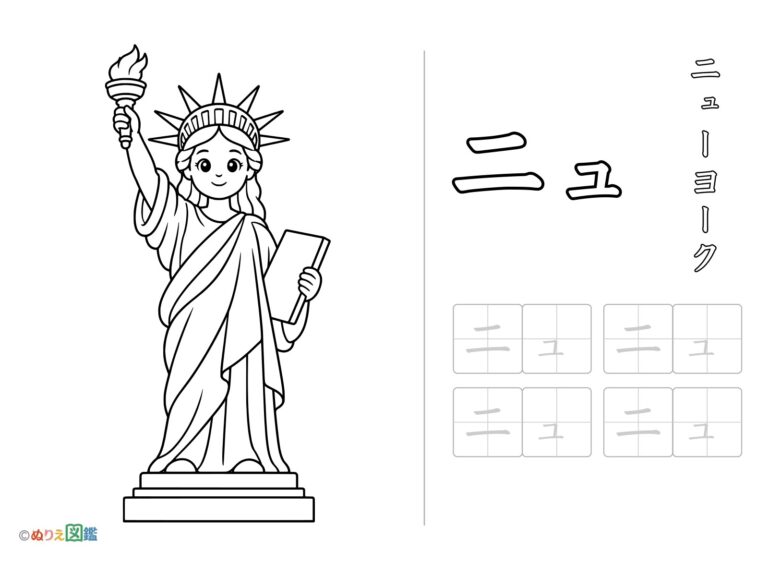
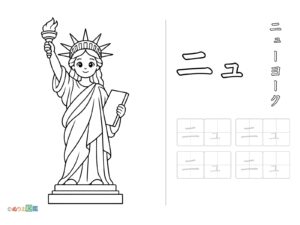
The letters on this coloring page are Katakana "ニュ".
The word is "New York". "ニュ" comes at the beginning of the word.
New York is a big city in America with lots of tall buildings.
The picture on the left is the Statue of Liberty standing in New York Harbor. She wears a crown on her head, holds a torch up high in her right hand, and holds a board that looks like a book in her left hand.
Katakana is often used to write words from other languages, names of animals and plants, and sounds or animal noises. You also use Katakana to write the names of foreign countries and cities!
"ニ" and a small "ュ" make 1 sound together
Katakana "ニュ" is written by adding a small "ュ" after "ニ".
You write it with 2 letters, but you read it as 1 single sound, "ニュ". Sounds like this are called youon.
If you write the "ュ" big like "ニユ", it becomes 2 separate sounds, "ニ" and "ユ". Writing it small or big changes how you read it!
Try saying "ニューヨーク" (New York) while clapping your hands. You only need to clap 1 time for Katakana "ニュ".
The Kanji that Katakana "ニュ" came from
Katakana are characters that were made by taking a part of a kanji or using the shape of a kanji.
It is said they started when monks long ago used them to write down the readings of kanji in scriptures super fast.
"ニ" comes from the "二" on the right side of the kanji "仁".
The small "ュ" is just a smaller version of the big "ユ", and "ユ" was made from the kanji "由".
Tips for writing
"ニ" takes 2 strokes.
You write it with 2 horizontal lines. The trick is to make the top line short and the bottom line long.
Leave a little space between the 2 lines. Write both from left to right, and stop at the end.
Small "ュ" is written in the same order as big "ユ", and it takes 2 strokes.
When you write sideways, draw it small in the bottom left of the box. Be careful not to make it the same size as "ニ".
Words with Katakana "ニュ"
Words that start with Katakana "ニュ" include news from TV and newspapers, and New Zealand, a country floating in the southern sea.
Katakana "ニュ" can also be inside words, like menu when you choose food at a restaurant.
The English word "new" means "not old". News is also something that tells you about new events!
How to Color Katakana "ニュ"
For Big Katakana "ニュ", Use Different Colors for the 2 Letters
The big Katakana "ニュ" at the top right is a letter for you to color inside the lines.
If you color the big "ニ" and the small "ュ" in different colors, you can easily see that it is made of two letters.
It looks wonderful if you make "ニ" blue-green like the Statue of Liberty, and the small "ュ" orange like the flame of the torch.
It is also fun to change colors line by line, following stroke order stroke 1 and stroke 2!
The Statue of Liberty is Blue-Green
The real Statue of Liberty is a light blue-green color. Let's color her whole body in blue-green or light green.
If you color the deep parts of the folds on her dress a little darker, the statue will look grand.
Color the torch's flame in yellow and orange to make it shine brightly!
If you make the pedestal gray or light brown, it will look like it is made of stone.
Tracing is 1 Set of 2 Letters
In the boxes at the bottom right, 4 sets of light gray Katakana "ニュ" are lined up. You can see "ニ" in the left box and a small "ュ" in the right box.
Hold your pencil correctly and trace over the gray lines slowly so you do not go outside the lines.
Using the vertical and horizontal centerlines in the boxes as a guide makes it easy to get the position and size of the letters right.
Check to see if the small "ュ" fits neatly in the bottom left of its box, too.
Every time you trace 1 set, say "ニュ" out loud. Then you can learn the letter and its sound together!
Fun Facts About Katakana "ニュ"
The Name Means "New York"
"New York" means "New York" in English.
"York" is the name of a place in England.
The name given by the people of England is still used today.
A Gift from France
The Statue of Liberty was sent from France to America as a sign of friendship.
It was finished in 1886, and now it is a World Heritage Site.
The date when America became independent is carved on the tablet in her left hand.
It Was Copper-Colored at First
The Statue of Liberty is covered with thin plates of a metal called copper.
When it was just made, it had a reddish-brown color like a copper coin.
Over many long years, the copper formed rust and changed into the blue-green color you see today.
Let's Compare Katakana "ニュ" with Hiragana "にゅ"
When you write Katakana "ニュ" in hiragana, it is "にゅ".
Actually, both hiragana "に" and katakana "ニ" came from the same kanji character, "仁".
Hiragana was made by changing the full shape of the kanji, while katakana was made from a part or simple shape of the kanji. That is why they look different even though they came from the same character!
The small "ゅ" and "ュ" are also like brother and sister characters, because both came from the kanji "由".
Share These Katakana "ニュ" Coloring Pages


-
Tracing the "Nyu" (New York)
-