Katakana "Pa" Coloring Pages


About Katakana "Pa"
"Pa" as in "Panda"
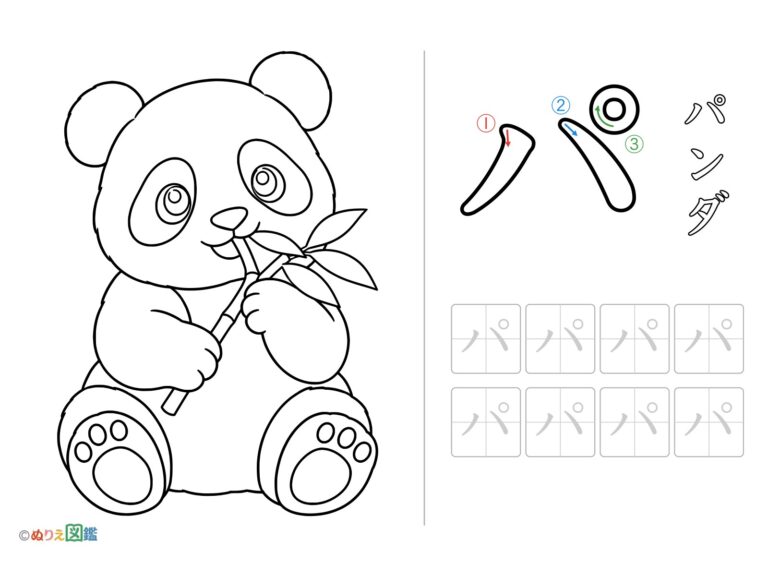
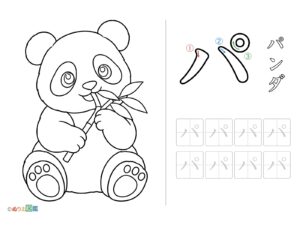
This coloring page lets you trace Katakana "Pa".
The picture on the left shows a baby panda sitting and eating bamboo leaves.
The black parts on its eyes, ears, and legs are not filled in. They just have outline lines.
"Panda" is the name of an animal from another country, so you write it in katakana.
Katakana is often used when you write words from other countries, names of animals and plants, and words for sounds or feelings like "woof-woof" or "thump-thump."
Almost all animal names at the zoo are written in katakana, aren't they?
The Kanji That Formed Katakana "Pa"
Katakana "Pa" is the letter Katakana "Ha" with a little circle (handakuten) added to the top right.
The original "Ha" came straight from the shape of the kanji "八".
It is said that long ago, monks created katakana by taking just parts of kanji so they could write down pronunciations quickly while reading scriptures and books.
When you add a circle to "Ha", it becomes "Pa", and when you add two small dots, it becomes "Ba".
Say "Ha", "Ba", and "Pa" out loud to compare the different sounds!
Tips for writing Katakana "Pa"
You write Katakana "Pa" in 3 strokes, adding 1 small circle stroke to the 2 strokes of "Ha".
Stroke 1 is a line that sweeps nicely from top to bottom left.
Stroke 2 is a line on the right side of stroke 1, going from top to bottom right.
Do not join the two lines at the top. Leave a space between them.
Finally, draw a small circle on the top right.
Try not to make the circle too big. Draw a neat, small loop and connect the start and end carefully.
Leave a little space so the circle does not hit the start of stroke 2. That makes Katakana "Pa" look so pretty!
Words that start with Katakana "Pa"
Besides panda, words that start with Katakana "Pa" include pan (bread), pajamas, patcar (police car), puzzle, and pineapple.
Most words that start with Katakana "Pa" are words that came from other countries.
You can also find Katakana "Pa" in sound effect words like "pachi-pachi" (clapping) and "paku-paku" (munching).
When a panda eats bamboo, does it go "paku-paku" or "mogu-mogu"?
Let's find words with Katakana "Pa" and say them aloud while you clap your hands "pachi-pachi"!
How to Color Katakana "Pa"
Color the big Katakana "Pa" in your favorite colors
Color inside the lines of the big Katakana "Pa" on the top right using any colors you like.
If you use a different color for the "Ha" part and the small circle on the top right, the circle will really stand out.
It could also be fun to use black and white, just like a panda!
To keep inside the lines, color slowly near the edges and freely in the middle.
Color the panda's black parts yourself
The panda in this picture only has outlines for its black parts.
Try coloring the around the eyes, ears, paws and feet, and the band from its shoulders to its front paws in black.
When you color it black, leave the white parts inside the eyes uncolored.
You can leave the white parts of the body white, or add just a tiny bit of light cream or light gray to make it look soft and fluffy.
For the bamboo grass, switch between green and yellow-green for each leaf to make it look full of life.
If you add a little dab of light pink on the nose and around the mouth, you will get a super cute baby panda!
Trace slowly with a pencil
In the boxes on the bottom right, there are 8 light gray Katakana "Pa"s in a row.
Use a pencil instead of a crayon to trace over the gray lines.
Use the vertical and horizontal dashed lines inside the boxes to guide you.
For the circle, use the tip of your pencil to make a neat little loop on the top right.
Write each one carefully. When you write them well, show them to your family!
By the time you finish writing all 8, your hand will surely remember how to form the shape.
Fun Facts About Katakana "Pa"
Pandas are in the bear family
A panda's full name is actually giant panda, and it is a member of the bear family.
They live in forests with lots of bamboo deep in the mountains of China.
They spend a huge part of their day eating bamboo.
Even though they are bears, almost all of their food is bamboo!
A secret "finger" to hold bamboo
On their front paws, pandas have five fingers, plus a bump-like spot where their wrist bone sticks out.
They can hold bamboo super well by pinching it between this bump and their fingers.
It works like a sixth finger, so people sometimes call it the "sixth finger."
They are super tiny when they are born
When a baby panda is born, it weighs only about 100 to 200 grams.
That is so small compared to a grown-up panda!
When they are newly born, they do not have much fur, and their bodies are pink.
Pandas first came to Japan in 1972, and they became super popular at Ueno Zoo!
Share These Katakana "Pa" Coloring Pages


-
Tracing "Pa" (Panda)
-