Katakana "Su" Coloring Pages


About Katakana "Su"
The "Su" in "Spoon"
Katakana "Su" is the third letter in the Sa-line.
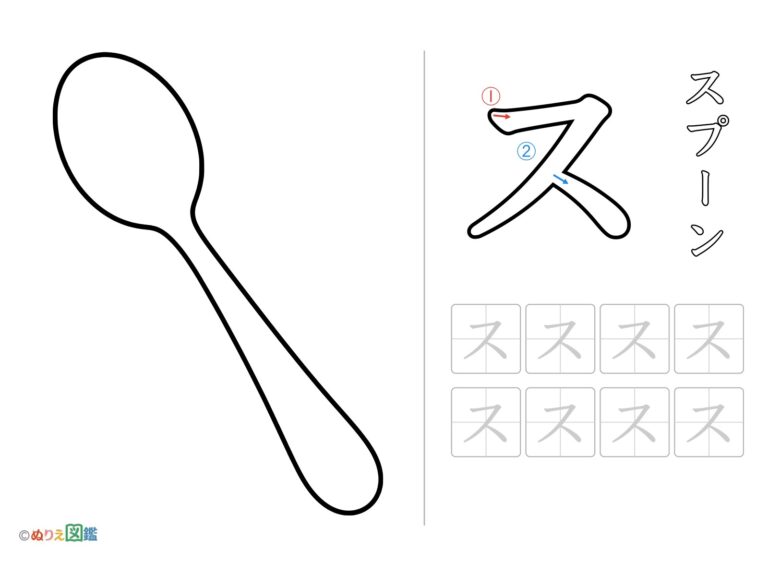
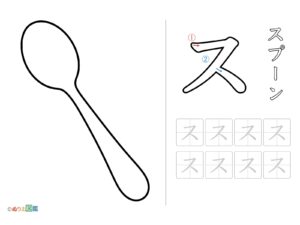
The word on this coloring page is "Spoon". It is a tool you use when you eat soup, curry, or dessert.
On the left side, we drew one spoon placed on a slant.
Take a close look at the rounded scoop and the handle you hold with your hand.
Everyone from little kids to grown-ups uses a spoon when they eat mealtime food.
Katakana "Su" Comes From the Kanji "須"
Katakana letters were made by taking small parts of Kanji.
Katakana "Su" was born from a part of the Kanji "須".
Hiragana "su" was made by simplifying the Kanji "寸".
So, even though Katakana "Su" and Hiragana "su" make the same sound, they come from different Kanji.
Their shapes are very different too, since Hiragana "su" has a nice little loop.
How to Write Katakana "Su"
You write Katakana "Su" with 2 strokes.
For stroke 1, go across, bend at the corner, and make a big sweeping stroke down to the left.
For stroke 2, start from the middle of stroke 1, go short down to the right, and stop.
If you start stroke 2 right near the middle of stroke 1's line, it will look very neat.
Katakana "Su" looks a lot like Katakana "Nu", but in "Nu", stroke 2 crosses right through the first line.
The Long Sound Mark "ー"
The word "Spoon" has a "ー" mark that stretches out the sound.
This "ー" is called a long sound bar, and it is a mark mostly used with Katakana words.
In Hiragana, you stretch sounds by writing letters like "a" or "i", but Katakana mostly uses "ー".
The word on this coloring page is written top-to-bottom, so the "ー" is a standing line too.
It becomes a side-to-side line when you write across, and a standing line when you write top-to-bottom, so check out the difference!
Words That Have Katakana "Su"
Spoon comes from English, so you write it in Katakana.
Words that start with Katakana "Su" include Suika (watermelon), Suzume (sparrow), Sukaato (skirt), Sukee (ski), and Sukeeto (skate).
Suika and Suzume are names of living things, while skirt, ski, and skate are words that came from other countries.
The "pu" in "Spoon" is just the letter "fu" with a little circle attached.
Try playing a word-chain game using words that have Katakana "Su"!
How to Color Katakana "Su"
Color the big Katakana "Su" with shiny colors
Color the big Katakana "Su" with your favorite colors.
If you use gray or light blue to match the spoon, Katakana "Su" will look shiny like real metal.
It is also a great idea to change colors between the 1st stroke and 2nd stroke.
Color the spoon and leave some bright spots
It is good to color the metal spoon with gray or light blue.
For the round bowl part, make the edges a little darker and the middle lighter. That makes it look hollowed out!
If you leave a few white lines, it will look shiny, just like light is sparkling on it.
If you want to make a wooden spoon, try coloring it with light brown or ochre.
If it is a plastic spoon, you can make it cute with any colors you like, such as pink or yellow-green.
How to trace the letters
Trace Katakana "Su" in the boxes on the bottom right using your pencil.
For the corner of the 1st stroke, bend it sharply, then sweep down to the left smoothly.
The trick for the 2nd stroke is to keep it short and stop your pencil neatly.
Once you write 8 of them, compare them with "ヌ" to make sure the 2nd stroke does not poke through!
Finally, let's read the word too
On the top right, next to the big Katakana "Su", the word "Spoon" is written vertically.
When you finish coloring, trace the word with your finger and read "Spoon" out loud.
When pictures, letters, and words connect, it becomes much easier to remember the letters!
It is nice to save your finished coloring page by putting it on the wall or keeping it in a folder.
Fun Facts About Katakana "Su"
Faces in a Spoon
When you look into a shiny spoon, you can see your face!
On the curved inside, your face shows up upside down.
On the bumpy outside, your face stays right side up.
Try looking into a spoon at home!
Tablespoons and Teaspoons
Measuring spoons used for cooking include tablespoons and teaspoons.
One tablespoon is 15 milliliters, and one teaspoon is 5 milliliters.
So, one tablespoon is the same as three teaspoons!
"Saji" in Japanese
In Japanese, a spoon is also called a "saji."
Long ago, doctors used spoons to measure medicine, which led to the saying "saji wo nageru" (to throw the spoon).
This means giving up because nothing more can be done.
Types of Spoons
At ramen shops and Chinese restaurants, people sometimes use a deep, large spoon called a renge.
There are also flat spoons for eating ice cream and tiny spoons for stirring coffee.
There are many different spoon shapes made for different foods!
Share These Katakana "Su" Coloring Pages


-
Tracing the letter "Su" (Spoon)
-