Katakana "Jo" Coloring Pages


About Katakana "Jo"
"Jo" in "Jogging"
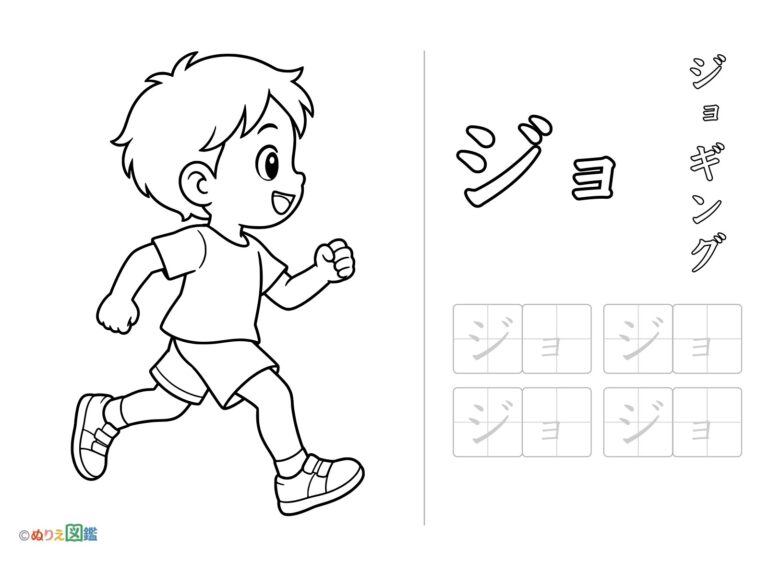
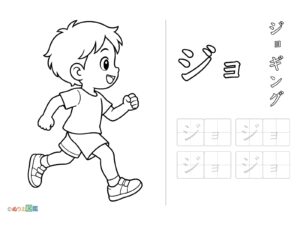
This coloring page is for practicing Katakana "Jo".
The word is "Jogging". That means running at a nice, slow pace where you can still talk.
On the left, there is a side view of a child having fun jogging and swinging their arms wide.
They are lifting their knees high and running with lots of energy!
Two characters for one sound
Katakana "Jo" is made of two characters, "Ji" and a small "yo," to make one sound.
Letters like this, made into one sound by adding a small "ya," "yu," or "yo," are called youon.
When you say it out loud, try connecting them as one sound instead of saying "Ji" and "Yo" separately.
How Katakana "Jo" came to be
Katakana characters were made a long time ago. People took just a part of a Kanji character or made its shape simpler.
"Ji" is the character "Shi" with two little dots. These dots are also called dakuten.
The original "Shi" came from a simplified version of the Kanji character "之".
The small "ョ" is a smaller version of "ヨ". "ヨ" was created from part of the Kanji character "与".
While Hiragana was made by smoothing out Kanji shapes, Katakana was made from parts of Kanji. That is why Katakana has a lot of straight lines!
How to write Katakana "Jo"
Katakana "Jo" starts with 3 strokes for "Shi" and adds 2 small dots, making 5 strokes in total.
To write "Shi", start on the left side and draw 2 dots, one below the other from top to bottom.
For the 3rd stroke, sweep your line upward from the bottom left to the top right.
It is easy to mix up with "Tsu", so watch how the dots line up and which way the 3rd stroke goes.
At the end, write 2 short dots side by side at the top right.
Small "ョ" has 3 strokes. For stroke 1, draw a line that goes right and then turns down. Stroke 2 is the middle side-to-side line, and stroke 3 is the bottom side-to-side line.
If you leave the same amount of space between the 3 side-to-side lines, it will look super neat!
You write small letters about one-fourth the size of the box. When writing sideways, put it near the bottom left of the box. When writing top-to-bottom, put it near the top right of the box.
If you make "ョ" too big, people will read it as two sounds, "JI" and "YO", so be careful!
Words with Katakana "Jo"
Katakana is often used when you write words that come from other countries.
"Jogging" is a word that comes from English, too.
Words that start with Katakana "Jo" include jouro (watering cans) for watering flowers, the joker in playing cards, and a jokki (mug) for drinks.
People say that jouro comes from a Portuguese word.
When you find words with Katakana "Jo", it can be fun to look up which country they came from with your family.
How to Color Katakana "Jo"
Color the big Katakana "Jo" in your favorite color
Try coloring the big, outlined Katakana "Jo" in the top right with your favorite color.
To match the energetic running look, try using bright colors like orange, yellow-green, or light blue.
To keep it looking neat, slowly color the inside of the lines first. Then, fill in the middle!
Color the workout clothes in bright colors
Try coloring the child's shirt and pants in bright colors you like, such as red, blue, or yellow.
If you use different colors for the shirt and pants, you can clearly see the arms and legs move. It will make the running look so lively!
If you leave the shoes white and only color the laces or stripes, they will look just like real sneakers.
Color the skin and face in soft colors
Color the arms, legs, and face with light peach or light orange.
If you put a little light pink on the cheeks, it will look like the child's body got warm from running.
You can also draw paths or trees around them to make a picture of running in the park!
Trace the letters carefully, one pair at a time
In the bottom right boxes, there are 4 sets of light gray Katakana "Jo", with 2 letters in each set.
Try tracing slowly over the light letters with a dark or soft pencil.
Use the center lines inside the boxes as a guide. This helps you see the size difference between the big letter and the small letter!
Say the stroke order out loud while you write to help you remember it easily.
Just like jogging, write at your own pace without rushing!
Fun Facts About Katakana "Jo"
Jogging is a Speed Where You Can Still Talk
Jogging means running at a slow speed, fast enough that you can still chat with the person next to you.
You can run for a long time without pushing yourself too hard, so lots of people, from kids to adults, enjoy it.
Don't forget to do some warm-up stretches before you run!
A Marathon is 42.195 Kilometers
Marathons are long-distance running events where people run 42.195 kilometers.
That is so long that it would take almost a whole day if you walked it normally!
Marathon runners build up their strength every day by jogging, bit by bit.
Swinging Your Arms Makes Running Easier
If you swing your arms back and forth when you run, it is easier to keep your balance.
Your feet will move forward easily along with your arm swings, so you can run with a great rhythm.
The child on the coloring page is swinging their arms really well, too!
Let's Try Writing It in Romaji
When you write Katakana "Jo" in Romaji, it becomes jo or zyo.
There are two ways to write Romaji. The style with "j" is often used on signs at train stations and roads.
You will learn Romaji in Japanese class around third grade.
It is written on train station names and road signs, so try reading it if you spot it!
Share These Katakana "Jo" Coloring Pages


-
Tracing "Jo" (Jogging)
-