Katakana "Cha" Coloring Pages


About Katakana "Cha"
The "Cha" in "Fried Rice"
The character on this coloring page is Katakana "Cha".
The word is
"fried rice" (chāhan). The word starts with "Cha"!
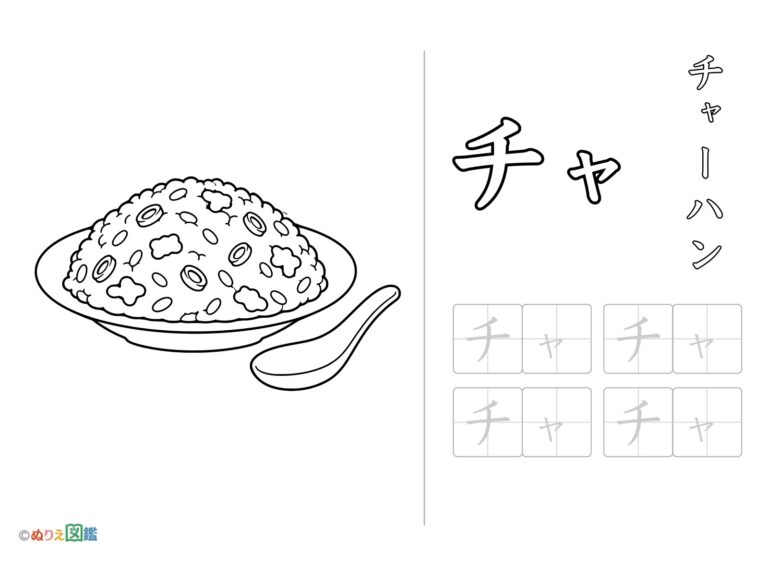
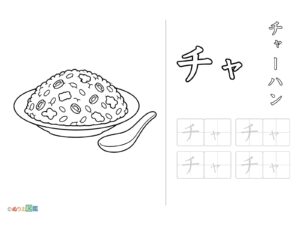
The picture on the left shows a big plate of fried rice with a Chinese soup spoon. You can see green onions and eggs mixed in with the rice!
It is a Chinese dish made by stir-frying rice with delicious ingredients.
Katakana characters are often used for words that come from other countries, names of animals and plants, and sounds or animal noises. "Fried rice" is a word that came from Chinese!
"Chi" and a small "Ya" make one sound
Katakana "Cha" is written by putting a small "ャ" after "チ".
You write it with 2 characters, but you read it as 1 sound: "Cha". Sounds like this are called 拗音 (youon).
If you write "ャ" big and make it "チヤ", it becomes 2 sounds: "chi" and "ya". Writing it small or big changes how you read it!
Try saying "チャーハン" (fried rice) while clapping your hands. For Katakana "Cha", you only need to clap 1 time.
The Kanji That Formed Katakana "Cha"
Katakana are characters that were made by taking a part of a Kanji or using the shape of a Kanji.
It is said that they started long ago when monks used them to quickly write down how to read Kanji in sacred books.
"Chi" came from the Kanji "千". If you put "千" and "Chi" side by side, their shapes look very similar, don't they?
The small "ャ" is just a smaller version of the big "ヤ", and "ヤ" came from the Kanji "也".
How to Write Katakana "Cha"
"Katakana "Cha"" has 3 strokes.
For the 1st stroke, make the short top line by curving diagonally from right to left.
For the 2nd stroke, draw a longer horizontal line in the middle.
For the 3rd stroke, bring the line down from near the middle of the horizontal line, and finish with a curve to the left.
The small "ャ" has 2 strokes, drawn in the same order as the big "ヤ".
When writing horizontally, write it small in the bottom-left of the box. Be careful not to make it the same size as "チ".
Words with Katakana "Cha"
Words that start with "cha" include the school chime, the strongest winner called a champion, and trying your best at a new challenge.
Sometimes "cha" comes at the end of a word, like in kabocha, which means pumpkin.
You can also find "cha" hidden in fun splashy sounds, like pacha-pacha when you play in the water!
How to Color Katakana "Cha"
For the big Katakana "Cha", use different colors for the two letters
The big Katakana "Cha" at the top right is a letter for you to color inside the outline.
If you color the big "チ" and the small "ャ" in different colors, you can easily see that it is made of two letters.
If you make "チ" an egg-like yellow and the small "ャ" a green-onion-like green, it will look super yummy.
It is also fun to change colors for each line, like stroke 1 and stroke 2 in the stroke order.
The rice is yellow, and the green onions are green
Let's color the fried rice with light yellow or cream color.
If you color the bits of egg you see here and there with dark yellow, you can tell them apart from the rice.
Color the green onions yellow-green or green. If you color each small piece one by one, it will look like it has lots of toppings.
You can leave the spoon white or add light blue patterns to it. Giving the rim of the plate a color will make it look extra fun, too.
The tracing letters come in pairs of two
In the boxes at the bottom right, there are 4 pairs of light gray Katakana "Cha". You can see "チ" in the left box and a small "ャ" in the right box.
Hold your pencil correctly and trace over the gray lines slowly so you do not go outside the lines.
If you use the vertical and horizontal center lines inside the boxes as a guide, it is easy to get a feel for the letter's place and size.
Check to see if the small "ャ" fits neatly in the bottom left of its box, too.
Every time you trace 1 pair, say "Cha" out loud, and you can learn the letter and its sound together.
Fun Facts About Katakana "Cha"
"Cha" Means Stir-Frying
When you write "Fried Rice" in Chinese, it is written as "炒飯".
"炒" means to stir-fry, and "飯" means cooked rice.
So, fried rice literally means "stir-fried rice"!
The Asian Soup Spoon Looks Like a Flower Petal
The Asian soup spoon you use to eat fried rice got its Japanese name because its shape looks like a lotus flower petal.
A lotus flower is called "Renge" in Japan.
It looks like a single fallen flower petal, so it is also called "Chiri-renge"!
Kabocha Squash Got Its Name from a Country
People say that the vegetable kabocha squash got its name from the Southeast Asian country Cambodia.
Long ago, a Portuguese ship brought it to Japan and said it came from Cambodia.
The word "Cambodia" slowly changed over time to become "Kabocha"!
Let's Compare Katakana "Cha" with Hiragana "Cha"
When you write Katakana "Cha" in Hiragana, it looks like "ちゃ".
The Hiragana "Chi" came from the Kanji character "知", while the Katakana "Chi" came from the Kanji character "千".
Even though they make the same sound, the original Kanji characters were different! That is why "ち" and "チ" look so different from each other.
The small "ゃ" and "ャ" both came from the Kanji character "也", so they are like brother and sister characters!
Share These Katakana "Cha" Coloring Pages


-
"Cha" tracing ("Fried rice")
-