Katakana "Gyo" Coloring Pages


About Katakana "Gyo"
The "Gyo" in "Gyoza"
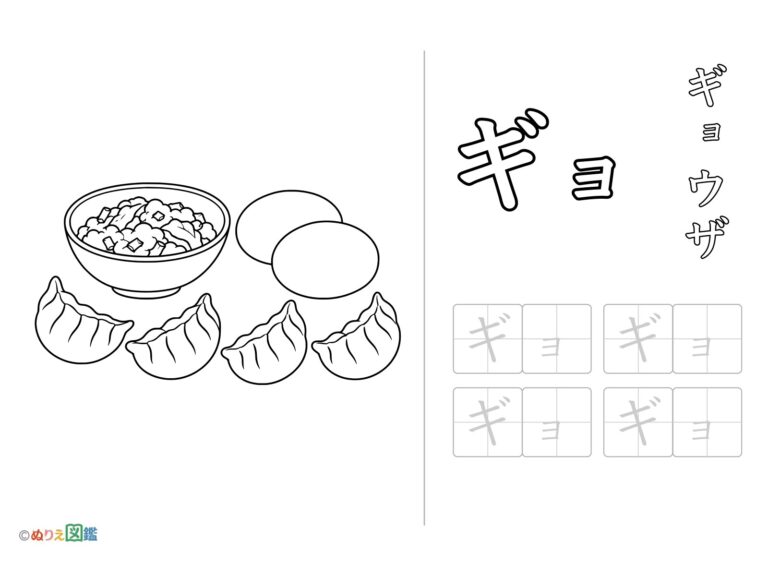
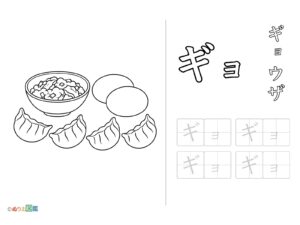
This coloring page is for practicing the Katakana "Gyo".
The word is "Gyoza". It is a dish made by wrapping minced meat and vegetables in thin dough skins.
On the left, there is a picture of someone making gyoza by hand.
You can see 4 gyoza wrapped with neat folds, 2 round skins ready to be wrapped, and a bowl with the filling inside.
Have you ever tried wrapping them together with someone in your family?
One sound with two letters
Katakana "Gyo" uses two letters, "ギ" and a small "ョ", to make one single sound.
Letters like this, made by adding a small "ャ", "ュ", or "ョ" to make one sound, are called 拗音 (youon).
When you say it out loud, do not separate "ギ" and "ヨ". Say them all at once together! The "ギョウ" in "ギョウザ" (gyoza) is made by stretching out the Katakana "Gyo" sound just a bit.
How Katakana "Gyo" Was Made
Katakana characters were made a long time ago by people who took one part of a Kanji character or simplified its shape.
"ギ" is the character "キ" with two little dots. These dots are also called dakuten.
The original "キ" came from a part of the Kanji character "幾".
The small "ョ" is just a smaller version of "ヨ". "ヨ" was made from a part of the Kanji character "与".
While Hiragana was made by smoothing out whole Kanji characters, Katakana was made from small parts of Kanji, so it has a lot of straight lines!
How to write Katakana "Gyo"
Katakana "Gyo" has 5 strokes in total. You take the 3 strokes of "Ki" and add 2 little dots.
"Ki" is made of 2 horizontal lines with a vertical line going right through them.
If you make the bottom horizontal line a little longer than the top one, it will look super neat!
At the very end, draw 2 short dots side by side on the top right.
Small "ョ" has 3 strokes. For stroke 1, write a line that goes across and then turns down. For stroke 2, write the middle side-to-side line. For stroke 3, write the bottom side-to-side line.
If you leave about the same space between the 3 side-to-side lines, it will look super neat!
You write small letters about one-fourth the size of a box. Put it in the bottom left of the box when writing sideways, and in the top right of the box when writing top-to-bottom.
If you write "ョ" too big, it will sound like two separate sounds, "Gi-yo", so be careful!
Words with Katakana "Gyo"
Gyoza is a dish that came from China, and in Kanji, it is written as 「餃子」.
Usually, it is written in Kanji or Hiragana, but you might see it in Katakana on restaurant menus.
The sound Katakana "Gyo" also shows up in words that describe how things look or feel, like gyoro-gyoro for rolling your eyes, or gyo when you get surprised.
In Hiragana, there are lots of words with "gyo" in them, like kingyo (goldfish) and gyoretsu (line or queue).
Try searching for words with "gyo" and compete to see how many you can find!
How to Color Katakana "Gyo"
Color the big Katakana "Gyo" in any color you like
Try coloring the big outlined Katakana "Gyo" at the top right in your favorite color.
If you use golden brown or orange—just like a nicely cooked gyoza—your letter will look super yummy!
To keep it neat, go slow along the outside lines first, and then fill in the inside without going over the edges.
Gyoza wrappers are cream-colored
Try coloring the wrapped gyoza and the round wrappers in cream or light yellow.
If you add a line of a slightly darker color along the folds, the pleats will look pop-out real!
If you want to make cooked gyoza, color the bottom in golden brown or light brown to make them look nice and crispy.
The filling in the bowl has veggie and meat colors
For the filling inside the bowl, use light pink or light brown for the minced meat, and mix in some green here and there for the chives and cabbage.
Color the bowl in silver, white, or any color you like to make the filling stand out!
Trace the letters carefully, one pair at a time
In the bottom-right boxes, there are 4 pairs of light gray Katakana "Gyo" letters.
Use a dark or soft pencil, and go slowly over the light letters.
Use the vertical and horizontal center lines in the boxes as a guide, and you will easily see the difference between the big letter and the small letter.
Saying the stroke order out loud as you write makes it easier to remember!
Just like making gyoza pleats, let's write them carefully one by one.
Fun Facts About Katakana "Gyo"
Boiled Dumplings Are Popular in China
In China, where Katakana "Gyo" came from, people often eat boiled dumplings.
In Japan, pan-fried dumplings cooked in a skillet are very popular.
Even with the same Katakana "Gyo", people eat it differently depending on the country!
Towns Famous for Katakana "Gyo"
Japan has towns that are famous for Katakana "Gyo".
Utsunomiya City in Tochigi Prefecture and Hamamatsu City in Shizuoka Prefecture are known as "Katakana "Gyo" towns."
There are so many Katakana "Gyo" shops in these towns!
Why Make Pleats?
When you make pleats on the Katakana "Gyo" wrapper, it seals tightly. This keeps the filling and tasty juices inside.
The pleats also help it keep its shape when you cook it.
It looks cute too, so it is fun to try different ways to fold the pleats!
Let's Write It in Romaji
When you write "Gyo" in Romaji, it becomes gyo.
For sounds with small "ya," "yu," or "yo," you add a y in Romaji.
You learn Romaji in Japanese class around 3rd grade.
It is also written on train station signs and street signs, so try to read it when you spot it!
Share These Katakana "Gyo" Coloring Pages


-
Tracing practice of "ギョ" (Gyoza)
-