Katakana "Za" Coloring Pages


About Katakana "Za"
"Za" in "Pomegranate" (Katakana "Za")
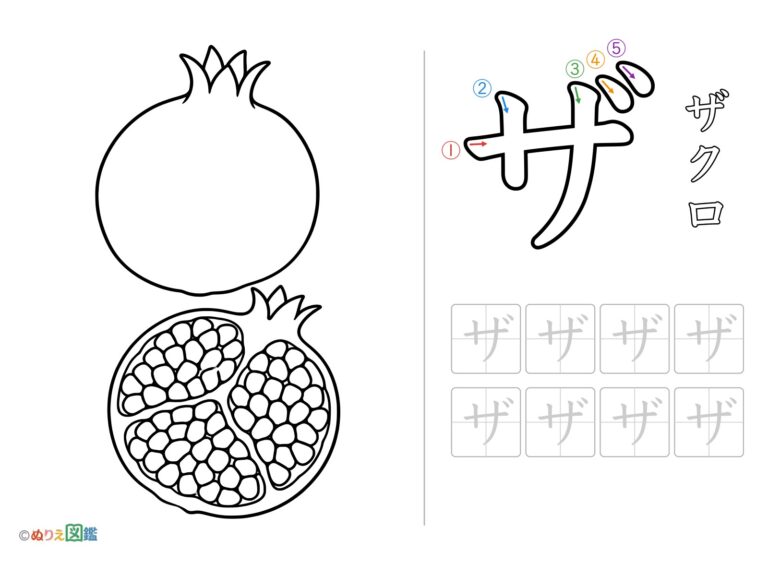
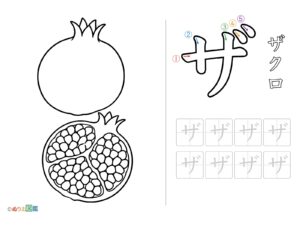
The letter on this coloring page is the Katakana "Za".
The word is "pomegranate".
On the left side, you can see one whole pomegranate and one split in half.
The cut side is packed full of tiny seeds.
These seeds are clear red and taste sweet and sour.
Pomegranates are fruits that grow in autumn.
Plant names are often written in Katakana, so we write "pomegranate" in Katakana too.
Katakana "Za" is "Sa" with dots
Katakana "Za" is the character "Sa" with two small dots (dakuten) added.
When you add the dots, the clear "Sa" sound changes into the buzzing "Za" sound.
Put your hand on your throat and say "Sa" and "Za." You can feel your throat vibrate when you say "Za"!
A buzzing sound like this is called a voiced sound.
How Katakana "Za" Came to Be
Long ago, people made Katakana by taking a piece of a Kanji character.
It is said that "Sa" came from a part of the Kanji "散".
So, Katakana "Za" (which is "Sa" with small dots) comes from the very same Kanji!
Katakana has fewer lines, so it was created to write small pronunciation notes next to tricky old texts.
How to write Katakana "Za"
You write "Katakana "Za"" in 5 strokes by adding 2 dot strokes to "Sa".
The 1st stroke is a horizontal line.
The 2nd stroke is a short vertical line on the left that goes through the horizontal line.
The 3rd stroke is a long vertical line on the right that curves to the left at the bottom with a sweeping stroke.
The 4th and 5th strokes are 2 dots on the top right.
Write the small dots on the right side of the 3rd stroke so they do not touch it.
Words starting with Katakana "Za"
Words that start with "Za" include pomegranate (zakuro), crayfish (zarigani), and humpback whale (zatoukujira).
Names of living things, like crayfish and humpback whales, are often written in Katakana, too.
"Za" also pops up a lot in sound words, like "zaa-zaa" for heavy rain, or "zabun" for splashing into water.
Try saying the words with "Za" out loud!
How to Color Katakana "Za"
For the big Katakana "Za", make the dots stand out
For the big Katakana "Za" at the top right, try coloring the "Sa" part in red or pink, and the dots in a different color like green or yellow.
If you change the color of the dots, it is easy to see how adding dots to "Sa" turns it into Katakana "Za".
If you color carefully near the edges, it is easier to stay inside the lines.
Pomegranate skin is red and yellow
Try coloring the pomegranate skin in red or dark red.
If you mix in yellow or orange here and there, it will look like a real pomegranate.
For the crown-shaped part at the top of the fruit, use dark brown or deep red.
If you color the inside of the skin on the cut side in light yellow or cream color, the red seeds will pop!
Make the seeds look like jewels
Color the seeds on the cut side one by one in red or pink.
If you leave a tiny white dot at the edge of each seed, they will look like shiny, clear jewels!
There are a lot of seeds, so take your time and color each one carefully.
If you mix deep red and light red, you can see every single seed clearly.
Pay attention to the 2 vertical lines when tracing
In the box at the bottom right, there are 8 light gray Katakana "Za" lined up.
Use your pencil to trace "Sa" first, and then write the dots at the very end.
Sweep the left vertical line short, and the right vertical line long.
If you use the center line of the box as a guide, your letter will fit right in the middle.
Write each one carefully!
Fun Facts About Katakana "Za"
The part you eat is around the seeds
Inside every single pomegranate seed, there is a seed right in the middle.
The clear red part surrounding that seed is what you eat.
There are so many seeds packed inside just one fruit!
Its home is West Asia
Pomegranates are a fruit said to come from around Western Asia.
They have been grown for a very long time, and they came to Japan long ago by way of China.
In Japan, people do not just eat them, but they also often plant them in gardens to enjoy their pretty flowers.
Grenades and Pomegranates
A throwing weapon that explodes is a grenade, called a "grenade" in English.
It is said that this name comes from the French word for pomegranate.
That is because its shape, packed with many small pieces inside, looked just like a pomegranate!
Kishimojin and Pomegranates
Kishimojin, known as a god who protects children, is sometimes shown holding a pomegranate.
Pomegranates have lots of seeds inside, so they have long been seen as a sign of having many children.
Share These Katakana "Za" Coloring Pages


-
Traced writing of "ザ" (Pomegranate)
-