Katakana "Mu" Coloring Pages


About Katakana "Mu"
"Mu" as in "Giant Flying Squirrel"
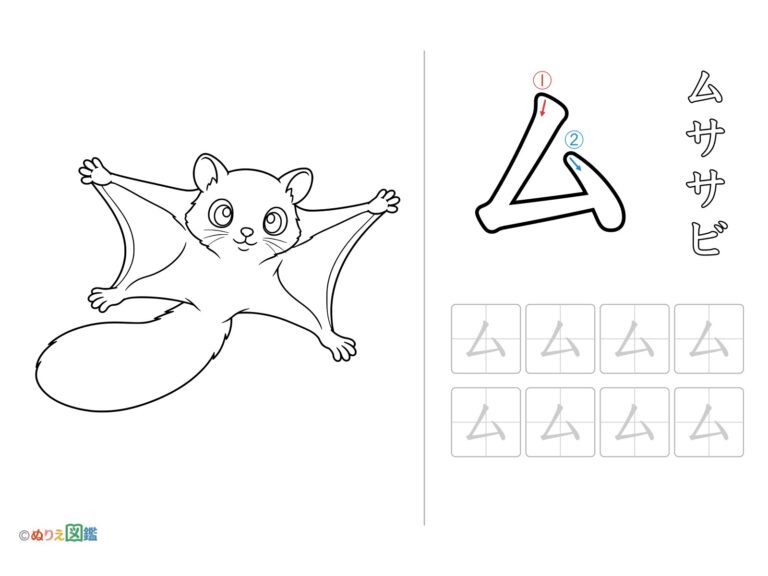
This coloring page is for learning the Katakana "Mu".
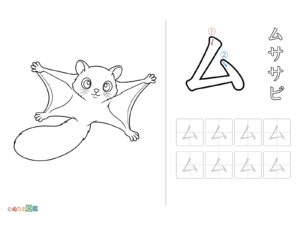
The word is "Musasabi" (flying squirrel). On the left, you can see one flying squirrel gliding through the air.
It spreads the membranes between its front and back legs wide to float gently.
Try to find its big eyes and bushy tail, too!
Write Creature Names in Katakana "Mu"
"Musasabi" is a word that has been used in Japan for a very long time.
In picture books and guidebooks, the names of animals and plants are often written in Katakana "Mu".
Katakana is also used for words from other countries, and for sound words like "fuwa" (fluffy) or "byun" (zoom).
The Katakana "Mu" Came from the Character "牟"
Katakana "Mu" was made from the top part of the kanji character 「牟」.
If you look at the top of 「牟」, you can see a shape that looks just like Katakana "Mu".
Hiragana "mu" came from a different kanji character, 「武」.
Even though they make the same "mu" sound, Hiragana and Katakana come from different kanji characters!
How to write Katakana "Mu"
You write Katakana "Mu" in 2 strokes.
For the 1st stroke, start from the top and go down to the left, then turn around and stretch it out to the right.
For the 2nd stroke, make a short dot on the right side.
If you slant the line stretching to the right slightly upward in the 1st stroke, it will look super neat!
The trick is to draw the dot near the right end of the 1st stroke.
Let's compare Katakana "Mu" and "Ma"
The letter "マ" looks a lot like Katakana "Mu".
"マ" starts with a line going across, but Katakana "Mu" starts with a line going down to the left.
Also, you can find the shape of Katakana "Mu" inside Kanji like "台" and "去".
Try to find the shape of Katakana "Mu" inside a book!
Let's find words that start with Katakana "Mu"!
Words that start with Katakana "Mu" include centipede, barley, mousse, and mussel.
Centipede and barley are names of living things, and mousse is a word that came from another country.
There are not very many words that start with Katakana "Mu", so it might be a little hard to find them.
Katakana "Mu" Does Not Take Tenten
Katakana "Mu" does not get tenten or maru.
Tenten mostly go on letters in the "Ka," "Sa," "Ta," and "Ha" rows.
Let's find letters with tenten and letters without them on the AIUEO chart.
How to Color Katakana "Mu"
For the big Katakana "Mu", use 2 colors
Color the big Katakana "Mu" in the top right with your favorite colors.
If you use different colors, like brown for the 1st stroke and orange for the 2nd stroke dot, you can easily see that it is a 2-stroke character.
Take your time and color slowly along the outline.
Color the flying squirrel brown and white
Color the flying squirrel's back with brown, dark brown, or grayish brown.
For the face, leave the area around the eyes and cheeks mostly white. That will make it look just like a real flying squirrel!
Color the big eyes black and leave 1 tiny white spot for light. This makes the eyes look full of life.
Think about how the fur grows for the gliding membrane and tail
Color the spread-out membrane the same brown as the body. If you make the edges a little lighter, it will look like it is filled with air and spreading wide!
For the tail, draw thin lines in the same direction the fur grows to make it look nice and fluffy.
It is also wonderful to turn the background into a navy blue night sky and add a yellow moon and stars.
Trace carefully with a pencil
In the boxes at the bottom right, there are 8 light gray Katakana "Mu" characters.
Try tracing them carefully, one by one, with a pencil.
Use the center lines of the boxes to help you get the right size and position for each character.
When you reach the turn in the 1st stroke, pretend to stop for a second before you turn. This helps keep the shape neat.
Once you get used to tracing, try writing Katakana "Mu" without looking in the empty space outside the boxes!
Fun Facts About Katakana "Mu"
Animals That Live Only in Japan
The giant flying squirrel in the Katakana "Mu" coloring page is an animal that lives only in Japan.
They live in the forests of Honshu, Shikoku, and Kyushu, and they are relatives of squirrels.
They sleep inside tree holes during the day, and start moving around at night.
Sometimes, they even make their homes in big trees at Shinto shrines.
Gliding, Not Flying
Giant flying squirrels do not flap their wings to fly like birds. Instead, they open their skin membranes and glide down from tall trees.
When they do it well, they can glide as far as 100 meters!
People say their tails help them steer while they are in the air.
Giant Flying Squirrels and Small Flying Squirrels
There is an animal very similar to the giant flying squirrel called the Japanese dwarf flying squirrel.
Dwarf flying squirrels are much smaller than giant flying squirrels, and are small enough to fit in the palm of your hand.
When a giant flying squirrel opens its body, it is about the size of a floor cushion, so people sometimes call it the "flying cushion."
They eat tree leaves, nuts, flower buds, and other plants.
How to Find a Giant Flying Squirrel
Giant flying squirrels move around at night, so it is hard to find them during the day.
In the evening, a little while after sunset, they peek out from tree holes and head out.
If you find leaves on the ground with tiny bite marks, a giant flying squirrel might be close by!
Share These Katakana "Mu" Coloring Pages


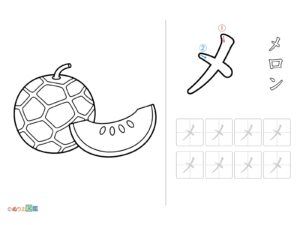
-
Traced lettering of "Mu" (Japanese Giant Flying Squirrel)
-