Katakana "Nu" Coloring Pages


About Katakana "Nu"
"Nu" for "Wildebeest"
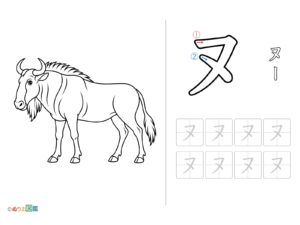
This coloring page is for learning Katakana "Nu".
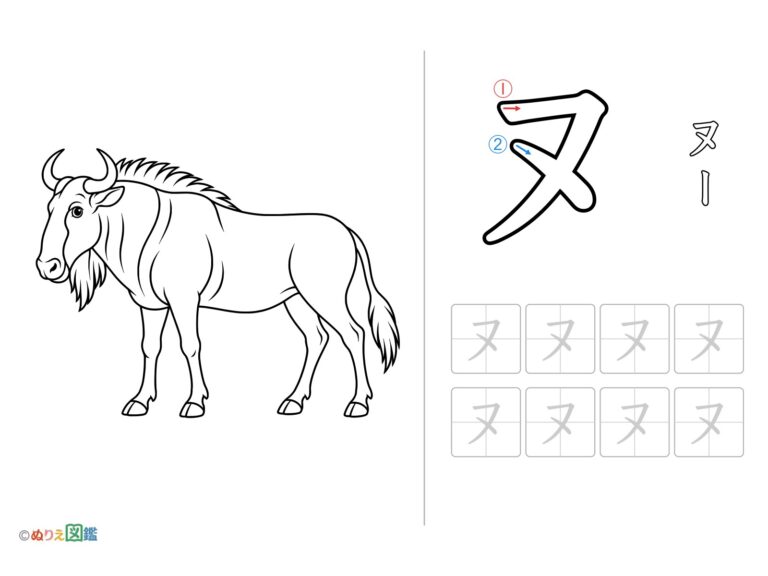
The word is "Nu" (wildebeest). On the left, there is one wildebeest, an animal that lives in Africa, drawn facing sideways.
Try to find its two curved horns, its chin beard, its neck mane, and its 4 legs.
Katakana "Nu" is an animal that lives in huge herds on the big grasslands of Africa.
"-" Is the mark for long sounds
The "ー" in "ヌー" is a mark that shows a long vowel sound.
In Katakana words, long vowel sounds are often written with "ー", like in "ヌー", "ノート", and "ケーキ".
Katakana is used for words from other countries, names of animals and plants, and sound words.
Katakana "Nu", the African animal, is also a name written in Katakana.
Katakana "Nu" Comes from "奴"
The Katakana "Nu" was made by taking the "又" part from the right side of the Kanji character "奴".
If you put "又" and Katakana "Nu" side by side, you can see their shapes look very similar, right?
The Hiragana "ぬ" was also born from the same Kanji "奴".
How to write Katakana "Nu"
Katakana "Nu" is written in 2 strokes.
The 1st stroke goes across, turns around, and sweeps down to the left, just like a "フ".
The 2nd stroke is a short line near the middle, going from the top left to the bottom right.
The trick is to make sure the 2nd stroke crosses the 1st stroke.
Katakana "Nu" looks a bit like "フ" and "ス", so try writing them together to see how they are different!
Not many words start with Katakana "Nu"
Actually, there aren't very many words that start with "ヌ".
Some examples are noodle, the water-dwelling animal nutria, and the candy nougat.
Try taking on a challenge with someone in your family to see how many words starting with Katakana "Nu" you can find!
Let's look at Katakana "Nu"'s body
Katakana "Nu" has a body that is high at the shoulders and a little lower at the back.
It has a big head and a wide snout.
Its legs are thin and long, which is great for running long distances across the grasslands.
The big ones are over 1 meter tall at the shoulders.
Take a close look at the horns and beard of Katakana "Nu" on this coloring page!
How to Color Katakana "Nu"
Color the Big "ヌ" in Two Colors
Color the big "ヌ" at the top right in your favorite colors.
If you use different colors, like brown for the first stroke and orange for the second stroke, you can easily see that Katakana "Nu" has two strokes.
Be careful not to go outside the lines!
Color the Wildebeest in Gray and Black
Color the wildebeest's body in gray or brownish gray.
If you add a few vertical stripe lines around its neck and shoulders using dark gray, it will look like a real wildebeest!
Color the mane, beard, and tail in black or dark brown.
If you make the horns and face dark or black, it will look cool and sharp.
It is also fun to picture the ocher-colored grassy plains all around as you color!
Look at the Position of the Second Stroke for Tracing
In the boxes at the bottom right, eight light gray Katakana "Nu" characters are lined up.
Try tracing them carefully, one by one, with your pencil.
Use the center line of the box as a guide, and look closely at where the short second stroke goes.
For the sweeping strokes, gently lift your pencil at the end!
Show the Flow of the Fur with Lines
Instead of coloring in the mane and beard solid, try drawing many thin lines along the flow of the fur to make it look fluffy.
Try layering lines at the tip of the tail the same way, too.
Making the belly a little lighter and the back darker gives it a cool 3D look!
Fun Facts About Katakana "Nu"
Relative of cows
Katakana "Nu" looks a bit like a horse with its face and mane, but it is actually a relative of cows.
Both males and females have curved horns growing on their heads.
In English, besides "gnu," Katakana "Nu" is also called a "wildebeest."
Great migration looking for grass
On the grasslands of Tanzania and Kenya in East Africa, Katakana "Nu" travels in huge herds of over 1 million animals to look for grass.
Zebras travel along with them, and this amazing sight is called the "Great Migration."
On their journey, they even cross rivers full of crocodiles!
Standing up right after birth
A Katakana "Nu" baby can stand up on its own feet just a few minutes after it is born.
It learns to run with the herd right away so lions cannot catch it.
It is a smart, strong trick for animals living on the grasslands!
Babies born all at once
A lot of Katakana "Nu" babies are born all at the same time during the rainy season.
People think having many babies born together makes it easier for the herd to protect them all.
Share These Katakana "Nu" Coloring Pages



-
Tracing the letter "Nu" (Wildebeest)
-