Katakana "Zo" Coloring Pages


About Katakana "Zo"
Katakana "Zo"
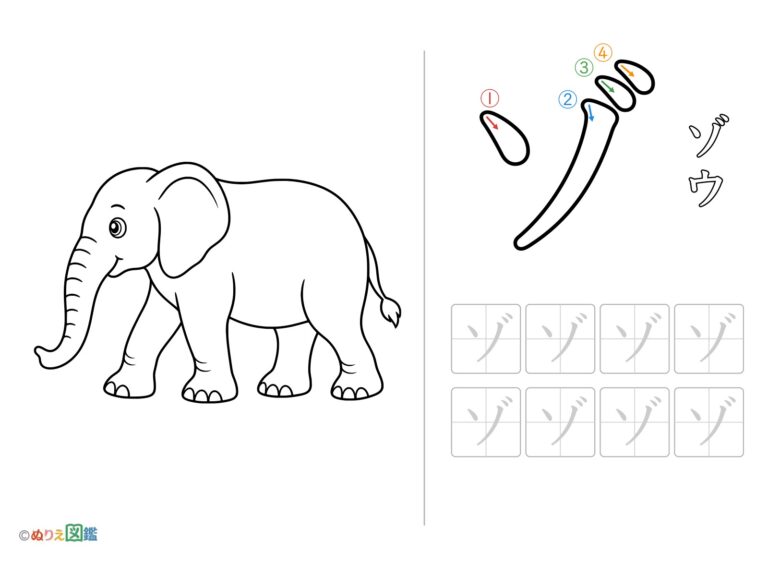
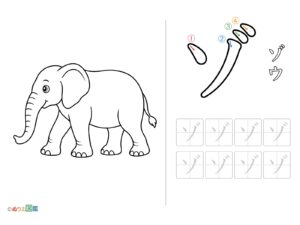
This coloring page is for Katakana "Zo"Katakana "Zo"This is a coloring page where you can trace Katakana "Zo".
The picture on the left shows an adultKatakana "Zo"is what Katakana "Zo" looks like from the side.
It has a long trunk, big ears, four thick legs, and a short tail!
Elephant is written as "象" in Kanji, but Katakana "Zo"Animal Namesis usually written in Katakana in picture books and encyclopedias.
Katakana isWords from other countriesYa,Names of animals and plants, like "wan-wan" or "doki-doki"Words for sounds and how things lookis often used when writing Katakana "Zo".
The Kanji behind Katakana "Zo"
"Zo" is made by taking the Katakana "So" and addingtenten (voiced sound mark)is a letter with a dakuten.
The original Katakana "Zo" comes from the Kanji"Zo"It was born by taking away the two dots near the top of "ゾ".
People say that long ago, monks made Katakana from small parts of Kanji. They created these letters so they could quickly write down how to read holy texts and books written only in Kanji!
When you add two little dots, the clear "So" sound changes into the buzzy "Zo" sound.
Tips for writing Katakana "Zo"
Katakana "Zo" is made by adding two dots to the two strokes of "So", and4 strokesLet's write Katakana "Zo"!
The 1st stroke is a short dot at the top left, and you write it going toward the bottom right.
The second stroke is a long line that sweeps down to the left from the top right.
"So" is a KatakanaKatakana "Zo"It looks a lot like , so be careful!
The first stroke of Katakana "Zo" isFrom top to bottom, the first stroke of "ン" isFacing almost to the sideLet's write Katakana "Zo"!
As for the 2nd stroke, "ソ" is alsoFrom top to bottomIt curves, but Katakana "Zo" isFrom bottom to topFlip it up!
Finally, let's draw two small dots at the top right, one by one from left to right.
Words that start with Katakana "Zo"
Words that start with Katakana "Zo" includeKatakana "Zo"In addition toGalapagos tortoise.Katakana "Zo"and more!
The Elephant Tortoise is a super big turtle, and the Paramecium is a tiny creature that you cannot even see with your eyes!
Both are names of living things, so they are often written in Katakana.
There aren't many words that start with Katakana "Zo".
You can also find "Zo" in words that describe how things look or feel, like "Zokuzoku" (shivering) or "Zorozoro" (crowding)!
Let's try a word search while pretending to be an elephant marching along!
How to Color Katakana "Zo"
Color the big Katakana "Zo" with your favorite colors
Try coloring inside the lines of the big Katakana "Zo" at the top right with any colors you like.
If you use different colors for the main "ソ" part and the two dots, it is easy to see where the dots go!
It looks great if you color it gray or light blue to match the elephant, too.
To keep inside the lines, go slow near the edges, and color freely in the middle.
Color the elephant with dark and light gray
Try coloring the elephant's body gray.
If you make its tummy and the back of its legs a darker gray, its body will look nice, round, and heavy.
If you make the edges of its big ears and the wrinkles on its trunk a bit darker, it will look real!
If it has tusks, leave them white or color them light cream.
Instead of gray, you can use light blue or pink to make a cute elephant like in a picture book.
Trace slowly with a pencil
In the boxes at the bottom right, there are 8 light gray Katakana "Zo".
Use a pencil instead of a crayon to trace over the gray lines.
Use the dotted lines inside each box to help you.
Make sure it does not look like "ン"! Curve the second stroke smoothly from top to bottom.
Write each one carefully. When you write them well, show them to your family!
By the time you finish all 8, your hand will surely remember the shape.
Fun Facts About Katakana "Zo"
The Biggest Animal on Land
Elephants are the biggest animals that live on land.
There are African elephants that live in Africa, and Asian elephants that live in Asia.
African elephants have bigger ears.
They flap their big ears to cool off their bodies.
The Trunk Works Like a Hand
Katakana "Zo"'s long trunk is made of its nose and upper lip grown together.
It uses its trunk to grab grass and put it in its mouth. It can also suck up water to drink or spray it on its body.
There are no bones in the trunk, but it has lots of muscles, so Katakana "Zo" can move it freely.
Babies Stay in the Tummy for Almost 2 Years
Baby Katakana "Zo" grow inside their mothers' tummies for almost two years before they are born.
They are big babies, weighing about 100 kilograms right when they are born.
Katakana "Zo" live in herds of mothers and aunts, and everyone protects the babies together.
Tusks Are Very Long Teeth
The white tusks growing out from the sides of Katakana "Zo"'s mouth are actually teeth that grew super long.
They use their tusks to dig the ground or peel bark off trees.
Female Asian elephants usually do not have tusks that you can see from the outside.
Share These Katakana "Zo" Coloring Pages


-
"Zo" tracing ("ゾ" for elephant)
-