Katakana "Bi" Coloring Pages


About Katakana "Bi"
The "Bi" in "Biscuit"
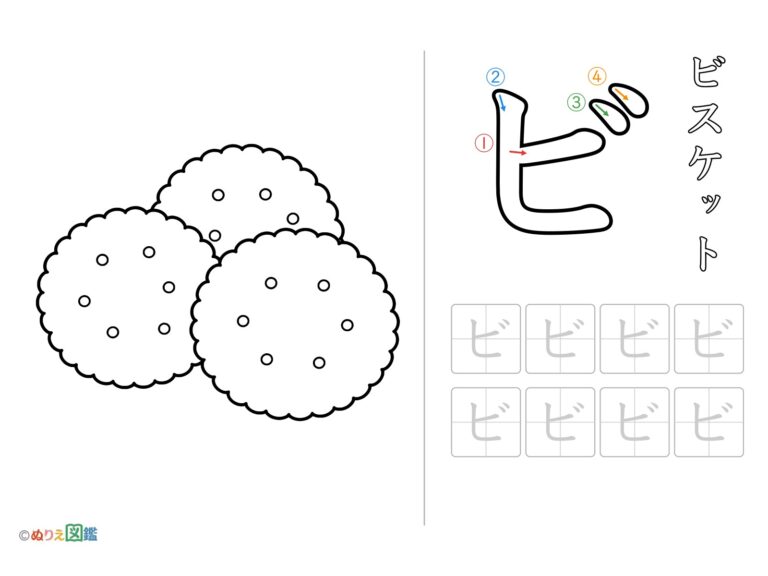
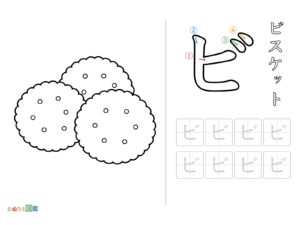
This coloring page lets you trace Katakana "Bi".
The picture on the left shows three round biscuits resting on top of each other.
You can see little dots on the top and bumpy edges around them.
Since "biscuit" is a word from another country, we write it in Katakana.
We often use Katakana to write words from other countries, names of animals and plants, and sound words like "bow-wow" or "thump-thump."
The small "ッ" in "biscuit" shows a pause sound.
When you say it out loud, can you feel your breath stop for a quick second?
The Kanji That Formed Katakana "Bi"
Katakana "Bi" is the character "Hi" with two small dots (dakuten) added to it.
The original "Hi" came from taking the right part of the kanji character "比".
People say katakana was created a long time ago by monks. They took parts of kanji characters so they could quickly write down how to read holy books and scrolls that only had kanji in them.
When you add the two small dots, the clear "Hi" sound changes into the buzzy "Bi" sound.
Tips for writing Katakana "Bi"
To write Katakana "Bi", add two small dots to the two strokes of "ヒ" for a total of 4 strokes.
The 1st stroke is a horizontal line that goes from left to right, slanting up just a little bit.
The 2nd stroke goes down from top to bottom, then bends to the right at the bottom.
If you make the bottom part of the 2nd stroke longer than the 1st stroke and stretch it to the right, Katakana "Bi" will look nice and sturdy.
It looks completely different from the Hiragana "ひ", so try comparing them!
Finally, let's draw two little dots on the top right.
If you draw the two dots a little above the right end of the 1st horizontal line, Katakana "Bi" will look nice and neat.
Words that start with Katakana "Bi"
Besides biscuits, words that start with Katakana "Bi" include building, beads, marbles, and beaver.
Beaver is an animal name, so we write it in Katakana.
Loquat, the fruit, is also often written in Katakana.
Katakana "Bi" also pops up in words describing sounds or actions, like "biri-biri" (ripping) and "byun-byun" (zooming).
See how many words starting with Katakana "Bi" you can say!
How to Color Katakana "Bi"
Color the big Katakana "Bi" in your favorite colors
Try coloring inside the lines of the big Katakana "Bi" at the top right with any colors you like!
If you use different colors for the main "Hi" part and the two dots, it is easy to see where the dots go.
It is also cute to color it golden-brown or light brown to match the biscuits!
Go slowly near the edges so you do not go outside the lines, and color the middle smoothly.
Biscuits are nice and golden-brown
Try coloring the biscuits in light yellowish-brown or golden-brown.
If you make the bumpy edges a little darker brown, they will look nicely baked.
Keep the middle bright and make the edges a little darker to look like real biscuits!
Trace the tiny dot holes on the top with a dark brown crayon.
If you use slightly different shades of brown for all 3 biscuits, you can easily see how they overlap.
It also looks yummy if you color 1 biscuit chocolate color to make a chocolate biscuit!
Trace the letters slowly with a pencil
There are 8 light gray Katakana "Bi" in the boxes at the bottom right.
Use a pencil instead of a crayon to trace over the gray lines.
Use the dotted lines that go up, down, and across the box to help you.
For the second stroke, extend the bottom line to the right, below the dotted line across the box.
Write each one carefully. When you do a great job, show it to your family!
By the time you finish all 8, your hand will surely remember the shape.
Fun Facts About Katakana "Bi"
Secret of the holes in biscuits
There is a real reason for the small holes on the surface of a biscuit.
When it bakes, the air and steam inside the dough escape from these holes.
People say that if there were no holes, the dough would puff up too much or break easily.
The name means "baked twice"
It is said that the word "biscuit" originally comes from a word meaning "baked twice."
Long ago, people baked them until they were very dry so they would not spoil and would last a long time during long trips or on ships.
That is why biscuits were a hard food that lasted a long time.
February 28th is Biscuit Day
In Japan, February 28th is "Biscuit Day."
It comes from the day a doctor in Nagasaki sent a letter explaining how to make biscuits near the end of the Edo period.
Back then, biscuits got a lot of attention as a great food for ships or emergencies.
It might be fun to eat some biscuits with your family on February 28th!
Share These Katakana "Bi" Coloring Pages


-
Tracing the Letter "Bi" (Biscuits)
-