Katakana "Ryo" Coloring Pages


About Katakana "Ryo"
The "Ryo" in "Ryokucha"
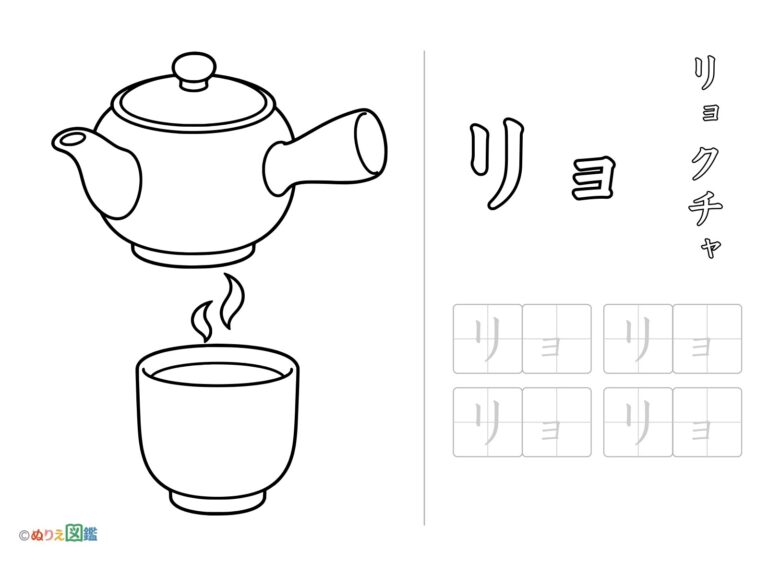
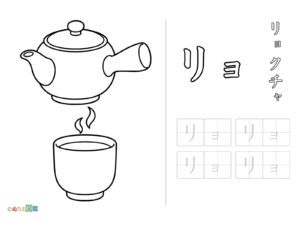
This coloring page is for the Katakana "Ryo".Katakana "Ryo"This page is for practicing Katakana "Ryo".
Words are"Green tea"! In kanji, it isGreen TeaThis is a tea written as and enjoyed in Japan since long ago.
On the left, there is green tea in a teacup, and a teapot for pouring the teaKyusu (Teapot)is drawn here.
A little bit of warm steam is rising above the teacup, isn't it?
2 Characters make 1 sound
"Katakana "Ryo"" is made of 2 letters: "Ri" and a small "Yo," andOne soundIt shows the letter.
Characters that combine with a small "ya," "yu," or "yo" to make a single sound like this are calledContracted SoundsIt is called Katakana "Ryo".
When you say it out loud, don't split "リ" and "ヨ". Try saying them all together at once! For Katakana "Ryo", imagine making your mouth round while saying "リ" to slide right into "ョ".
How Katakana "Ryo" came to be
Katakana comes from how people long ago used KanjiPartIt is a character created by taking parts of kanji or making their shapes simpler.
"Ryo" came from the right part of the Kanji character "利", which is "刂".
The small "ョ" is just a smaller version of "ヨ". "ヨ" came from a part of the kanji character "与".
While Hiragana was made by simplifying whole Kanji, Katakana was made from parts of Kanji. That is why it has many straight lines!
How to write Katakana "Ryo"
You write Katakana "Ryo" with 2 strokes. Write the short vertical line on the left first. For the 2nd long line, sweep smoothly to the left at the bottom.
Making the line on the right longer than the line on the left is the key to writing Katakana "Ryo" neatly.
The small "ョ" is 3 strokes. For the first stroke, draw a line going from side to down. For the second stroke, draw the middle side line. For the third stroke, draw the bottom side line.
If you leave about the same amount of space between the 3 horizontal lines, Katakana "Ryo" will look nice and neat!
Write small letters about a quarter of the size of the grid. When you write horizontally, put them in theBottom left, and in vertical writing, it goes in the boxTop rightWrite it close to .
If you write "ョ" too big, it will be read as two separate sounds, "リヨ", so please be careful.
Words with Katakana "Ryo"
Katakana is often used for words from other countries, names of animals and plants, and sound words.
Usually, "Ryokucha" (green tea) is written in kanji or hiragana. But in this coloring page, it is written in katakana so you can practice Katakana "Ryo".
Actually, the sound of Katakana "Ryo" isTrip,Cooking,FishermanAs in words like this, it pops up in lots of Kanji words!
Katakana "Ryo" does not show up very often in katakana words that come from other countries.
Try looking for words that have "Ryo" in them with someone at home, just like playing a word-chain game!
How to Color Katakana "Ryo"
The big Katakana "Ryo": Pick your favorite color
Try coloring the big outlined Katakana "Ryo" in the top right with your favorite color.
Katakana "Ryo" is the letter for green tea, so green is a perfect choice too. You can make the big "Ri" dark green and the small "Yo" light green.
To keep it nice and neat, color the outside edges slowly first so you don't go over the lines. Then fill in the middle!
Green tea: Use light yellow-green
If you color the green tea in the teacup with yellow-green or light yellow, it will look like fresh, warm tea!
Making the middle a little lighter and the edges a little darker gives the water a shiny look.
If you leave the steam white, it will look nice and hot.
Color the teacup white or light brown, and the teapot dark brown, dark green, or black to make a wonderful Japanese-style picture.
It is also fun to add your favorite patterns, like flowers or polka dots, onto the teacup!
Tracing practice: Go slowly, pair by pair
In the boxes at the bottom right, there are four pairs of faint gray Katakana "Ryo". That's two letters in each pair!
Trace over the faint letters slowly with a dark colored pencil or a soft pencil.
Use the center lines going up, down, and across the box to help you. They will show you the difference in size between the big letter and the small letter.
Saying the stroke order out loud as you write makes it easy to learn.
Did you manage to write the three short lines of the small "Yo" without squishing them?
Fun Facts About Katakana "Ryo"
Green tea and black tea come from the same tree
Green tea, black tea, and oolong tea are actually all made from the leaves of the same tree, called Chanoki.
To make green tea, picked leaves are quickly heated by steaming or roasting, so they stay green.
For black tea, the leaves are left alone until their color changes, so it turns a reddish color.
Shincha starts at the end of spring
Tea made from the very first picked leaves of the year is called Shincha.
Making Shincha starts all over the country from the end of spring to the beginning of summer.
Hachijuhachiya, the 88th day after the start of spring, is around early May and is famous as the time for picking tea.
Where tea is grown
In Japan, Shizuoka Prefecture and Kagoshima Prefecture are famous for making a lot of tea.
The neat, trimmed tea fields lined up on gentle mountain slopes look just like green stripes!
Let's write in Romaji
When you write Katakana "Ryo" in Romaji, it becomes ryo.
For sounds with small "ya", "yu", or "yo", you add the letter y in Romaji.
You will learn Romaji in Japanese class around 3rd grade.
It is also written on station names and street signs, so try reading it when you find it!
Share These Katakana "Ryo" Coloring Pages


-
Tracing the katakana "リョ" (Green Tea)
-