Katakana "O" Coloring Pages


About Katakana "O"
"O" as in "Omelet Rice"
Katakana "O" is the fifth character in katakana and the very last character in the A-row.
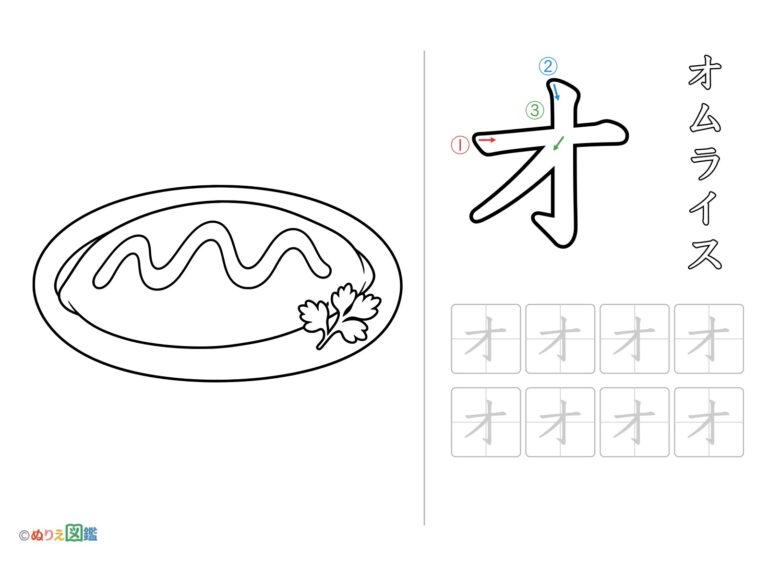
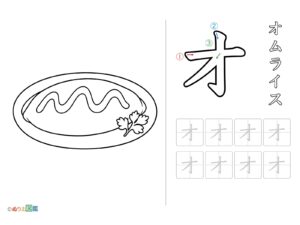
The word on this coloring page is "Omelet Rice". It is a dish made of ketchup-flavored rice wrapped in a thin cooked egg.
On the left side, there is one omelet rice on a plate.
There are ketchup squiggles on top and green parsley on the side.
Try coloring it while thinking about what kind of pattern you want to draw with ketchup!
Katakana "O" Comes from the Kanji "於"
Katakana characters were made by taking a part of a kanji character.
Katakana "O" was born from the shape of the left side of the kanji "於".
People say that hiragana "O" was also made by simplifying the same kanji "於".
Hiragana was made by simplifying the whole kanji, and katakana was made by taking just one part of the kanji, so their shapes look very different even though they come from the same character!
How to Write Katakana "O"
You write Katakana "O" with 3 strokes.
The first stroke is a line going across.
The second stroke goes down from top to bottom, crossing the line going across, and ends with a hook upward to the left.
The third stroke sweeps down to the left from near where the lines cross.
It is easy to forget the hook on the second stroke, so be careful!
It looks like the kanji "才", but Katakana "O" is written a bit more simply.
Words That Start with Katakana "O"
Omelet Rice is a word made in Japan by combining the French word "omelet" and the English word "rice".
Words that start with Katakana "O" include orange, organ, fur seal, wolf, and okra.
Orange and organ are words that came from other countries, and fur seal and wolf are names of animals.
Shouting "O-i!" to call someone is also sometimes written in katakana.
Think about whether any of your favorite foods start with Katakana "O"!
Katakana for Yummy Things
A whole lot of food names are written in katakana.
Western food names like omelet rice, hamburger steak, curry rice, and spaghetti are almost all katakana.
This is because they are dishes that came from other countries, or because their names were made from words from other countries.
Menus and store signs have lots of katakana lined up on them.
When you go to a restaurant, try looking for Katakana "O" on the menu!
Just like omelet rice, there are also dishes that were born in Japan but still have katakana names.
How to Color Katakana "O"
Color the big Katakana "O" like eggs
Color the big Katakana "O" with your favorite colors.
If you use yellow or red to match the omelet rice, your Katakana "O" will look delicious.
Color neatly inside the lines, all the way to the hook on the second stroke.
Color the omelet rice with yellow and red
Color the egg part yellow. If you add a little orange near the edges, it will look nice and cooked.
Color the wavy ketchup line red.
Mix green and yellow-green for the parsley to make it look soft and fluffy.
You can leave the plate white, or color just the rim with light blue or pale yellow.
If you leave a little white spot on top of the egg, it will look soft and shiny!
How to trace the letter
Trace the Katakana "O" in the bottom-right boxes slowly with your pencil.
Draw the side-to-side line a little above the middle line to make it look just right.
The trick for the hook on the second stroke is to make it small and quick!
After you write all 8, check each one to see if you made nice hooks.
Read the word to finish up
In the top right, next to the big Katakana "O", the word "Omurice" is written from top to bottom.
When you finish coloring, trace the word with your finger and say "Omurice" out loud.
Connecting pictures, letters, and words helps you remember letters much better.
When your coloring page is finished, you can hang it on a wall or put it in a binder to keep it safe!
Fun Facts About Katakana "O"
Omelet Rice Was Born in Japan
Omelet rice sounds like a dish from another country, but it is actually a Western-style dish born in Japan.
People say it was first made in a Japanese Western-style restaurant around the end of the Meiji period or during the Taisho period.
There are a few different stories about which restaurant made it first!
Wrapped Omelet Rice and Topped Omelet Rice
There are two main types of omelet rice: one where thin eggs wrap neatly around the rice, and one where soft, fluffy eggs sit right on top of the rice.
Sometimes, people put demi-glace sauce or white sauce on top instead of ketchup!
Ketchup Comes from Tomatoes
The red ketchup you put on omelet rice is made from tomatoes.
Tomatoes are cooked down and flavored with salt, sugar, vinegar, and other ingredients.
That bright red color comes right from the tomatoes!
This is the End of the "A-row"
With Katakana "O", you now have all 5 letters of the A-row: "A, I, U, E, O"!
These 5 sounds are very important because they are the base for all other sounds.
Once you trace all the letters in the A-row, say "A-I-U-E-O" out loud and look at how your mouth changes shape!
To make the sound for Katakana "O", make your mouth into a round circle.
Share These Katakana "O" Coloring Pages


-
Tracing letter "O" (Omurice)
-