Katakana "He" Coloring Pages


About Katakana "He"
The "He" in "Helmet"
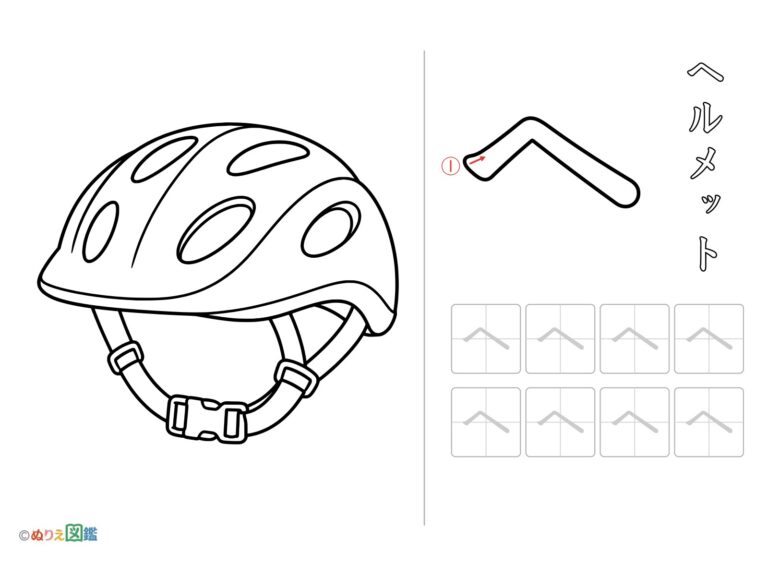
This coloring page is for learning Katakana "He".
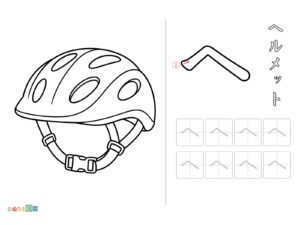
The word is "helmet". On the left, there is one kids' bicycle helmet drawn from an angle.
It has holes to let air through, and a chin strap that fastens under the chin.
Helmets are made to protect your important head if you fall or bump into something.
Words from other countries
"Helmet" is a word that comes from English.
Words that come from other countries like this are often written in katakana.
Katakana is also used for the names of animals and plants, as well as words that describe feelings or states, like "hetoheto" (exhausted).
The small "ッ" in "helmet" shows a paused sound.
Katakana "He" Comes From "部"
Katakana "He" was made from the right part of the kanji 「部」.
Hiragana "He" was born from the same kanji "部", too.
That is why Hiragana "He" and Katakana "He" have almost the exact same shape.
Out of all hiragana and katakana, "へ" and Katakana "He" look so much alike that it is hard to tell them apart!
How to Write Katakana "He"
You can write Katakana "He" in 1 stroke.
Start from the bottom left and go up to the top right with a short upward line. Turn around at the top of the mountain, and draw a long line going down to the bottom right.
The trick is to make the going-up line short and the going-down line long!
Try to write it all in one go without lifting your pencil.
Katakana "He", "Be", and "Pe"
If you add two small dots to Katakana "He", it becomes "Be", and if you add a small circle, it becomes "Pe".
Like "Be" in "bell", or "Pe" in "penguin"!
You write the dots or circle on the top right side of the mountain peak.
Let’s find words that start with Katakana "He"
Words that start with "He" include snake, sponge gourd, helicopter, and hairpin.
Snakes and sponge gourds are living things, while helicopters and hairpins are words that came from other countries.
How to wear a helmet correctly
Put your helmet on facing forward, so it comes down to just above your eyebrows.
If it slides back and exposes your forehead, it cannot protect your head when you fall.
It is best to tighten the chin strap so that about one finger can fit underneath.
It is also important to choose a helmet that fits the size of your head.
How to Color Katakana "He"
The big Katakana "He" is shaped like a mountain
The big Katakana "He" on the top right is a character made with just 1 stroke.
It looks like a mountain! It is fun to color it like a mountain by making the left going-up line yellow-green and the right going-down line green.
Be careful not to color outside the lines!
Color the helmet with bright colors
Many bicycle helmets come in bright colors so cars can see them easily.
Try coloring it with your favorite bright color, like red, yellow, light blue, or yellow-green.
If you color the air holes dark gray or black, the holes will stand out.
It is great to make the chin strap black or navy blue.
Leave some light to make it shiny
If you leave a little white part uncolored near the top of the helmet, it will look shiny!
If you color a bit darker around the bottom edge, everyone can see the round helmet shape.
You can also draw extra patterns like stars or lightning to make it your very own helmet!
Look at the top of the mountain when you trace
There are 8 light gray Katakana "He" lined up in the boxes on the bottom right.
Try tracing them neatly one by one with a pencil.
Take a close look at how the top of the mountain goes to the left of the center vertical line in the box.
It is fun to compare it with the Hiragana "He" while you write!
Looking from behind
Pretend you put a shiny reflector sticker on the back of the helmet by drawing small yellow or silver squares!
Fun Facts About Katakana "He"
Wear a helmet when you ride a bike
In Japan, starting in April 2023, everyone who rides a bike must try to wear a helmet.
Grown-ups and kids should all wear a helmet when riding a bike.
It is important to fasten the chin strap tightly so it does not get loose.
The secret inside the helmet
Inside a bike helmet, there is often a soft material like Styrofoam.
When you bump your head, this material gets crushed to soften the shock to your head.
If a helmet takes a hard hit even once, it is best to change to a new one, even if it looks okay.
Many kinds of helmets
Besides biking, helmets are also used by construction workers, firefighters, and baseball batters.
They have different shapes and weights to fit each job or sport.
"Helmet" and Kabuto
Long ago, Japanese samurai wore a kabuto (samurai helmet) in battle to protect their heads.
A kabuto had the same job as today's helmets: to protect the head.
The kabuto displayed on Children's Day holds a wish for children to grow up healthy and strong.
Share These Katakana "He" Coloring Pages


-
Tracing the hiragana "ヘ" (Helmet)
-